
“This AI will heat up any club”: Reggaetón and the Rise of the Cyborg Genre


This series listens to the political, gendered, queer(ed), racial engagements and class entanglements involved in proclaiming out loud: La-TIN-x. ChI-ca-NA. La-TI-ne. ChI-ca-n-@. Xi-can-x. Funded by an Andrew W. Mellon Foundation as part of the Crossing Latinidades Humanities Research Initiative, the Latinx Sound Cultures Studies Working Group critically considers the role of sound and listening in our formation as political subjects. Through both a comparative and cross-regional lens, we invite Latinx Sound Scholars to join us as we dialogue about our place within the larger fields of Chicanx/Latinx Studies and Sound Studies. We are delighted to publish our initial musings with Sounding Out!, a forum that has long prioritized sound from a queered, racial, working-class and “always-from-below” epistemological standpoint. —Ed. Dolores Inés Casillas
—
Busco la colaboración universal donde todos los Benitos puedan llegar a ser Bad Bunny. –FlowGPT, TikTok
In November of 2023, the reggaetón song “DEMO #5: NostalgIA” went viral on various digital platforms, particularly TikTok. The track, posted by user FlowGPT, makes use of artificial intelligence (Inteligencia Artificial) to imitate the voices of Justin Bieber, Bad Bunny, and Daddy Yankee. The song begins with a melody reminiscent of Justin Bieber’s 2015 pop hit “Sorry.” Soon, reggaetón’s characteristic boom-ch-boom-chick drumbeat drops, and the voices of the three artists come together to form a carefully crafted, unprecedented crossover.
Bad Bunny’s catchy verse “sal que te paso a buscar” quickly inundated TikTok feeds as users began to post videos of themselves dancing or lip-syncing to the song. The song was not only very good but it also successfully replicated these artists– their voices, their style, their vibe. Soon, the song exited the bounds of the digital and began to be played in clubs across Latin America, marking a thought-provoking novelty in the usual repertoire of reggaetón hits. In line with the current anxieties around generative AI, the song quickly generated public controversy. Only a few weeks after its release, ‘nostalgIA’ was taken down from most digital platforms.

The mind behind FlowGPT is Chilean producer Maury Senpai, who in a series of TikTok responses explained his mission of creative democratization in a genre that has been historically exclusive of certain creators. In one video, FlowGPT encourages listeners to contemplate the potential of this “algorithm” to allow songs by lesser-known artists and producers to reach the ears of many listeners, by replicating the voices of well-known singers. Maury Senpai’s production process involved lyric writing, extensive study of the singers’ vocals, and the Kits.ai tool.
Therefore, contrary to FlowGPT’s robotic brand, ‘nostalgIA’ was the product of careful collaboration between human and machine– or, what Ross Cole calls “cyborg creativity.” This hybridization enmeshes the artist and the listener, allowing diverse creators their creative desires. Cyborg creativity, of course, is not an inherent result of GenAI’s advent. Instead, I argue that reggaetón has long been embedded in a tradition of musical imitation and a deep reliance on technological tools, which in turn challenges popular concerns about machine-human artistic collaboration.
Many creators worry that GenAI will co-opt a practice that for a long time has been regarded as strictly human. GenAI’s reliance on pre-existing data threatens to hide the labor of artists who contributed to the model’s output. We may also add the inherent biases present in training data. Pasquinelli and Joler propose that the question “Can AI be creative?” be reformulated as “Is machine learning able to create works that are not imitations of the past?” Machine learning models detect patterns and styles in training data and then generate “random improvisation” within this data. Therefore, GenAI tools are not autonomous creative actors but often operate with generous human intervention that trains, monitors, and disseminates the products of these models.
The inability to define GenAI tools as inherently creative on their own does not mean they can’t be valuable for artists seeking to experiment in their work. Hearkening back to Donna Haraway’s concept of the cyborg, Ross Cole argues that
Such [AI] music is in fact a species of hybrid creativity predicated on the enmeshing of people and computers (…) We might, then, begin to see AI not as a threat to subjective expression, but another facet of music’s inherent sociality.
Many authors agree that unoriginal content—works that are essentially reshufflings of existing material—cannot be considered legitimate art. However, an examination of the history of the reggaetón genre invites us to question this idea. In “From Música Negra to Reggaetón Latino,” Wayne Marshall explains how the genre emerged from simultaneous and mutually-reinforcing processes in Panamá, Puerto Rico, and New York, where artists brought together elements of dancehall, reggae, and American hip hop. Towards the turn of the millennium, the genre’s incorporation of diverse musical elements and the availability of digital tools for production favored its commercialization across Latin America and the United States.
The imitation of previous artists has been embedded in the fabric of reggaetón from a very early stage. Some of the earliest examples of reggaetón were in fact Spanish lyrics placed over Jamaican dancehall riddims— instrumental tracks with characteristic melodies. When Spanish-speaking artists began to draw from dancehall, they used these same riddims in their songs, and continue to do so today. A notable example of this pattern is the Bam Bam riddim, which is famously used in the song “Murder She Wrote” by Chaka Demus & Pliers (1992).
This riddim made its way into several reggaetón hits, such as “El Taxi” by Osmani García, Pitbull, and Sensato (2015).
We may also observe reggaetón’s tradition of imitation in frequent references to “old school” artists by the “new school,” through beat sampling, remixes, and features. We see this in Karol G’s recent hit “GATÚBELA,” where she collaborates with Maldy, former member of the iconic Plan B duo.
Reggaetón’s deeply rooted tradition of “tribute-paying” also ties into its differentiation from other genres. As the genre grew in commercial value, perhaps to avoid copyright issues, producers cut down on their direct references to dancehall and instead favored synthesized backings. Marshall quotes DJ El Niño in saying that around the mid-90s, people began to use the term reggaetón to refer to “original beats” that did not solely rely on riddims but also employed synthesizer and sequencer software. In particular, the program Fruity Loops, initially launched in 1997, with “preset” sounds and effects provided producers with a wider set of possibilities for sonic innovation in the genre.
The influence of technology on music does not stop at its production but also seeps into its socialization. Today, listeners increasingly engage with music through AI-generated content. Ironically, following the release of Bad Bunny’s latest album, listeners expressed their discontent through AI-generated memes of his voice. One of the most viral ones consisted of Bad Bunny’s voice singing “en el McDonald’s no venden donas.”
The clip, originally sung by user Don Pollo, was modified using AI to sound like Bad Bunny, and then combined with reggaetón beats and the Bam Bam riddim. Many users referred to this sound as a representation of the light-heartedness they saw lacking in the artist’s new album. While Un Verano Sin Ti (2022) stood out as an upbeat summer album that addressed social issues such as U.S. imperialism and machismo, Nadie Sabe lo que va a Pasar Mañana (2023) consisted mostly of tiraderas or disses against other artists and left some listeners disappointed. In a 2018 post for SO!, Michael S. O’Brien speaks of this sonic meme phenomenon, where a sound and its repetition come to encapsulate collective discontent.
Another notorious case of AI-generated covers targets recent phenomenon Young Miko. As one of the first openly queer artists to break into the urban Latin mainstream, Young Miko filled a long-standing gap in the genre—the need for lyrics sung by a woman to another woman. Her distinctive voice has also been used in viral AI covers of songs such as “La Jeepeta,” and “LALA,” originally sung by male artists. To map Young Miko’s voice over reggaetón songs that advance hypermasculinity– through either a love for Jeeps or not-so-subtle oral sex– represents a creative reclamation of desire where the agent is no longer a man, but a woman. Jay Jolles writes of TikTok’s modifications to music production, namely the prioritization of viral success. The case of AI-generated reggaetón covers demonstrates how catchy reinterpretations of an artist’s work can offer listeners a chance to influence the music they enjoy, allowing them to shape it to their own tastes.
Examining the history of musical imitation and digital innovation in reggaetón expands the bounds of artistry as defined by GenAI theorists. In the conventions of the TikTok platform, listeners have found a way to participate in the artistry of imitation that has long defined the genre. The case of FlowGPT, along with the overwhelmingly positive reception of “nostalgIA,” point towards a future where the boundaries between the listener and the artist are blurred, and where technology and digital spaces are the platforms that allow for an enhanced cyborg creativity to take place.
—
Featured Image: Screenshot from ““en el McDonald’s no venden donas.” Taken by SO!
—
Laurisa Sastoque is a Colombian scholar of digital humanities, history, and storytelling. She works as a Digital Preservation Training Officer at the University of Southampton, where she collaborates with the Digital Humanities Team to promote best practices in digital preservation across Galleries/Gardens, Libraries, Archives, and Museums (GLAM), and other sectors. She completed an MPhil in Digital Humanities from the University of Cambridge as a Gates Cambridge scholar. She holds a B.A. in History, Creative Writing, and Data Science (Minor) from Northwestern University.
—

REWIND!…If you liked this post, you may also dig:
Boom! Boom! Boom!: Banda, Dissident Vibrations, and Sonic Gentrification in Mazatlán—Kristie Valdez-Guillen
Listening to MAGA Politics within US/Mexico’s Lucha Libre –Esther Díaz Martín and Rebeca Rivas
Ronca Realness: Voices that Sound the Sucia Body—Cloe Gentile Reyes
Echoes in Transit: Loudly Waiting at the Paso del Norte Border Region—José Manuel Flores & Dolores Inés Casillas
Experiments in Agent-based Sonic Composition—Andreas Pape
Share this:

Ronca Realness: Voices that Sound the Sucia Body

This series listens to the political, gendered, queer(ed), racial engagements and class entanglements involved in proclaiming out loud: La-TIN-x. ChI-ca-NA. La-TI-ne. ChI-ca-n-@. Xi-can-x. Funded by an Andrew W. Mellon Foundation as part of the Crossing Latinidades Humanities Research Initiative, the Latinx Sound Cultures Studies Working Group critically considers the role of sound and listening in our formation as political subjects. Through both a comparative and cross-regional lens, we invite Latinx Sound Scholars to join us as we dialogue about our place within the larger fields of Chicanx/Latinx Studies and Sound Studies. We are delighted to publish our initial musings with Sounding Out!, a forum that has long prioritized sound from a queered, racial, working-class and “always-from-below” epistemological standpoint. —Ed. Dolores Inés Casillas
—
My Puerto Rican grandmother used to sing Pedro Infante’s “Las mañanitas” to all the women in the family on their birthdays, so naturally I grew up thinking this was a Puerto Rican song. Not quite – it’s Mexican. When my family came to New York City from Puerto Rico in the 1950s, they were starved of warm waters, mountains, and family members, but they were not starved of Spanish-language music and media thanks in large part to Mexico’s Golden Age of Cinema. In the Bronx, Puerto Ricans would go the theaters to watch movies like Nosotros los Pobres (1948),which popularized boleros like “Las Mañanitas.” This movie-going ritual in the wake of relocation and diaspora has provided the birthday soundtrack to my life.
My mother grew up listening to her father sing boleros, and she would later sing with the Florida Grand Opera Chorus when I was a child. My early knowledge of opera came from her. Growing up in Miami Beach, I would also listen to reggaetón and hip-hop in afterschool programs. The Parks & Recreation department would host dances for us, and that was where I first learned to dance perreo. My early musical surroundings represent what it means to be a colonial subject, to hear the Italianate vocal legacies of opera mixed with the Afro-Diasporic and Indigenous rhythms of reggaetón. This post contextualizes my experience within bolero’s colonial history and legacy particularly its operatic disciplining of brown and Black bodies and voices. Reggaetóneras provide models for sonic subversion by being ronca, raspy, or breathy, and thus overriding internalized Eurocentric dichotomies of feminine and masculine vocal timbres.
When I began my own operatic training in college, I was constantly told to “purify” my voice, to resist vocal “fry,” and to handle my acid reflux by avoiding spicy foods. I was steered away from singing the pop songs I had grown up with, and kept many musical activities secret, like when I soloed for the tango ensemble and my a cappella group. In graduate school, thanks to my Latina roommates, I began listening to reggaetón again. I reunited with the voices that raised me and was reassured that their teachings of resistance would always present themselves when I needed them.
After 20 years of listening to Ivy, I have located the descriptor that most closely encapsulates the way her voice sounds to me: ronca. This is Spanish for hoarse, and in my experience, it’s been used colloquially, mostly by women, to describe moments when their throats might feel sore, and their voices sound raspy, or masculine, even. Ronca has been articulated as an epistemology of vocal sounding in the artistry of lower-class Black reggaetón creators like Don Omar and more recently, Ozuna. Sounding ronca is a signifier of realness, of truly knowing the struggle of race and class oppression. It is a vocalization of full-body rage fueled by poverty and colonization.
Ivy’s voice is so special to me because she sounds like my aunt when she’s had a long day, my mom when she’s yelling, and my grandma after years of having long days and yelling at people. She sounds like the raw, unfiltered power that comes from exhaustion. She sounds like inner will and justified fury. She sounds like yelling at landlords and ex-husbands for hot water and child support. She sounds like age. And she always has, even when she was “young.” And this sound is even more beautiful and life-giving to me after 4+ years in a classical voice program that told me it was bad to sound hoarse or raspy, surveilled my eating, and perpetuated the colonization of Native and Black peoples through musical subjugation.

Operatic training utilizes mechanisms that are opposite of what is “natural” for me as a poor Latina from the barrio. It asks me to lift my voice, clarify it, and feminize it. This, to me, is antithetical to the girl who laughs really loudly, gets raspy often from yelling and eating too many Takis, and loves to sing from her chest. Ivy’s voice empowers my place as the antithesis. Even as I sang classically in college, my voice was still often described as “soulful,” “hoarse,” “raspy,” “throaty.” My voice, although in a moment of attempted cleanup in college, was read as having previously engaged in genres that disrupt colonial dichotomies of “art” and “noise.” The sonic Blackness– in particular the exoticized and tropicalized Blackness of Latinidad in the U.S.- of my timbre was legible, and perhaps even hyper-audible, in moments when I was trying to adapt to European art forms. Raquel Z. Rivera asserts in New York Ricans from the Hip Hop Zone (2003) that Latinidad doesn’t take away from Blackness but adds an element of exoticism to the Blackness. Thus, I have come to understand ronca voices as representative of a Latina/e liberatory sonic and embodied praxis that resists the derogatory discourse around racialized voices predicated on European ideals of cleanliness.
The ronca voice is negotiating suciedad, Deborah Vargas’ analytic for how queers of color may reclaim their abject bodies and social spaces. Readings of my voice in predominantly white spaces were contextualized by my queer ambiguously-brown body, which in direct opposition to whitening regimes, was sounding suciedad. This is what ronca voices do, and what I conceptualize as “ronca realness”: the tendency of Latinas/es to not hide behind the voice but rather keep it real with the audience via their vocal timbre. Ronca voices sound another option to Barthes’ hegemonic article “The Grain of the Voice,” which has been applied to Ivy Queen and Don Omar in Jennifer Domino Rudolph’s “‘Roncamos Porque Podemos,’” and Dara Goldman’s “Walk like a Woman, Talk like a Man: Ivy Queen’s Troubling of Gender.” I intend ronca realness to be understood as a queer of color vocal analytic born from community and lived experience.

Ronca voices reflect emotional states, flip colonial gendered vocal scripts, reveal if the singer had coffee that morning and Hot Cheetos the night before, and navigate tough musical contours with strain and stress; most importantly, they refuse to be white(ned). In college, my ronca realness was not always a choice. Keeping it real, in general, is sometimes undecided upon prior to the act of realness; it is an additional and deeply engrained responsibility that queer people of color have in white spaces to sound their dissent, or else face the continued exploitation of their communities. Further, these acts of realness may not even be legible as such but are often coded as bad behavior or an attitude problem.
Within communities of color and (im)migrant communities, it’s important to recognize that Ivy Queen’s ronca timbre was permissible because she was light-skinned, thin, and usually took on the masculine role of the rapper, rather than the feminine role of the dancer, in several of her videos. These privileges have left Afro-Latina ronca reggaetóneras like La Sista in the shadows.
La Sista has veered away from sounding ronca in recent years, but in her debut album, Majestad Negroide (2006), she praised Yoruba goddess Yemaya and Taino cacique Anacaona with a hoarse, raspy, bold sound. She is the Afro-Indigenous Latina many of us needed growing up, and her absence speaks to the ways in which Black ronca voices are policed and erased within Latinx culture and elsewhere. Let us praise her now.
—
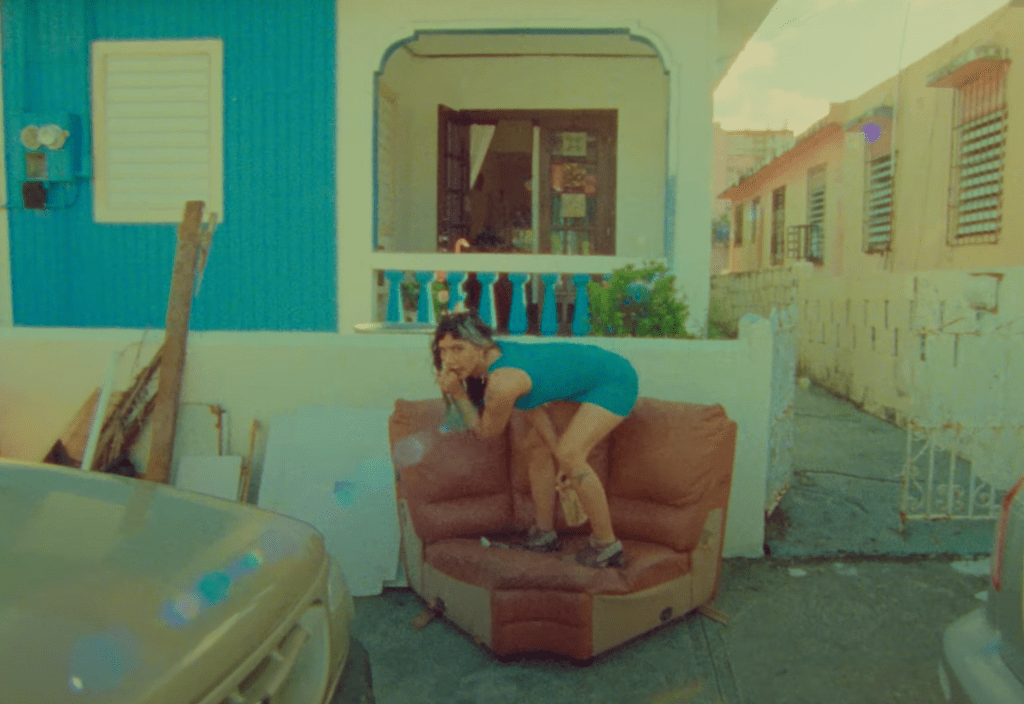
Featured Image: Still image by SO! from RaiNao’s “Tentretiene”
—
Cloe Gentile Reyes (she/her) is a queer Boricua scholar, poet, and performer from Miami Beach. She is a soon-to-be Faculty Fellow in NYU’s Department of Music and earned her PhD in Musicology from UC Santa Barbara. Her writing explores how Caribbean femmes navigate intergenerational trauma and healing through decolonial sound, fashion, and dance. Cloe’s poems have been featured in the womanist magazine, Brown Sugar Lit, and she has presented and performed at PopCon, Society for American Music, International Association for the Study of Popular Music-US Branch, among several others.
—
REWIND!…If you liked this post, you may also dig:
Contra La Pared: Reggaetón and Dissonance in Naarm, Melbourne—Lucreccia Quintanilla
“How Many Latinos are in this Motherfucking House?”: DJ Irene, Sonic Interpellations of Dissent and Queer Latinidad in ’90s Los Angeles—Eddy Francisco Alvarez Jr.
Unapologetic Paisa Chingona-ness: Listening to Fans’ Sonic Identities–Yessica Garcia Hernandez
SO! Podcast #74: Bonus Track for Spanish Rap & Sound Studies Forum
Cardi B: Bringing the Cold and Sexy to Hip Hop—Ashley Luthers
Share this:


Current Top Posts





April 2021

January 2020

November 2019

October 2019

August 2019

April 2014

November 2017

March 2015

December 2017

October 2015
 Sounding Out!
Recent Comments