
Straight Outta Compton . . .Via New York

Sounding Race in Rap Songs explores the production of musical identity in hip hop’s first two decades as a commercial genre. Although I don’t ignore lyrics or visual imagery, my main purpose is to analyze rap music as music, to understand how specific artistic decisions contribute to racial meaning in particular songs. My methods revolve around the study of how producers manipulate breakbeats, also commonly known as “breaks.” Initially understood as short, percussion-heavy passages that appear in many songs recorded in the 1960s and 1970s, breaks have been central to hip hop from the music’s earliest days in the South Bronx when DJs began isolating and looping them on their turntables to the delight of dancers. Since then, producers have tried out new approaches to working with breakbeats: hiring studio musicians to re-record them; programming drum machines to imitate them; and using sampling-sequencing technology to capture and rearrange them.
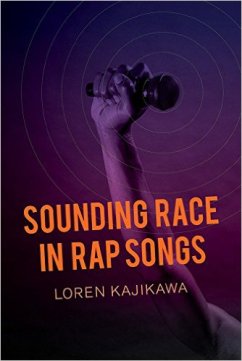 Throughout the book, I describe how producers use breaks and give rise to musical-racial codes that can be manipulated to project a variety of identities and attitudes. The following excerpt from the third chapter of Sounding Race, explains how the style of beat making popularized by the New York-based Bomb Squad (Public Enemy’s production team) provided a blueprint for pioneering west coast gangsta rap group N.W.A’s depiction of Compton, California. By layering multiple loops into a dense, cacophonous mix, N.W.A transposed Public Enemy’s “too black, too strong” sound onto the world of Los Angeles’s postindustrial streets.
N.W.A and its former members have been in the news recently thanks to the biopic Straight Outta Compton. Yet one aspect of the group’s development downplayed in the film is the way that its members formulated their identities in relation to east coast rap. In the mid-1980s, New York was the undisputed center of the industry, and its influence on L.A.-based acts is easy to see and hear. Ice Cube’s first group C.I.A. ( Cru’ In Action) used a nasal, hocket style approach to rapping cribbed directly from the Beastie Boys 1986 album License to Ill. And the cover of N.W.A’s first album N.W.A and the Posse, features numerous group members posing with the giant clock necklaces made famous by Public Enemy’s Flavor Flav. In similar fashion, the beat Dr. Dre produced for “Straight Outta Compton” (the title track to their breakout 1988 album) followed the Bomb Squad’s potent formula for signifying militant blackness. —Loren Kajikawa
—
The following is an excerpt from Chapter Three “‘Let Me Ride’: Gangsta Rap’s Drive Into The Popular Mainstream,” of Loren’s Kajikawa’s Sounding Race in Rap Songs, with thanks to The University of California Press. Any notes have been included in the text to conform to Sounding Out!‘s style sheet.
We [Public Enemy] were in Vegas and they [N.W.A.] were on tour with us, and I had just got the vinyl in. That’s what this is all about. Because Run-DMC and LL Cool J gave me energy. And if our energy happened to be transferred to N.W.A., then that’s what this whole thing is for.” Chuck D as quoted in Brian Coleman, Check The Technique: Liner Notes For Hip-Hop Junkies (New York: Villard Books, 2007), 354.
According to Chuck D, Public Enemy’s musical style directly influenced Dre, and he recalls giving the first two copies of It Takes a Nation of Millions To Hold Us Back to Dr. Dre and Eazy-E prior to the album’s official release. The recorded evidence supports Chuck D’s recollection. For many of the tracks on Straight Outta Compton, Dr. Dre seems to have borrowed from the “loops on top of loops” style of Public Enemy’s Bomb Squad.
In fact, when Ice Cube left N.W.A. in 1989, he hoped that Dre would continue to make beats for his solo project. When this proved impossible due to Dre’s contractual obligations to N.W.A., Ice Cube began collaborating with the Public Enemy’s Bomb Squad, which served as the production unit for his album Amerikkka’s Most Wanted (1990). N.W.A.’s breakthrough was finding a way to put a distinctive spin on these influences, and the artistic strategy that they arrived at for their first Ruthless Records release was designed to put themselves on the map—both literally and figuratively.
Rather than shout out the multiplicity of neighborhoods where their members were actually from (as they had done in “Panic Zone”), N.W.A. chose to center their identity around Dr. Dre and Eazy-E’s hometown of Compton, California. The sound of Compton as Dr. Dre imagined it, however, drew on musical practices and artistic decisions similar to those found in Public Enemy’s “Rebel Without a Pause.” To construct the rhythmic foundation of “Straight Outta Compton,” Dre looped the breakbeat from The Winstons’ “Amen Brother” (1969), one of the most sampled beats in hip hop, that also served as the foundation for dozens of songs in the UK’s “jungle” (aka “drum and bass”) genre.

Like other heavily sampled breaks from this era, the one-measure loop features a syncopated interlocking of snare and bass hits that is reminiscent of James Brown’s “Funky Drummer (featuring Clyde Stubblefield’s famous beat). As if he were following the Bomb Squad’s exact formula, Dr. Dre layered a drum machine (Roland TR-808) over this break.

The 808 was programmed to add its characteristic bass boom to the first two drum kicks of the “Amen” loop, and to tick off a 16-count hi-hat pulse with a closing hi-hat clasp on the downbeat of every other measure. The “Amen” break and the two hi-hat parts, provide the rhythmic foundation around which Dr. Dre places numerous other repeating sounds. Two other ingredients stand out in this beat: a guitar ostinato and a low drone on what sounds like a baritone sax or trombone (or perhaps a downwardly pitched sample of another instrument). The guitar ostinato, which plays straight eighth-notes on E-flat except for a one step descent to D-flat on the “and” of every fourth beat, churns out tight 1-measure units of sound.

The horn drone (also on E-flat) has a raw, muddled quality, and casts an ominous cloud over the track.
By combining these layers with the dense percussion track, Dre created a tightly packed funk groove with many sonic similarities to Public Enemy’s Bomb Squad. Like “Rebel Without a Pause,” the track to “Straight Outta Compton” features tight 1-measure loops stacked on top of one another to create a thick and intense groove.

Comparison of layers of looped sound in Public Enemy’s “Rebel Without a Pause” and N.W.A.’s “Straight Outta Compton”
Except for the drone, most of the elements in the track have a punchy feel, full of rhythmic stabs and staccato attacks, including the automatic gunfire that Dre samples to follow Ice Cube’s reference to an AK-47 assault rifle. Due to the “noisiness” of the beat, the way sonic space seems filled to maximum capacity, the members of N.W.A.—similar to Public Enemy’s Chuck D and Flavor Flav—practically yell their verses, as if they must raise their voices in order to be heard over the cacophony. Even before the actual words to “Straight Outta Compton” are digested, the sound of the track and the group’s vocals evoke the palpable tension of imminent conflict, which reinforces the theme of violent confrontation in the song’s lyrics. For the chorus of “Straight Outta Compton,” Dr. Dre strings together a series of samples with rapid-fire precision. The sound of screeching car tires from Davy DMX’s “One for the Treble” is followed by turntable scratching; the scratching leads directly to a choppy sample of the words “City of Compton” from Ronnie Hudson’s “Westcoast Poplock,” which is then followed by more scratching. The whole chain of musical events is deployed over the breakbeat from Funkadelic’s “You’ll Like It Too,” which Dr. Dre splices into the beat just for the chorus. The rapid cutting from one sample to the next exemplifies the “rupture” Tricia Rose identifies as fundamental to hip hop’s post-industrial aesthetic in Black Noise: Rap Music and Black Culture in Contemporary America (39).
Thus, the music and lyrics for “Straight Outta Compton” depict the city as a place of extremes, where things happen fast and change is sudden and complete. It is a place where one is either equipped to deal or left behind. In this way, Dr. Dre exploited the spatial characteristics encoded in Public Enemy’s music to depict Compton as place. The sonic characteristics that animated Public Enemy’s militant blackness were rerouted and effectively transposed onto N.W.A.’s depiction of Los Angeles gangstas.
—
Loren Kajikawa has served on the faculty at the University of Oregon’s School of Music and Dance since 2009. His main area of research and teaching is American music of the twentieth and twenty-first centuries, and he offers a variety of courses in music history, ethnomusicology, and musicology. Kajikawa’s writings have appeared in American Music, Black Music Research Journal, ECHO: a music-centered journal, Journal of the Society for American Music,and Popular Music and Society, among others. His recent book Sounding Race in Rap Songs (University of California, 2015) explores the relationship between rap music’s backing tracks and racial representation.
—
 REWIND! . . .If you liked this post, you may also dig:
“‘I’m on my New York s**t’: Jean Grae’s Sonic Claims on the City”––Liana Silva
Love and Hip Hop: (Re)Gendering The Debate Over Hip Hop Studies–Travis Gosa
Caterpillars and Concrete Roses in a Mad City: Kendrick Lamar’s “Mortal Man” Interview with Tupac Shakur–Regina Bradley
Share this:

Deaf Latin@ Performance: Listening with the Third Ear

 This is the fourth and final post in Sounding Out!’s 4th annual July forum on listening in observation of World Listening Day on July 18th, 2015. World Listening Day is a time to think about the impacts we have on our auditory environments and, in turn, their effects on us. For Sounding Out! World Listening Day necessitates discussions of the politics of listening and listening, and, as Trevor Boffone prescribes, a much wider and more corporeal understanding of the practice that goes beyond an emphasis on the ear and even on sound itself. –Editor-in-Chief JS
—
As Kent, a Deaf man, stands on stage in Tamales de Puerco, signing his story of struggling and growing up in a hearing family, the only aural sounds in the theater come from the audience: the sounds of crying. Performed in English, Spanish, and American Sign Language (ASL), Tamales offers a glimpse into the seldom seen realities of life as a single mother to a Deaf child as it intersects with Latinidad. The play presents the story of Norma, a young mother who confronts her abusive husband and challenges a country that rejects and oppresses her as an undocumented immigrant. She overcomes the hardships of being Latina, undocumented, and having a Deaf child (Mauricio) without any support from her husband, her mother, and local and state institutions. Ultimately, Norma must negotiate cultural citizenship and notions of belonging to the Deaf Latin@ community so that her son can have more opportunities. The play uses—and calls attention to—silence as an essential building block in the process of constructing, remixing, and performing the complexities of Latin@ identity.

Listening to the silences in Latin@ theatre performance offers crucial insight into how the Latin@ population and Latinidad fit into the fabric of the United States in the 21st Century, as Marci R. McMahon notes in “Soundscapes of Narco Silence.” In Tamales, the staging of Deafness creates a particular kind of silence that promotes new listening strategies. What I find most compelling is how Deafness on stage–and the particular silences Deafness can create–opens up a space for what Steph Ceraso calls “multimodal listening,” listening as a full-bodied event not solely linked to the ears, but rather connected to “bodies, affects, behaviors, design, space, and aesthetics.” Calling attention to the body as it does, the silences in the play give weight to Kent’s story and affects the viewer beyond the limits of voiced acting by encouraging spectators to concentrate on the actors’ physical emotions and how actors’ bodies work to transmit messages without verbal cues. I argue Tamales promotes multimodal listening by forcing spectators to use their “Third Ear”—a mode of listening across domains of silence, sound, and the moving body—as a device to understand a seemingly silent world.
To do this, I engage with the playscript and recordings of the 2013 production of Mercedes Floresislas’s Tamales de Puerco at CASA 0101 Theater under Edward Padilla’s direction. While Floresislas’s script raised many complex issues surrounding the Deaf Latin@ community, Padilla’s staging focused on the intersections of Deafness and Latinidad by foregrounding the use of silence in the production. [Note: I use the capitalized versions of Deaf and Deafness. A standard dictionary definition of “deaf” represents one who is partially or unable to hear (deaf and hearing impaired are essentially interchangeable). Deaf with a capital D, however, refers to the community that self-identifies as belonging to the Deaf culture. Deafness, therefore, is a sign of health and prognosis of well-being among sign language dependent hearing-impaired people. Likewise, hearing versus Hearing represents a similar biological/cultural binary.]
In Hearing Difference: The Third Ear in Experimental, Deaf, and Multicultural Theater, one of the few studies to devote critical attention to Deaf theater as it relates to multicultural experience and identity, Kanta Kochhar-Lindgren introduces the “Third Ear,” a useful term that facilitates focusing one’s attention on the performative forms of expression. Blending sensory, spatial, and visual elements generates a Third Ear that acts as a “Deaf-gain,” a hybrid mode of hearing and coming to know the world. When specific senses are lost, the mind becomes dynamic in such a way that continues to allow affected individuals to actively engage with their surroundings, with their community. Deaf people, therefore, do not lack a vital sense, but rather they gain a new sense—one typically inaccessible to hearing individuals– that enables them to successfully navigate their surroundings. Kochhar-Lindgren’s work focuses attention on the “sense” of performance and the different movements that work together to form speech sensed by the “Third Ear.” For audience members, learning to perceive the mixing of forms together as communication is fundamental to understanding the messages presented on stage; inevitably, the Third Ear promotes auditory silence yet it establishes that a lack of sound does not necessarily correspond with a lack of understanding. By removing all sound, silence gains power.

The evocation of the Third Ear separates Tamales from the majority of Latin@ theater productions grounded in aural languages such as English, Spanish, and Spanglish. Deafness is seldom represented onstage in any type of theater, aside from revivals of William Gibson’s The Miracle Worker and Mark Medoff’s Children of a Lesser God, more contemporary works such as Suzan Zeder’s Ware Trilogy and Bruce Norris’s Clybourne Park, and the work of Deaf West Theatre in Hollywood, whose most recent production, Spring Awakening received rave reviews and will move Broadway in September 2015. The work of Deaf West has been of particular interest to Sound Studies scholars for its unique contributions to the American Theatre. In Cara Cardinale’s 2012 SO! post, she discusses Deaf West’s production of Tennessee Williams’ A Streetcar Named Desire in which the roles were reversed. The production’s interpreters were for the hearing audience and, thus, sign language took center stage. Yet, all of these more well-known works focus on Anglo experiences, neglecting the specific intersectional challenges that Deaf people of color face such as limited access to state-funded resources such as counseling services, educational inequality and the achievement gap, not to mention that the majority of Deaf Latin@s do not have parents who can sign with them (re: effectively communicate).
The Third Ear, as evoked in Tamales, seems especially suited for representing Latin@ Deafness onstage and evoking a concomitant visceral understanding in audiences. Floresislas’s writing and Padilla’s direction work together to strategically allow audience members to develop a Third Ear at key moments in the play, enabling them to fill silences they might have otherwise perceived as gaps. Entering Tamales’ silent world not only compels hearing audiences to recognize their supposed privilege, but pushes toward a deeper understanding of the relativity of hearing-as-privilege. In a Deaf world, hearing is not a privilege, but rather one of many ways to come to know the world. In this regard, Tamales reiterates Liana Silva’s argument that “deafness complicates what it means to listen” by calling attention to the many non-auditory signals that are vital to the act.
 In addition, Tamales deliberately fosters moments of uncomfortable silences that are one of the production’s strengths. For example, silence plays a key role in an early scene in which Norma decides to leave her abusive husband, Reynaldo. In this violent episode–either by a deafening blow or disassociation–everything in her world goes silent. While Reynaldo yells at her and throws things around the house, his voice fades out. However, as Norma sits in silence, she becomes better able to navigate her abusive marriage. Norma hears the silence. Her hypervigilance increases her ability to identify potential threat(s) and, ultimately, she takes her son and flees from the situation. While Norma taps into her Third Ear on stage, the audience also enters a silent world in which they must seek alternative methods to actively engage with the production. By “losing” their hearing along with Norma, the audience must pay a different kind of attention to her to gain an understanding of the scene.
Along with recognizing certain hearing privileges, listening with the Third Ear both connects and separates the audience. For instance, in the scene in which Norma attends an AA meeting for Deaf people, Padilla’s direction activates the Third Ear by removing sound from the stage. In the original playscript, Floresislas wanted Kent’s monologue to include a voice-over, but during rehearsals, Padilla saw the potential to foreground the silence in this scene (and throughout the piece, as well); his direction transformed the staging from an aural scene to a silent one. Listening with the Third Ear enables the audience to blend sensory and visual hearing in order to understand the emotional depth of the action transpiring on stage. As Kent stands in silence, signing his story about the difficulties of connecting with his hearing father, many in the audience were audibly moved. During Kent’s monologue, the actor remained silent while supertitles revealed his speech:
Yesterday, my father had a heart attack and I got called to his bedside at the hospital. I had not seen him for almost 15 years! I had never had a conversation with my father; yes, he was hearing and I was his only deaf child. (…) I always believed by dad hated me; nothing I did was ever good enough. He was always watching me and looking angry for everything I ever did or asked. I actually wished he’d ignore me like the rest of the family! (15)

Particularly gripping, this scene acts as a crucial building block in the necessity of creating opportunities for her son that drives Norma’s story forward, not to mention that it calls attention to the fact that reading isn’t necessarily a silent act. Kent’s story reveals much to a hearing audience who may be unfamiliar with the Deaf Latin@ community. Kent’s experience is typical of Deaf Latin@s, only 20% of whom have parents that can sign. It compels an understanding of the reasons why Norma learns ASL and pushes for a better life for her son. She does not want him to be in the same position that Kent finds himself in. And, she does not want to have the regret of having never learned to communicate with him. Kent continues:
Yesterday, he looked frail; he was paralyzed on one side. When he saw me, he moved his hand like this (brushes his left hand up the center of his chest then points at). At first, I didn’t understand what he was doing. But when he did it again, I understood. He said, “I’m proud of you.” Then he signed “I love you.” (…) My niece told me he had been learning ASL for the last 3 months because he wanted to tell me how sorry he was for not being able to talk to me. My dad didn’t hate me; he hated himself for not being able to talk to me! (…) But yesterday, I also had my first and last conversation with my dad he signed for me! That…makes me feel very proud! (15-16)
As Kent stands in silence, his emotional journey is given life through his hands and body. Interestingly, the silences enacted onstage by Tamales actually create sound, amplifying the sobbing that emanates from the audience in both its auditory and visual manifestations. The way in which silence allows the audiences’ sonic reactions to become part of the play itself suggests that how—and why–the audience responds may actually be more important than the performance itself. How much are the sobs about the heartbreaking nature of Kent’s story and how much of it is recognizing one’s own privileges? How much of it is the audience connecting with the story? How much of it is about seeing themselves represented? And how does silence amplify “listening” to Kent’s story?
.

.
While not exhaustive, my reading of Tamales widens the conversation about the intricacies of Deaf Latin@ performance. The 2013 production of Tamales best hints at the possibilities of Latin@ performance in Boyle Heights and how community-based theater companies such as CASA 0101 can work to provide more access to Deaf people, thus forging both an inclusive community and theater company. More plays featuring Deaf characters, incorporating Deaf actors, and Deaf dramatists are needed, something Floresislas is already exploring. Still, much research remains as to how Deaf Latinidad is heard and how this identity fits into a performance framework. Through multimodal listening, Tamales urges spectators to leave the theater considering how they may or may not alter their actions to better benefit underprivileged and underrepresented communities such as the Latin@ Deaf community. Quite frankly, Tamales opens the “eyes and ears” of audiences. Now is the time to listen to Deaf Latinidad. What will we choose to hear in the silence?
—
Still Images from Tamales de Puerco, permission courtesy of CASA 0101 Theatre. Featured Image: Olin Tonatiuh and Cristal Gonzalez in “Tamales De Puerco.” Photo by Ed Krieger.
—
Trevor Boffone is a Houston-based scholar, educator, dramaturge, and producer. He is a co-founder of Amaranto Productions and a member of the Latina/o Theatre Commons Steering Committee. Trevor is a doctoral candidate in the Department of Hispanic Studies at the University of Houston where he holds a Graduate Certificate in Women’s, Gender, & Sexuality Studies. His dissertation, Performing Eastside Latinidad: Josefina López and Theater for Social Change in Boyle Heights, is a study of theater and performance in East Los Angeles, focusing primarily on Josefina López’s role as a playwright, mentor, and community leader. He has published and presented original research on Chicana Feminist Teatro, the body in performance, Deaf Latinidad, Queer Latinidad, as well as the theater of Adelina Anthony, Nilo Cruz, Virginia Grise, Josefina López, Cherríe Moraga, Monica Palacios, and Carmen Peláez. Trevor recently served as a Research Fellow at LLILAS Benson Latin American Studies and Collections at the University of Texas at Austin for his project Bridging Women in Mexican-American Theater from Villalongín to Tafolla (1848-2014).
Share this:


Current Top Posts





April 2021

January 2020

November 2019

October 2019

August 2019

April 2014

November 2017

March 2015

December 2017

October 2015
 Sounding Out!
Recent Comments