
“How Many Latinos are in this Motherfucking House?”: DJ Irene, Sonic Interpellations of Dissent and Queer Latinidad in ’90s Los Angeles

How Many Latinos are in this Motherfucking House? –DJ Irene
At the Arena Nightclub in Hollywood, California, the sounds of DJ Irene could be heard on any given Friday in the 1990s. Arena, a 4000-foot former ice factory, was a haven for club kids, ravers, rebels, kids from LA exurbs, youth of color, and drag queens throughout the 1990s and 2000s. The now-defunct nightclub was one of my hang outs when I was coming of age. Like other Latinx youth who came into their own at Arena, I remember fondly the fashion, the music, the drama, and the freedom. It was a home away from home. Many of us were underage, and this was one of the only clubs that would let us in.
Arena was a cacophony of sounds that were part of the multi-sensorial experience of going to the club. There would be deep house or hip-hop music blasting from the cars in the parking lot, and then, once inside: the stomping of feet, the sirens, the whistles, the Arena clap—when dancers would clap fast and in unison—and of course the remixes and the shout outs and laughter of DJ Irene, particularly her trademark call and response: “How Many Motherfucking Latinos are in this Motherfucking House?,” immortalized now on CDs and You-Tube videos.
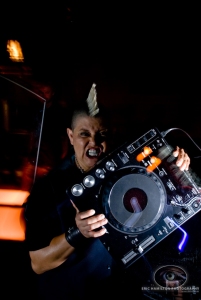
DJ Irene
Irene M. Gutierrez, famously known as DJ Irene, is one of the most successful queer Latina DJs and she was a staple at Arena. Growing up in Montebello, a city in the southeast region of LA county, Irene overcame a difficult childhood, homelessness, and addiction to break through a male-dominated industry and become an award-winning, internationally-known DJ. A single mother who started her career at Circus and then Arena, Irene was named as one of the “twenty greatest gay DJs of all time” by THUMP in 2014, along with Chicago house music godfather, Frankie Knuckles. Since her Arena days, DJ Irene has performed all over the world and has returned to school and received a master’s degree. In addition to continuing to DJ festivals and clubs, she is currently a music instructor at various colleges in Los Angeles. Speaking to her relevance, Nightclub&Bar music industry website reports, “her DJ and life dramas played out publicly on the dance floor and through her performing. This only made people love her more and helped her to see how she could give back by leading a positive life through music.”
DJ Irene’s shout-out– one of the most recognizable sounds from Arena–was a familiar Friday night hailing that interpellated us, a shout out that rallied the crowd, and a rhetorical question. The club-goers were usually and regularly predominately Latin@, although other kids of color and white kids also attended. We were celebrating queer brown life, desire, love in the midst of much suffering outside the walls of the club like anti-immigrant sentiment, conservative backlash against Latinos, HIV and AIDS, intertwined with teen depression and substance abuse.
From my vantage today, I hear the traces of Arena’s sounds as embodied forms of knowledge about a queer past which has become trivialized or erased in both mainstream narratives of Los Angeles and queer histories of the city. I argue that the sonic memories of Arena–in particular Irene’s sets and shout outs–provide a rich archive of queer Latinx life. After the physical site of memories are torn down (Arena was demolished in 2016), our senses serve as a conduit for memories.
As one former patron of Arena recalls, “I remember the lights, the smell, the loud music, and the most interesting people I had ever seen.” As her comment reveals, senses are archival, and they activate memories of transitory and liminal moments in queer LA Latinx histories. DJ Irene’s recognizable shout-out at the beginning of her sets– “How Many Latinos are in this House?”–allowed queer Latinx dancers to be seen and heard in an otherwise hostile historical moment of exclusion and demonization outside the walls of the club. The songs of Arena, in particular, function as a sonic epistemology, inviting readers (and dancers) into a specific world of memories and providing entry into corporeal sites of knowledge.
Both my recollections and the memories of Arena goers whom I have interviewed allow us to register the cultural and political relevance of these sonic epistemologies. Irene’s shout-outs function as what I call “dissident sonic interpolations”: sounds enabling us to be seen, heard, and celebrated in opposition to official narratives of queerness and Latinidad in the 1990s. Following José Anguiano, Dolores Inés Casillas, Yessica García Hernandez, Marci McMahon, Jennifer L. Stoever, Karen Tongson, Deborah R. Vargas, Yvon Bonenfant, and other sound and cultural studies scholars, I argue that the sounds surrounding youth at Arena shaped them as they “listened queerly” to race, gender and sexuality. Maria Chaves-Daza reminds us that “queer listening, takes seriously the power that bodies have to make sounds that reach out of the body to touch queer people and queer people’s ability to feel them.” At Arena, DJ Irene’s vocalic sounds reached us, touching our souls as we danced the night away.
Before you could even see the parade of styles in the parking lot, you could hear Arena and/or feel its pulse. The rhythmic stomping of feet, for example, an influence from African-American stepping, was a popular club movement that brought people together in a collective choreography of Latin@ comunitas and dissent. We felt, heard, and saw these embodied sounds in unison. The sounds of profanity–“motherfucking house”–from a Latina empowered us. Irene’s reference to “the house,” of course, makes spatial and cultural reference to Black culture, house music and drag ball scenes where “houses” were sites of community formation. Some songs that called out to “the house” that DJ Irene, or other DJs might have played were Frank Ski’s “There’s Some Whores in this House,” “In My House” by the Mary Jane Girls, and “In the House” by the LA Dream Team.
Then, the bold and profane language hit our ears and we felt pride hearing a “bad woman” (Alicia Gaspar de Alba) and one of “the girls our mothers warned us about” (Carla Trujillo). By being “bad” “like bad ass bitch,” DJ Irene through her language and corporeality, was refusing to cooperate with patriarchal dictates about what constitutes a “good woman.” Through her DJing and weekly performances at Arena, Irene contested heteronormative histories and “unframed” herself from patriarchal structures. Through her shout outs we too felt “unframed” (Gaspar de Alba).
Dissident sonic interpellation summons queer brown Latinx youth–demonized and made invisible and inaudible in the spatial and cultural politics of 1990s Los Angeles—and ensures they are seen and heard. Adopting Marie “Keta” Miranda’s use of the Althusserian concept of interpellation in her analysis of Chicana youth and mod culture of the 60s, I go beyond the notion that interpellation offers only subjugation through ideological state apparatus, arguing that DJ Irene’s shout-outs politicized the Latinx dancers or “bailadorxs” (Micaela Diaz-Sanchez) at Arena and offered them a collective identity, reassuring the Latinxs she is calling on of their visibility, audibility, and their community cohesiveness.
Perhaps this was the only time these communities heard themselves be named. As Casillas reminds us “sound has power to shape the lived experiences of Latina/o communities” and that for Latinos listening to the radio in Spanish for example, and talking about their situation, was critical. While DJ Irene’s hailing did not take place on the radio but in a club, a similar process was taking place. In my reading, supported by the memories of many who attended, the hailing was a “dissident interpolation” that served as recognition of community cohesiveness and perhaps was the only time these youth heard themselves publicly affirmed, especially due to the racial and political climate of 1990s Los Angeles.
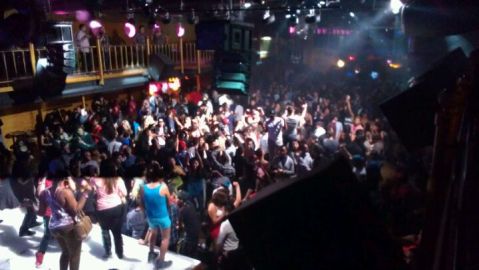
Vintage photo of Arena, 1990s, Image by Julio Z
The 1990s were racially and politically tense time in Los Angeles and in California which were under conservative Republican leadership. At the start of the nineties George Deukmejian was finishing his last term from 1990-1991; Pete Wilson’s tenure was from 1991-1999. Richard Riordan was mayor of Los Angeles for the majority of the decade, from 1993- 2001. The riots that erupted in 1992 after the not guilty verdict for the police officers indicted in the Rodney King beating case and the polarizing effect of the OJ Simpson trial in 1995 were indicative of anti-black and anti-Latinx racism and its impacts across the city. In addition to these tensions, gang warfare and the 1994 earthquake brought on its own set of economic and political circumstances. Anti-immigrant sentiment had been building since the 1980s when economic and political refugees from Mexico and Central American entered the US in large numbers and with the passing of the Immigration Reform and Control Act in 1986, what is known as Reagan’s “Amnesty program.” On a national level, Bill Clinton ushered in the implementation of the “Don’t Ask, Don’t Tell” policy in the military, which barred openly LGB people from service. In 1991, Anita Hill testified against Clarence Thomas’s nomination to the United States Supreme Court due to his ongoing sexual harassment of her at work; the U.S. Senate ultimately browbeat Hill and ignored her testimony, confirming Thomas anyway.
In the midst of all this, queer and minoritized youth in LA tried to find a place for themselves, finding particular solace in “the motherfucking house”: musical and artistic scenes. The club served a “house” or home to many of us and the lyrical references to houses were invitations into temporary and ephemeral sonic homes. Counting mattered. Who did the counting mattered. How many of us were there mattered. An ongoing unofficial census was unfolding in the club through Irene’s question/shout-out, answered by our collective cheers, whistles, and claps in response. In this case, as Marci McMahon reminds us, “Sound demarcates whose lives matter” (2017, 211) or as the Depeche Mode song goes, “everything counts in large amounts.”
Numbers mattered at a time when anti-immigrant sentiment was rampant, spawning white conservative sponsored legislation such as Prop 187 the so-called “Save Our State” initiative (which banned “undocumented Immigrant Public Benefits”), Prop 209 (the ban on Affirmative Action), and Prop 227 “English in Public Schools” (the Bilingual Education ban). Through these propositions, legislators, business people, and politicians such as Pete Wilson and his ilk demonized our parents and our families. Many can remember Wilson’s virulently anti-immigrant 1994 re-election campaign advertisement depicting people running across the freeway as the voiceover says “They keep coming” and then Wilson saying “enough is enough.” This ad is an example of the images used to represent immigrants as animals, invaders and as dangerous (Otto Santa Ana). As Daniel Martinez HoSang reminds us, these “racial propositions” were a manifestation of race-based hierarchies and reinforced segregation and inequity (2010, 8).
While all of this was happening— attempts to make us invisible, state-sponsored refusals of the humanity of our families—the space of the club, Irene’s interpellation, and the sounds of Arena offered a way to be visible. To be seen and heard was, and remains, political. As Casillas, Stoever, and Anguiano and remind us in their work on the sounds of Spanish language radio, SB 1070 in Arizona, and janitorial laborers in Los Angeles, respectively, to be heard is a sign of being human and to listen collectively is powerful.
Listening collectively to Irene’s shout out was powerful as a proclamation of life and a celebratory interpellation into the space of community, a space where as one participant in my project remembers, “friendships were built.” For DJ Irene to ask how many Latinos were in the house mattered also because the AIDS prevalence among Latinos increased by 130% from 1993 to 2001. This meant our community was experiencing social and physical death. Who stood up, who showed up, and who danced at the club mattered; even though we were very young, some of us and some of the older folks around us were dying. Like the ball culture scene discussed in Marlon M. Bailey’s scholarship or represented in the new FX hit show Pose, the corporeal attendance at these sites was testament to survival but also to the possibility for fabulosity. While invisibility, stigma and death loomed outside of the club, Arena became a space where we mattered.
For Black, brown and other minoritized groups, the space of the queer nightclub provided solace and was an experiment in self-making and self-discovery despite the odds. Madison Moore reminds us that “Fabulousness is an embrace of yourself through style when the world around you is saying you don’t deserve to be here” (New York Times). As Louis Campos–club kid extraordinaire and one half of Arena’s fixtures the Fabulous Wonder Twins–remembers,
besides from the great exposure to dance music, it [Arena] allowed the real-life exposure to several others whom, sadly, became casualties of the AIDS epidemic. The very first people we knew who died of AIDS happened to be some of the people we socialized with at Arena. Those who made it a goal to survive the incurable epidemic continued dancing.
The Fabulous Wonder Twins
Collectively, scholarship by queer of color scholars on queer nightlife allows us entryway into gaps in these queer histories that have been erased or whitewashed by mainstream gay and lesbian historiography. Whether queering reggaetón (Ramón Rivera-Servera), the multi-Latin@ genders and dance moves at San Francisco’s Pan Dulce (Horacio Roque-Ramirez), Kemi Adeyemi’s research on Chicago nightlife and the “mobilization of black sound as a theory and method” in gentrifying neighborhoods, or Luis-Manuel García’s work on the tactility and embodied intimacy of electronic dance music events, these works provide context for Louis’ remark above about the knowledges and affective ties and kinships produced in these spaces, and the importance of nightlife for queer communities of color.
When I interview people about their memories, other Arena clubgoers from this time period recall a certain type of collective listening and response—as in “that’s us! Irene is talking about us! We are being seen and heard!” At Arena, we heard DJ Irene as making subversive aesthetic moves through fashion, sound and gestures; Irene was “misbehaving” unlike the respectable woman she was supposed to be. Another queer Latinx dancer asserts: “I could fuck with gender, wear whatever I wanted, be a puta and I didn’t feel judged.”
DJ Irene’s “How many motherfucking Latinos in the motherfucking house,” or other versions of it, is a sonic accompaniment to and a sign of, queer brown youth misbehaving, and the response of the crowd was an affirmation that we were being recognized as queer and Latin@ youth. For example, J, one queer Chicano whom I interviewed says:
We would be so excited when she would say “How Many Latinos in the Motherfucking House?” Latinidad wasn’t what it is now, you know? There was still shame around our identities. I came from a family and a generation that was shamed for speaking Spanish. We weren’t yet having the conversation about being the majority. Arena spoke to our identities.
For J, Arena was a place that spoke to first generation youth coming of age in LA, whose experiences were different than our parents and to the experiences of queer Latinxs before us. In her shout-outs, DJ Irene was calling into the house those like J and myself, people who felt deviant outside of Arena and/or were then able to more freely perform deviance or defiance within the walls of the club.
Our responses are dissident sonic interpellations in that they refuse the mainstream narrative. If to be a dissident is to be against official policy, then to be sonically dissident is to protest or refuse through the sounds we make or via our response to sounds. In my reading, dissident sonic interpellation is both about Irene’s shout out and about how it moved us towards and through visibility and resistance and about how we, the interpellated, responded kinetically through our dance moves and our own shout outs: screaming, enthusiastic “yeahhhhs,” clapping, and stomping. We were celebrating queer brown life, desire, love in the midst of much suffering outside the walls of the club. Arena enabled us to make sounds of resistance against these violences, sounds that not everyone hears, but as Stoever reminds us, even sounds we cannot all hear are essential, and how we hear them, even more so.
Even though many of us didn’t know Irene personally (although many of the club kids did!) we knew and felt her music and her laughter and the way she interpellated us sonically in all our complexity every Friday. Irene’s laughter and her interpellation of dissent were sounds of celebration and recognition, particularly in a city bent on our erasure, in a state trying to legislate us out of existence, on indigenous land that was first our ancestors.
In the present, listening to these sounds and remembering the way they interpellated us is urgent at a time when gentrification is eliminating physical traces of this queer history, when face-to face personal encounters and community building are being replaced by social media “likes,” and when we are engaging in a historical project that is “lacking in archival footage” to quote Juan Fernandez, who has also written about Arena. When lacking the evidence Fernandez writes, the sonic archive whether as audio recording or as a memory, importantly, becomes a form of footage. When queer life is dependent on what David Eng calls “queer liberalism” or “the empowerment of certain gay and lesbian U.S. citizens economically through an increasingly visible and mass-mediated consumer lifestyle, and politically through the legal protection of rights to privacy and intimacy,” spaces like Arena–accessed via the memories and the sonic archive that remains– becomes ever so critical.
Voice recordings can be echoes of a past that announce and heralds a future of possibility. In their Sounding Out! essay Chaves-Daza writes about her experience listening to a 1991 recording of Gloria Anzaldúa speaking at the University of Arizona, which they encountered in the archives at UT Austin. Reflecting on the impact of Anzaldúa’s recorded voice and laughter as she spoke to a room full of queer folks, Chaves-Daza notes the timbre and tone, the ways Anzaldúa’s voice makes space for queer brown possibility. “Listening to Anzaldúa at home, regenerates my belief in the impossible, in our ability to be in intimate spaces without homophobia,” they write.
Queer Latinxs coming across or queerly listening to Irene’s shout out is similar to Chaves-Daza’s affective connection to Anzaldúa’s recording. Such listening similarly invites us into the memory of the possibility, comfort, complexity we felt at Arena in the nineties, but also a collective futurity gestured in Chaves-Daza’s words:. “Her nervous, silly laugh–echoed in the laughs of her audience–reaches out to bring me into that space, that time. Her smooth, slow and raspy voice–her vocalic body–touches me as I listen.” She writes, “Her voice in the recording and in her writing sparks a recognition and validation of my being.” Here, Anzaldúa’s laughter, like Irene’s shout-out, is a vocal choreography and creates a “somatic bond,” one I also see in other aspects of dancers, bailadorxs, remembering about and through sound and listening to each other’s memories of Arena. Chaves-Daza writes, “sound builds affective connections between myself and other queers of color- strikes a chord in me that resonates without the need for language, across space and time.”
In unearthing these queer Latin@ sonic histories of the city, my hopes are that others listen intently before these spaces disappear but also that we collectively unearth others. At Arena we weren’t just dancing and stomping through history, but we were making history, our bodies sweaty and styled up and our feet in unison with the beats and the music of DJ Irene.“ How Many Latinos in the Mutherfucking House?”, then, as a practice of cultural citizenship, is about affective connections (and what Karen Tongson calls “remote intimacies”), “across, space and time.” The musics and sounds in the archive of Arena activates the refusals, connections, world-making, and embodied knowledge in our somatic archives, powerful fugitive affects that continue to call Latinx divas to the dancefloor, to cheer, stomp and be counted in the motherfucking house: right here, right now.
—
—
Featured Image: DJ Irene, Image by Flickr User Eric Hamilton (CC BY-NC 2.0)
—
Eddy Francisco Alvarez Jr. came of age in the 1990s, raised in North Hollywood, California by his Mexican mother and Cuban father. A a first generation college student, he received his a BA and MA in Spanish from California State University, Northridge and his PhD in Chicana and Chicano Studies from University of California, Santa Barbara. A former grade school teacher, after graduate school, he spent three years teaching Latinx Studies in upstate New York before moving to Oregon where he is an Assistant Professor in the Departments of Women, Gender, and Sexuality Studies and University Studies at Portland State University. His scholarly and creative works have been published in TSQ: Transgender Studies Quarterly, Aztlan: A Journal of Chicano Studies, Revista Bilingue/Bilingual Review, and Pedagogy Notebook among other journals, edited books, and blogs. Currently, he is working on a book manuscript titled Finding Sequins in the Rubble: Mapping Queer Latinx Los Angeles. He is on the board of the Association for Jotería Arts, Activism, and Scholarship (AJAAS) and Friends of AfroChicano Press.
—
 REWIND!…If you liked this post, check out:
“Music to Grieve and Music to Celebrate: A Dirge for Muñoz”-Johannes Brandis
On Sound and Pleasure: Meditations on the Human Voice-Yvon Bonenfant
Music Meant to Make You Move: Considering the Aural Kinesthetic– Imani Kai Johnson
Black Joy: African Diasporic Religious Expression in Popular Culture–Vanessa Valdés
Unapologetic Paisa Chingona-ness: Listening to Fans’ Sonic Identities–Yessica Garcia Hernandez
Share this:

My Time in the Bush of Drones: or, 24 Hours at Basilica Hudson
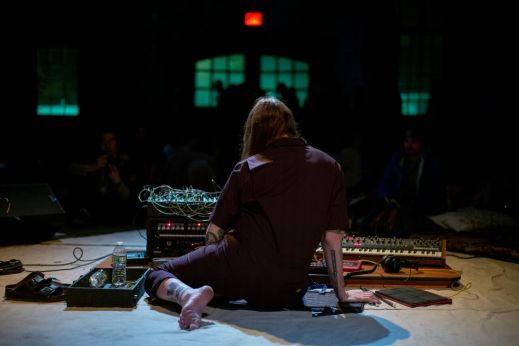
Ed. Note: We wanted to run this piece in advance of the Basilica Hudson’s SoundScape event taking place this Friday, September 14 – Sunday, September 16, 2018. Our Amplifying Du Bois at 150 forum will return next week.
—
“But why?”
Three weeks into a new semester and I am packing for another weekend of irresponsible travel. Irresponsible financially (because air travel on a graduate stipend is a decadence rarely rewarded) and irresponsibly professionally (because missing an annual department event, grading in a car, and sleeping on the ground for two days is a string of realities that stand sternly opposed to anything like good sense). I am doing all this in order to attend Basilica Hudson’s Soundscape: a wide and ranging line up of musicians and artists whose aesthetic commitments fall, shall we say, considerably aslant from the pop-cultural median. I am doing all this because of something that happened last year at this place, something I am still trying to work out. And this means, amongst concerned colleagues and family and friends, I’m again hearing that familiar, stuttering articulation of disbelief. Phrased, with equal parts confusion and concern, they rejoin:
Why?
This question first started popping up late last March. It came repeatedly, unblinkingly, and, I should add, not-unreasonably. What’s more, this was, in a very real way, my fault. For I had failed to develop a pithy ready-to-hand account of precisely why I was to travel from Chicago to New York City and New York City to Hudson, only to sleep on a thin mat on the concrete floor of a converted foundry while listening to loud, sustained bursts of noise (with varying degrees of harmonic familiarity) for an unbroken period of 24 hours.
Instead, I had only an intuition that failed to pass even the slightest of critical muster: Basillica Hudson’s 24-HOUR DRONE festival seemed weird and extreme and like something might happen there. On this basis, it seemed like a good thing to do.
I can now state with some clarity (though still lacking anything like critical poise) that something did in fact happen there, and it was indeed a good thing to do. Though what that “something” was remains frustratingly elusive.

24-Hour Drone, Image by Alt
This piece thus began as a review, but ended necessarily quite differently. The conventions of a review call for evaluation and normative judgement; they require statements regarding the quality of an event or object. I can offer very little in this vein. I’m still trying to wrest from memory something stubbornly mute and fleeting — still trying to figure out what it was, precisely, that happened there.
The drive up remains clear enough in memory. The usual crackle of reunited conversation between dear friends long-separated by geography; a decision not to listen to the then-new Grouper album (we would have enough heart-dragging ambient texture in the coming hours, we concluded); the sounds of Brooklyn passing into that hushed early-Spring upstate on Route 84. We at one point, for reasons that need not become articulate, listened to the Gin Blossoms. But as we pulled into the graveled parking lot a sense of anticipation and confusion returned. What was this thing?
To begin, we might reasonably call it an event.
Basilica Hudson — an upstate New York-based non-profit for the arts that puts on the event annually — admirably describes it thus:
An immersive event and all-encompassing experience, 24-HOUR DRONE is a roving, international series presented by Basilica Hudson and Le Guess Who?, featuring musicians and sound artists experimenting within the spectrum of drone to create 24 hours of unbroken, uninterrupted sound.
Through this expanded programming, 24-HOUR DRONE strives to break down barriers across borders, offering an opportunity to connect diverse musical communities and traditions, offering a localized snapshot of DRONE within the larger context of an imagined universal sound.
The language here should scan as familiar to anyone accustomed to reading music and arts press. Roving, experimental, barrier-breaking, border-crossing: these terms all call up a restless energy, the excitement of the wholly new, the different, the thoroughly non-normative. As it turns out, all these attributes turn out to be more-or-less (if uninterestingly) true.
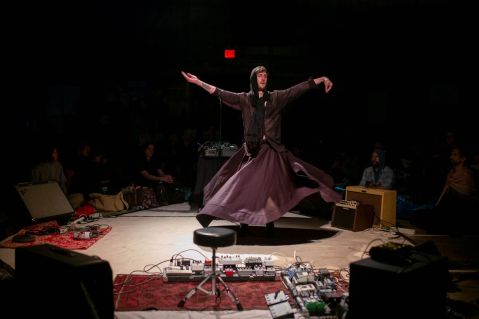
24-Hour Drone, Image by Alt
Over the course of the day and night, I heard the ethereal saxophone of PAUL, the whipping clangor of Pharmakon, and — I want to emphasize this — the absolutely breathless New Castrati, January Hunt’s exceptional and mournful work living up to her billing elsewhere as “synth, drones, and the annihilation of man.” A sentence above, though, still merits pause: “a localized snapshot of DRONE within the larger context of universal sound.” Roving energy and shattering experiment here take shape as a snapshot, the whirring and calamitous universal stalling for a moment in a discrete particular. 24-HOUR DRONE attempts to lends form to what was too diffuse to be seen.
So, modestly, in lieu of aesthetic judgement, a proposition: the value of Basilica Hudson’s 24-HOUR DRONE is to offer space to sound.
Indeed, for an event so centrally concerned with sound, 24-HOUR DRONE is as much about the Basilica — a converted nineteenth-century cathedral-esque foundry — as it is about sound. And for good reason: the Basilica has been beautifully repurposed — gutted of its original use and re-asserted as an malleable and improbably elegant arts space. Hundred-plus foot ceilings dwarf individual bodies, it’s begrimed upper windows modulate the midday sun into a speckled and hazy sepia, and the elaborate truss-work grids the scene in an industrial domework. The Basilica is a work of architecture meant to imagine and hold, however briefly, those fleeting shards and fragments of something yearning toward a “universal sound.”
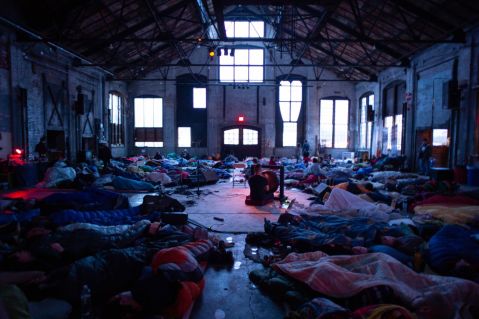
24-Hour Drone, Image by Alt
Though even as stunning a work of architecture as the Basilica can only ever confer a loose limit. These fragments are always clamoring for a more robust scene, always threatening to join the broader universal that awaits. Sound passes through walls, vibrates along concrete, penetrates skin and mingles among bodies. Spaces focalize sound’s capacities for the social and ethereal, by preserving and witnessing its constitutive ephemerality. Different spaces draw our attention to sound’s actually-existing materiality: a materiality that doesn’t quit, one that loosens our grip on our more ready-to-hand material worlds.
Grasping this materiality is not easy; it is maybe impossible. What possible cognitive torque will allows us to grasp at this overtopping universal? One option, it seems, is sheer brute force.
The term “endurance” rightly comes up repeatedly in press-documents and FAQs. For the event is knot of time and space (24 hours at the Basilica) which commands an attention to sound as a given, but sounding too as demanding an economy of attention wholly strange–a fidelity to sound that is without end. Limning out these ambitious parameters, to reign sound in, if for only a moment, requires something added.
Space, then.
Sonic spaces have a familiar, if knotty, history. Cathedrals invoke a beatific space, trussed by elaborate ornament and a spiritualized verticality. Music festivals inscribe traditions of sound and histories of capital — crowds and power, in Gina Arnold’s felicitous adaptation of Elias Canetti. Dwellings and offices, cafes and bars. Spaces arrange us in sound, and sound among us.
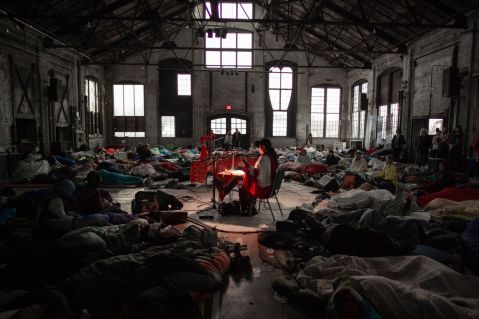
24-Hour Drone, Image by Alt
DRONE, then, is a provocation to think about sound — to think it over time, and to do so in a necessarily rarified space. This provocation worked; but I felt it only at an extreme limit.
At the twentieth hour (8 AM) I needed coffee. I had slept (kind of) through the night, rose to a bell ceremony, and walked immediately, groggily outside. As I passed through the door frame into the dewy and drizzly upstate morning, the sound — as if from a vacuum — muted and was voided of weight. I walked through the mostly empty streets.
These empty streets were, as it turned out, raucously loud. Distant cars motoring across country byways, the buzzing of a streetlight long past its prime; my tinnitus — a steadily pitched pulse acquired in those irresponsible salad days standing too-close to a crash cymbal — reminding me of all I may one day not hear. These sounds were, quite suddenly, clamoring for my attention, demanding my thought, straining for distinction. The espresso machine, the door hinges, the bathroom sink. Floorboards and rain and leaves and the Hudson and, and, and.
I walked back, not a little unsettled.
I had breakfast outside the venue among gravel-scraping shoes and overheard conversation.
Finally, I went back inside for what turned out to be the final act: Dronechoir Syllaba. The scene remains hauntingly clear.
A grouping of women entered, dressed entirely in white, each with one earbud in-ear, the other hanging loose. Some, if not all, had a length of yarn tied around their waist and dragging along the ground behind them a screw, nail, metal implement, which, as they walked produced a fragile, slender tone. They congregated in the center of the room and produced a careful and lush chord, its density piling up toward the far reaches of the ceiling. Slowly, the chord broke apart.
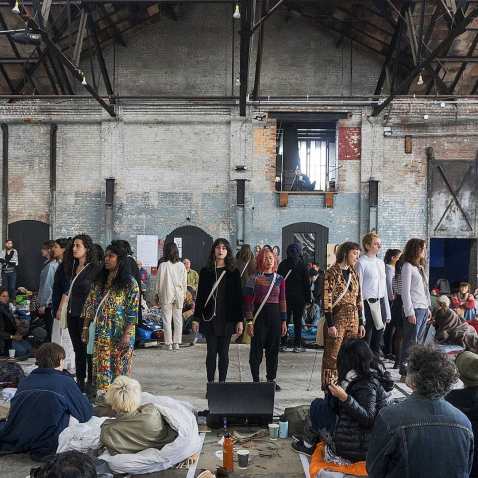
Dronechoir Syllaba, Basilica Hudson, 2018, Image by #noamplification
But, then, that’s not true.
I should say: slowly, the women moved apart, the chord remained, stretched and pitched against new and different coordinates, inhabiting the Basilica’s elastic space in a new configuration. Notes moved, their bearers slowly pacing around the exhausted and supine bodies of Droners along the floor.
A choir member approached me, holding out her free earbud. I shook my head, wearing a nervous grin. She insisted; I put it in. Playing quietly in that tinny bud was a reference tone for me to share. I looked at her as though I didn’t understand, and she smiled as if she did. Insisting. I managed a small hum, off-kilter and out of tune, before handing it back to her. Looking around, I saw the relationship I had repeated among others across the room. The chord kept mutating — dilating and contracting, swelling and receding, different tones calibrated along moving spatial coordinates. The choir returned to formation in center.
At noon, silence.
Everyone was smiling, dazed, like milkdrunk babies or punchdrunk lovers. We had slept amongst each other, passing a night in a shared space, while sound had enwrapped and enraptured us. We had borne witness to valences of sound hitherto under-noticed. We had joined a choir, if only for an offkilter moment in a space out-of-joint.
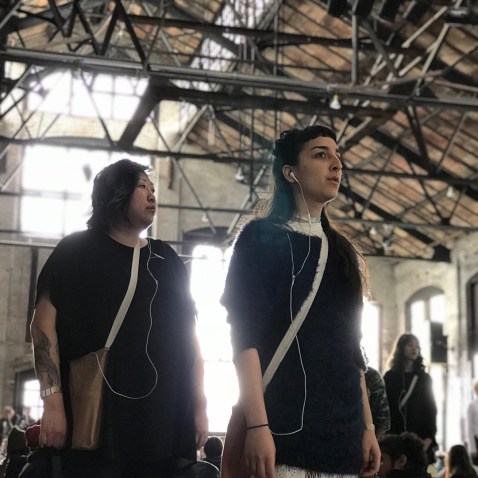
Dronechoir Syllaba, 24-Hour DRONE, Image by Andrew LaVallee via Instagram
***
We thought, my traveling companion and I, we thought the car ride back to the city would be for silence. For what else could you thirst after 24 such hours in the heart of sound? But this turned out to be deafening uncomfortable, weird. We were, in our own private ways, estranged from sound. Which is really another way of saying we were in different relation to sound and to the spaces it fills. There, a foundry. Here, a car. We put on, in lieu of silence, a little slice of magic, the condensation of all groove and beat, the most organized flash of pop brilliance this side of 1980. We of course put on Thriller.
As we roiled down the road to this joyous whispered desire — wanna be startin’ somethin’, got to be startin’ somethin’ — in a vehicle not made for dancing, the force of the Drone event began to take shape.
So, again: why?
To give attention to what we all already share — space and sound, history and music. To be adrift but not asleep in it all.
As for what happened?
I’ll try to grasp that next year.
—
Featured Image by Alt
—
Robert Cashin Ryan is a PhD candidate in the department of English at the University of Illinois-Chicago. He has written in various places about literary form and formalism, the relationship between Herman Melville and Charles Dickens, and Christmas as an intellectual problem. He curated and introduced a gathering of essays on music, sound, and noise for Post-digital forthcoming from Bloomsbury 2019.
—
REWIND!…If you liked this post, you may also dig:
This is Your Body on the Velvet Underground–Jacob Smith
Live Through This: Sonic Affect, Queerness, and the Trembling Body–Airek Beauchamp
Share this:


Current Top Posts





April 2021

January 2020

November 2019

October 2019

August 2019

April 2014

November 2017

March 2015

December 2017

October 2015
 Sounding Out!
Recent Comments