
Ritual, Noise, and the Cut-up: The Art of Tara Transitory

 Marginalized bodies produce marginalized sounds to communicate things that escape language. The queer body is the site of sounds that engage pleasure, repression, rage, isolation, always somehow outside of dominant language. Sound Studies tells us that we should trust our ears as much as our eyes, justifying our trust in sound, and of the resonating body. Affect Theory goes further, saying that all senses play into a body that processes input through levels of response, experience, and anticipation. Affect is the vibrational space that is both bodily memory and anticipation. So where do sound and affect meet in queer bodies? How do marginalized peoples use sound and the body to express liberation, objectification, joy, and struggle?
Our writers in Sound and Affect tackle these questions across a spectrum of the marginalized experience. I opened the series by offering the concept of the tremble, a sonic form of affect that is necessarily queer in its affective reach. Then, Kemi Adeyemi, sloooooooowed thingggggggggs doooooooooownnnnn so to hear the capitalist connections between the work expected of black bodies and the struggle for escape from this reality through the sonic affects, temporal shifts, and corporeal elsewhere of purple drank. Last week, Maria P. Chaves Daza explored the connection between voice, listening, and queer Chicana community formation: through space, across time, and with laughter. In the final post of the Sound and Affect forum, Justyna Stasiowska brings the noise in a discussion of the trans body and the performance work of Tara Transitory. —Guest Editor Airek Beauchamp
—
Ritual is another word that needs a new definition… Ritual, as I use the term, refers to an artistic process by which people gather and unify themselves in order to confront the challenges of their existence. –Anna Halprin
The shivering on your skin gradually builds like a soft electric shock that presses you down to the floor. The whole experience feels like an earthquake, with vibrations pricking through bone into organs. The affective tonality of the performance puts the body in a state of alarm, where listening turns into self-observation. Your perception is immersed in sensing the materiality of a room filled with other bodies, all attuning to the low frequencies resonating with the architecture of space, trying to maintain equilibrium. You refocus away from the artist to yourself and the rest of the audience, realizing the depth of your feelings of total connection.
This transcendence comes through dissolving the boundaries of the body and the vibrational disturbance of one’s kinesthetic sense of self in a room, or proprioception. As One Man Nation, Tara Transitory creates noise during her performances to offer out-of-body experiences for her listeners, a ritual where the unity of body and self dissolves. Using samples gathered through field recording and sounds from her midi controller, 64button monomer, and contact microphones on the tables and floor, Transitory catches her body moving and interacting with the instruments, amplifying the process of making sound in the here and now.

Tara Transitory Performing
Transitory’s artistic praxis enables me to explore the ways in which the body creates and receives noise. I define noise here as the unwanted and always-present materiality of (mis)communication. Transitory explores the body as a site of noise and disruption, working to disrupt the false narrative of unity pervasive in Western concepts of gender. Using cut-ups, noise, and ritual, Transitory exposes the falsehoods of gender norms and repositions the body as a locus of possibility that allows for transgression and what Angela Jones and Baran Germen have called “queer heterotopias.”
Queer Heterotopias and the Rituals of Self
Morning rituals like taking pills and brushing teeth produce the tiny noises of becoming one’s self, or at least molding one into a presentable self. Repetition is a key element, making the process seem effortless and automatic. As Judith Butler discussed in Gender Trouble, everyday movements, gestures, actions, and ways of using and presenting one’s body are framed by gender categories. Butler also demonstrated that gender is a performance made of repeating gestures and movement that are prescribed to male and female genders.
The everyday routine of Transitory’s life, therefore, in a specific socio-political context, can seem unnatural and marginalized. Taking drugs every day changes the meaning of an action, whether the drugs are hormonal, supplemental, medicinal, or recreational. Still, the “natural,” as most queer theorists show, exhibits power only through the framing of social categories as transparent, creating an illusion of normalcy. However, while this post-structuralist perspective seeks an antidote to the normalization of cultural schemes, it does not make clear what to do after destroying society’s illusion. Deconstructionist perspectives produce a constant grating sound coming from the friction between the conceptual framing of body and the materiality of fleshly gender performance.
In other words, what didn’t make the cut?
Cut-up spaces
As proposed by Brion Gysin and William Burroughs in The Third Mind, the cut-up method, an early analog method resembling sampling, involved artists cutting up pieces of text and reassembling the pieces in a new form. This technique, used across different media, enables artists to create a self outside the limits of the body. In Burroughs’ Invisible Generation, he describes creating a “cut-up” using a tape recorder. Recording, cutting up the tape, then reassembling it for playback allows the listener and the artist to become aware of a specific socio-cultural programming that Burroughs presents as method of policing the self. However, remixing and repetition also opens spaces to reprogram our-selves. The tape recording cut-up becomes a multisensory stimulant used to create an other self through de- and re-construction. Furthermore, the body, working as a membrane, becomes transformed through the repetition of these new sounds; sound affects listeners simultaneously at the level of cognition as well on the level of the body as a corporeal listening apparatus.

Lady Jaye Breyer P-Orridge on the left and Genesis P-Orridge on the right. Still from the documentary movie, “The Ballad of Genesis And Lady Jane.”
Genesis Breyer P-Orridge and Lady Jaye also explored the concept of the body itself as a cut up medium in their Pandrogeny project. They underwent the process by cutting up each other’s gestures and behaviours through mimesis and cutting up parts of their bodies by undergoing plastic surgery in order to create a third being. According to a post by a plastic surgeon in Louisville, the cut up material that they used is DNA, which they refer to as the “first recording.” They used the pronoun “We” even after Lady Jaye left her body (passing away in 2007), so the third being is not just a shared body, but a connection of minds and spirits across the divisions of gender and body. Making a cut-up of the body enabled them to create an other, a combined Genesis and Lady Jaye, the pandrogyne self, the WE that is now Genesis and Lady Jaye. Pandrogyny is, in their project, a unified being presented as the double self in the negation of gender. It is a performance aimed to create a space for the connected consciousness, the third mind within a physical space of the body.
Tara Transitory uses a different method of “cut-up,” focusing on vibrational exchange among bodies to create communitas—or common public– specific to ritual in order to disenchant the geopolitical connection of body and gender. Transitory’s “cut-up” aims to create a body in transition, which connects with other bodies through the amplification of noises the body produces. Her work uses vibration to establish communication across genders, within a body or between bodies in a state of flux.
The last day before the end of the world. Somehow I feel my life has been up till now very fulfilling and I really cannot think of what more I want, or what I need to do before the end. My only plan is to take my first pill of estrogen at 2359 tonight Bangkok time, the beginning of the apocalypse of my testosterone. –Tara Transitory, Ritual.
Originally from Singapore, Transitory works as One Man Nation, documenting and developing communities in Europe and Asia. Her project International //gender|o|noise\\ Underground consists of mapping and documenting lives of trans women in Asia and Europe and creating performances using noise. She, with Miriam Saxe Drucki-Lubecki, also took part in establishing a monthly trans/queer left- field music party in Granada called Translæctica. Translæctica has grown to other countries, with editions (in Paris, Bankok, Saigon), and includes lectures, workshops and film screenings mixed with electronic music. As posted on Translæctica’s Facebook page, the goal behind the event is to present “the idea of a new world as one borderless living space, with all the shifts and transformations and their irreversible impact on local/original cultures.” It connects local and international artists and activists to create an ever-evolving community without borders.
As Transitory’s name might suggest, she herself is not committed to a national identity. Throughout her migratory experience, Transitory gathers field recordings then uses narrative to transform them. Her site-specific approach focuses on concrete, situated realities that are entangled in current political situations, where friction arises between the policing norms in Asian and European societies and her own functioning as a nomadic being in state of transition. Her performances are rituals that blur the restrictions that society conveys through noise (screams, samples from field recording, the sound of the moving body) as an affective force, creating a state of meditation and catharsis. For example, while documenting the lives of trans experience, she worked with trans women street performers from Ho Chi Minh City in Vietnam.
These women make fire performances to “Gangnam Style,” moving during the night from one public place to another to perform for unsuspecting audiences. Sampling the street noises and then playing them back during the performance creates a mirror for the audience; interjecting common noise into a common dance song established a specific heterotopia, shifting what might be a normal experience into something uncanny within the conventions of street entertainment.
In her performances, Transitory uses noise as an intentional activity, suspending communication, disabling the recipient from receiving information, leading to an “immersion in noise.” This immersion is similar to sensory deprivation in that it overloads the receiver with stimuli, suspending communication. Its affective force comes from invading the body with frequencies and vibrations, where one feels the body in constant movement – a state of perpetual flux. It becomes the tactic of distancing from the self, enabling the listener to create different experiences, a heterotopian space of otherness and developing new rituals for specific situations.

Angkana Khunchai
One Man Nation’s performances end with Traditional Laotian Molam-style music (“Mo” is an artist and “Lam” is a kind of performance art where the artist tells a story using tonal inflections) sung by Angkana Khunchai, a 1970’s pop-music singer. The pop-ish songs are calming and soothing after the intense experience of Transitory’s performance. The text is a repetition of the words “calm down,” a therapeutic ending creating a sense of light from this cathartic performance. Transitory’s use of Molam eases re-entry into one’s everyday existence outside of the performance. The harmonies and softness of the song contrast with the harshness of noise performance as part of ritual – from transgressing the everyday and entering the liminal state that Transitory creates in her performances to better re-enter society.
Transitory’s work conjures new rituals of transcendence and distancing one-self from the body. I treat the //gender|o|noise\\ as a hacking of the everyday experience of body. By creating a temporary heterotopia. Tara’s work reveals the tactics of hacking gender, generating a temporary space for alternative modes of existence. She creates flux in bodies and bodies in flux, thus affectively crafting heterotopic spaces, sites which are, as Brian Massumi states:
[…]an open threshold — a threshold of potential. You are only ever in the present in passing. If you look at that way you don’t have to feel boxed in by it, no matter what its horrors and no matter what, rationally, you expect will come. You may not reach the end of the trail but at least there’s a next step (“Navigating Spaces”).
The everyday processes of becoming oneself by repeating practices become rituals when performed in different contexts. This ritual is a process of creating an affect, a space of potentiality that enables the body to reshape and change, much like Transitory refits old rituals into new skin. The ritual forms applied to actions of the everyday enable us to change their meaning and our perceptions, creating a sense of the transitory nature of one’s body. Sonic rituals like Transitory’s are tactics to develop a self-conscious and creative approach to everyday activities and use them, as Anna Halprin says, to confront the challenges of existence.
—
Featured Image: Tara Transitory in performance mode
—
Justyna Stasiowska is a PhD student in the Performance Studies Department at Jagiellonian University. She is preparing a dissertation under the working title: “Noise. Performativity of Sound Perception” in which she argues that frequencies don’t have a strictly programmed effect on the receiver and the way of experiencing sounds is determined by the frames or modes of perception, established by the situation and cognitive context. Justyna earned her M.A in Drama and Theater Studies. Her thesis was devoted to the notion of liveness in the context of the strategies used by contemporary playwrights to manipulate the recipients’ cognitive apparatus using the DJ figure. You can find her on Twitter and academia.edu.
—
 REWIND!…If you liked this post, check out:
Pleasure Beats: Using Sound for Experience Enhancement ––Justyna Stasiowska
Papa Sangre and the Construction of Immersion in Audio Games–Enongo Lumumba-Kasongo
SO! Reads: David Novak’s Japanoise: Music at the Edge of Circulation—Seth Mulliken
Share this:

Listening (Loudly) to Spanish-language Radio

 This is the third post in Sounding Out!’s 4th annual July forum on listening in observation of World Listening Day on July 18th, 2015. World Listening Day is a time to think about the impacts we have on our auditory environments and, in turn, their effects on us. For Sounding Out! World Listening Day necessitates discussions of the politics of listening and listening, and, as Inés Casillas prescribes, a wider understanding of the power and meaning of volume as material sensation as well as listening practice, particularly in communities marginalized by U.S. racial and ethnic hierarchies. “Listening loudly in the face of anti-immigrant public sentiment,” Casillas tells us, “becomes a form of radical self-love, a sonic eff-you, and a means of taking up uninvited (white) space.” –Editor-in-Chief JS
—
Chicana and Chicano friends across the southwest share different renditions of a similar childhood memory. The one where Mexican parents or grandparents crank up the rancheras -mournful, classic Mexican melodies – on an early Saturday morning or what seems to be an inappropriate, way-too-late weeknight. They reminisce about listening as children in wonderment to the familial, communal sing-along that seemed to instinctively take place among extended kin. That, or they tell of listening, cringing in silence, in fear that the non-Mexican neighbors will overhear the radio and spontaneous serenade; a telltale sign that their family is, indeed, Mexican. “As if,” shared Deborah Paredez in her account, “those few white neighbors somehow didn’t already know you were Mexican.”

“Woman Doing a Mexican Grito” by Flickr User Nan Palmero
For unfamiliar ears, the sounds of Spanish, the mariachi ensemble, and/or accented karaoke all work together to signal brownness, working-class, and even, according to Jennifer Stoever, illegality. To me, the most provocative detail in these recurring childhood stories rests more on the volume, often stationed on one of two settings – “loud” or “real loud.” Excessive, “loud accouterments,” according to Deborah R. Vargas, are heard and identified as unforgiving, racialized and queer forms of surplus; what she calls “lo sucio” (a vernacular for dirty or grimy). The high volume allows Mexicans and Chicanas/os to publically flaunt their brown identities under the increasingly watchful gaze of a post-9/11 state, during a record-deportation Obama era, and when Latinos have officially outnumbered whites in the Golden (now brown) state of California. Listening loudly in the face of anti-immigrant public sentiment becomes a form of radical self-love, a sonic eff-you, and a means of taking up uninvited (white) space.
These stories, strikingly similar, often point to the ranchera song-style, specifically, the talents of Vicente Fernández and his regal voice as the beloved malefactor. The timbre in Fernández’s famed voice rouses (drunken) merriments of Mexico, with lyrical utterings about acrimonious, heteronormative loves and losses. The gritos or sentimental cries that accompany such songs are gendered, nostalgic stand-ins for an affect of displacement shared by both Mexican immigrants and Chicana/os. Simon O’Sullivan insists that, “you cannot read affects, you can only experience them.” I would add, “through sound” to stress the ways in which sound travels and emotionally anchor a listener’s body. The fact that so many Chicanas and Chicanos have these recollections and several (read: me) reproduce these loud practices with our own children says more about the continued racialized, brown experiences of Mexicans and Chicana/os in the U.S. than perhaps the prowess of rancheras themselves.

Vicente Fernández Performing Live in 2010, Image by Flickr User Jennifer Cachola
In many ways, the workings of race, language and labor resonate through radio. I argue that the very public nature of Spanish-language radio listening represents a communal, classed, and brown form of listening that differs markedly from “white collar” modes of listening, which offers more solitary practices, promoted by commuting in private cars and listening to personal satellite radios, iPods, or Internet broadcasts.
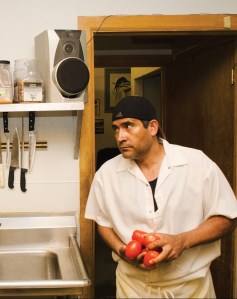
Workers listen to the radio in the kitchen of Taqueria El Nopal in Glenwood Springs, CO, Image by Andrew Cullen, High County News
For instance, one can routinely overhear loud Spanish-language broadcasts from the back kitchens of restaurants (regardless of the ethnic cuisine); outside bustling construction sites and Home Depot storefronts as day laborers await work; or from small radio sets balanced heroically on hotel housekeeping carts. On-air salutations heard throughout the day on Spanish-language radio are vocal nods to worksites as radio hosts greet washeros (car wash personnel), mecánicos (mechanics), fruteros and tamaleras (fruit and tamale street vendors), and those, presumably farmworkers, toiling under the sun. Despite the passivity in terms such as informal, invisible, and “under the table” to characterize a significant component of both U.S. and transnational economies, these recurrent and strong vocalizations of work and worksites makes audible the statistics of economist Lisa Catanzarite. She cites that recently immigrant Latino men constitute 40 to 71% of low-level service work such as “construction, agriculture, and manufacturing jobs, including waiters’ assistants, gardeners and groundskeepers, cooks, farm workers, and painters.” Not only do patrons and those passing by overhear radio at/near such worksites but radio also makes routine reference to labor and laborers. These “brown-collared” occupations coupled with the swift growth in Spanish and bilingual (Spanish-English) stations, have crafted a not-so-discrete, brown form of listening.
Arguably, it’s difficult to not hear the growth of Spanish-language radio as heavy metal, oldies, and jazz radio dials have surprised English-dominant listeners by switching to banda, norteños, and morning chatter in Spanish. In 1980 the Federal Communications Commission identified sixty-seven Spanish-oriented radio stations on the air. The 2010 figures list over 1300 radio stations broadcasting exclusively in Spanish. Proving all too well that those media pundits and scholars championing the digital era do not tune into broadcast Spanish-language radio.

“We espeekinglish tu!!!” Los Angeles, 2007
Spanish-language radio stations openly cater to a working-class and immigrant-minded listenership by advertising their call numbers and radio personalities at public transit stops. Latinos, loyal listeners of Spanish-language radio, are more likely to ride a bus or subway than to drive in a carpool lane to get to work. As an acoustic ally, these broadcasts not only assume listeners are a mix of undocumented persons, legal residents, and from mixed-status families, but radio hosts and radio programs openly rally in solidarity of their listeners’ civil rights, a provocative feat, given the recurrent changes in immigration politics. In fact, promotional billboards for radio stations often double as political statements. This one, for instance, featured Univisión’s then top rated morning host. The slogan symbolically pokes fun at unfriendly English-only attitudes and keenly reminds drivers that the United States is the second largest Spanish-speaking country in the world.

Dolores Inés Casillas’s Sounds of Belonging (NYU Press, 2014)
The portable and inexpensive cost of radio sets makes it possible for Latinos to tug their sets to work with them. Indeed, a recent listening report verified that the average Hispanic radio listener makes less than $35,000 a year and tunes in as early as 4am; indicative of graveyard, swing shifts and/or early treks to work. Closely aligned with my own assumptions about listening, Jose Anguiano’s doctoral study includes an insightful chapter on the listening preferences of custodial workers during late night shifts; in particular, how workers decided on where to place radio sets to optimize the acoustic sound of empty building spaces.
Yet, a troubling National Public Radio (NPR) segment devoted to the difficulty of finding a simple radio set bared the distinct classed uses of radio and radio listening. Producers visited high-end specialty stores in search of an AM/FM radio. The program broadcasted their collective laments at finding one radio set at their fifth store. Of course, their pursuit would have ended much earlier if they had visited a local swap meet, a K-Mart, or asked any of said laborers above where they had purchased their radio set. During my own research for Sounds of Belonging, twenty-seven of the thirty-three immigrant focus group participants interviewed indicated that a radio set was their first media purchase in the U.S.

Inside Espacio 1839 in Boyle Heights, California, retail and performance space and home of RADIO SOMBRA, a 24/7 community-based Internet radio station, Espacio is located at 1839 E. 1st Street and is open Wed-Sun, 12-8 pm. Image by Oliver Wang for KCET Artbound
Of course, such lucrative opportunities to woo radio listeners are not lost on corporate media. Latino listeners (whether they identify as Spanish-dominant or not) tune in to radio an average of three hours a week more than the “general” (white) U.S. radio listener, with an impressive 13.5 percent of all U.S. radio now broadcasting in Spanish. Univisión, a name long associated with Spanish-language television, now reigns as the empire of radio, owning the most Spanish-language radio stations in the United States.
Although tabulated figures showcase the popularity of left-leaning political broadcasts on Spanish-language commercial radio, Mari Castañeda and Monica de la Torre remind us of the significance and efficacy of community-based, Low Power FM radio for rural, Spanish-dominant Latino communities. Without the privilege of corporate sponsors such as McDonalds, or Kohls, small and fiercely independent, community-based bilingual and Spanish-language radio still thrives in farmlands across the U.S.
Sound, especially at high volume, daringly seeps and trespasses across public, racial boundaries. The policing of sound, according to Derek Vaillant, beginning in the nineteenth century were orchestrated civic attempts to eliminate unsightly and “noisy” cries from poor, ethnic immigrant street vendors peddling their goods. Another instance, during World War II, foreign language broadcasts were outlawed out of monolingual American fears that enemies were communicating via radio. City transits often post rules asking that passengers use audio/video equipment only with headphones. Public etiquette about appropriate levels of volume enforced through noise ordinances and ways of listening (privately) speak to larger issues about race, labor, and class. Not only do these public campaigns and transit rules privilege the dominant, western ear but it also, according to Jennifer Stoever, focuses on white sensory orientations of noise which inherently positions those most marginalized as the “noise makers.”

Lowrider Trike with Sound System, Image by George Garcia
For generations, Chicana/o and Mexican listeners have gravitated to radio for far more than the musical sounds of homelands imagined or left behind. Raising the volume on Spanish-language radio sends neighbors a racialized sign of “Mexican-ness” often heard as unruly, “noisy,” and perhaps worse, unassimilated. High volume from the private spaces of homes and cars disrupts the quiet, public acceptance of ear buds while also providing sheer, public glee. An audible, unabashed reminder of other forms of “lo sucio” – high credit card debt, more than 2.2 children, vegetable gardens in front yards, too-much-cologne or Virgin de Guadalupe adornments – and the brown refusal to tone, much less, to turn it down.
—
*Inspired by my six year old’s attempts to grito along with “Volver, Volver.”
—
Featured Image: Inside Espacio 1839 in Boyle Heights, California, retail and performance space and home of RADIO SOMBRA, a 24/7 community-based Internet radio station, Espacio is located at 1839 E. 1st Street and is open Wed-Sun, 12-8 pm. Image by Oliver Wang for KCET Artbound
—
Dolores Inés Casillas is an associate professor in the Department of Chicana and Chicano Studies and a faculty affiliate of Film & Media Studies at the University of California, Santa Barbara. She writes and teaches courses on Latina/o sound practices, popular culture, and the politics of language. Her book, Sounds of Belonging: U.S. Spanish-language Radio and Public Advocacy, was published in Fall 2014 by New York University Press as part of their Critical Cultural Communication series.
—
 REWIND! . . .If you liked this post, you may also dig:
“Speaking ‘Mexican’ and the use of ‘Mock Spanish’ in Children’s Books (or Do Not Read Skippyjon Jones)“–Dolores Inés Casillas
“Óyeme Voz: U.S. Latin@ & Immigrant Communities Re-Sound Citizenship and Belonging” –Nancy Morales
“Sonic Brownface: Representations of Mexicanness in an Era of Discontent“–reina alejandra prado saldivar
“Chicana Radio Activists and the Sounds of Chicana Feminisms“–Monica De La Torre
Share this:


Current Top Posts





April 2021

January 2020

November 2019

October 2019

August 2019

April 2014

November 2017

March 2015

December 2017

October 2015
 Sounding Out!
Recent Comments