
Flâneuse>La caminanta
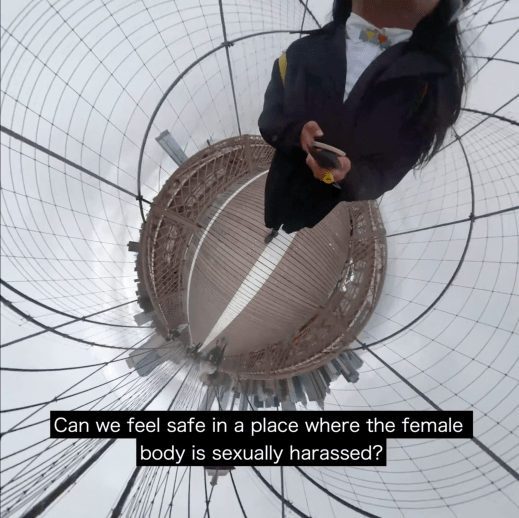
 Since its inception at the World Soundscape Project in the 1970s, soundwalking has emerged as a critical method for sound studies research and artistic practice. Although “soundwalking” now describes a diversity of activities and purposes, critical discussions and reading lists still rarely represent or consider the experiences of people of color (POC). As Locatora Radio hosts Diosa and Mala have argued in their 2018 podcast about womxn of color and the sound of sexual harassment in their everyday lives and neighborhoods, sound in public space is weaponized to create “sonic landscapes of unwelcome” for POC.
While we often think of soundwalks as engines of knowledge production, we must also consider that they may simultaneously silence divergent worldviews and perspectives of space and place. In “Black Joy: African Diasporic Religious Expression in Popular Culture,” Vanessa Valdés explored alternate conceptions of space held by practicioners of Regla de Ocha, epistemologies rarely, if ever, addressed via soundwalks. “Within African diasporic religions . . . including Palo Monte, Vodou, Obeah, Macumba, Candomblé – there is respect for the seemingly inexplicable,” Valdés remarks, “there is room for the miraculous, for that which can be found outside the realms of what has been deemed reasonable by systems of European thought. There is room for faith.” Does current soundwalk praxis—either as research method, public intervention, artistic medium, field recording subject, or pop culture phenomenon—impose dominant ideas about space and knowledge production as much as—if not more–they offer access to alternatives? Are there alternate historiographies for soundwalking that predate the 1970s? Can soundwalks provide such openings, disruptions, and opportunities without a radical rethinking? What would a decolonial/decolonizing soundwalk praxis look and sound like?
Soundwalking While POC explores these questions through the work of La caminanta, video teaser. –“>Allie Martin, Amanda Gutierrez, and Paola Cossermelli Messina. To read the series from the beginning click here: Today, Amanda Gutiérrez . —JS
Flâneuse>La caminanta is a video soundwalk project, edited as a virtual reality (VR) interactive environment that I created using a 360-degree camera to document participants’ journeys. Its title emphasizes a missing word in the French and Spanish languages for women as wanderers, a gap that also represents the lack of inclusive public spaces that allow female-identifying and non-conforming bodies safe passage and co-existence. The VR environment exposes the perspective of four women of color who navigate urban landscapes in Mexico City, Abu Dhabi, Manhattan and Brooklyn. The participants selected their own locations, building from places that have a personal meaning or memory in their everyday journeys.
Walking in Lightness
This post discusses Flâneuse>La caminanta, its influences, previous iterations, and use of the methodology of the soundwalk as an intervention exposing the dangers inherent in public space for women of color. To begin, Flâneuse>La caminanta is the virtual reality iteration of my previous film essay and photo series, Walking in Lightness. Walking in Lightness departs from my experience walking in the neighborhood of Sunset Park, Brooklyn. The soundscapes I recorded during soundwalks became a pivotal medium for offering subtle observations of a woman’s cultural identity, recording my interactions and tracing a psychogeographic path as the camera navigates urban spaces.
The sonic component of Walking in Lightness reflects my subjective experiences of recognizing sonic signifiers such as the Spanish language, music genres and what Barry Blesser and Linda-Ruth Salter call “auditory icons” (“Ancient Acoustic Spaces,” The Sound Studies Reader, 187). Auditory icons are sonic events that contain special symbolic meaning not present on the sound wave but reconstructed through cultural codes. While walking in these places, my recognition of the visibility and invisibility of cultural interpretations can be perceived inside the multicultural neighborhood of Sunset Park, where Muslim, Latino, and Chinese populations share the space.
.
Walking in Lightness’s soundwalks functioned as an anthropological tool where they indicated how my engagements with space are personal, often amplifying dissonances in the acoustic journeys when my embodied memories surfaced past associations with the sonic landscapes I traversed. I recorded each soundscape with binaural headphones. The sound was a vast fabric of cultural codes such as the popular music from the immigrant neighbors, the chants from a mosque, the voices of the men talking at us, which allowed me to reflect upon my embodied sound in the public space, through my conversations, breathing, and my disposable 35mm camera’s sounds.
I used the camera to compile images of placemaking marks such as stores using speakers in the sidewalk to attract their clientele, the sound of the paletas cart, adds of Mexican norteño bands, associating them with the sound landmarks that I found “readable” or familiar, such as conversations in Spanish, either by passing or my own interaction with street vendors, the radio tuned in a Latino station. While developing the project, I decided to use the images in the installation, so I learned the photo print process in the darkroom of the International Center of Photography, ultimately deciding on silver print techniques because of the indexical materiality and the elaborated manipulation of light in the 35 mm film printing process. This allowed me to have a meditative experience about the memory of sound and the connection with still images.
The long evenings and very exhausting printing process in the darkroom opened an introspective process confronting my role as an artist/ethnographer and challenging me to reckon with my own reasons for immigration to the United States. I had been living in Chicago, Illinois and currently in Brooklyn, New York since 2002, exploring the relationship of placemaking in the Mexican neighborhoods of Pilsen and Sunset Park. My reflections opened up for me the issue of the systematic gender violence present in Mexico as well in other countries, where women’s rights are still in an even more precarious condition than the U.S. I then used the photo prints as the materials of the cutout animations for the visual accompaniment to Walking in Lightness, and they symbolize my personal and intimate reflections of sensing the vulnerability—and the normalizing of—gender violence as a woman of color in U.S. public space.

Photo of the exhibition the of the solo exhibition, Walking in Lightness at The Camera Club of New York in Baxter Street Gallery, Manhattan, New York.
Where the Flâneuse walks
Flâneur: from the French noun flâneur, means “stroller,” “lounger,” “saunterer,” or “loafer.” The flâneur was, first of all, a literary type from 19th-century France, an imaginary character from the streets of Paris, which carried a set of rich associations such as the man of leisure, the idler, the urban explorer, the connoisseur of the street.

Paul Gavarni, Le Flâneur, 1842, Image via Wikipedia
The concept of the “flâneur” has been an essential figure in French writers’ novels such as Honoré de Balzac and Victor Fournel. However, Walter Benjamin defined Baudelaire as the ultimate flâneur in 1935, an individual poet that experiences and describes the modern city. Some consider Baudelaire the creator of modern poetry since his literature describes his personal experiences in the urban context while transiting and exploring the bohemian life of a male writer in salons and intellectual circles. Via Baudelaire, Benjamin cemented the image of the flaneûr as a bourgeois white male who can wander in the streets in late evenings and without much concern for his endless luscious time while on urban explorations.
Lauren Elkin widely explores this observation in her book, Flâneuse: Women Walk the City in Paris, New York, Tokyo, Venice, and London. Elkins begins by narrating her experience of spatial isolation living in suburban New York, unable to walk on the streets without seeming odd or calling suspicious attention; later she explores Paris as a writer who links her memories with other nineteenth-century female writers, whose practice of walking represented a primordial tool but also a constant struggle with danger.
The most pointed realization for me while reading Elkins was that in the French and Spanish vocabulary we do not define the concept of “the walker” /“flâneur” as a female subject (although these terms are supposed to be gendered neutral in both languages). However, there are other words in Spanish such as “pilgrim” that can be written as “peregrina” which functions as a referent to the female gender but also as an adjective. However the first pilgrims in the history of the Christian religion were women, such as the case of the noble Egeria, who embarked in the late 4th century in search of the Holly Places described by Saint Helene. From Mesopotamia to Syria, Constantinople to Jerusalem, Egeria narrated her impressions of her trips in the form of letters, titled Itinerarium Egeriae. She did not walk alone, however; as part of the imperial family, she walked with a court of people.
Nevertheless, Egeria’s trips were an early sign of independence and autonomy that would be taken away as women’s oppression increased with the rising power of Christian ideology. Although separated by centuries, Elkin and Egeria write from a perspective of privilege in societies where the concept of the women’s choice existed, allowing them to claim their autonomy by leaving their respective hometowns, and carrying with them the economic stability to secure their walks around the globe.
Feminicidio
In countries where gender equality remains elusive and all but nonexistent, however, it is difficult to imagine a woman wandering the streets during late evenings without being considered easy prey or a prostitute. Alternatively, an independent woman who walks alone on the streets in the late evenings in the contemporary moment represents a symbolic danger for the ruling patriarchy, a bold challenge to its power and domination. In countries like Mexico for example, walking and habituating in public space had been steadily becoming more dangerous, since women are being assaulted, kidnaped, and killed. These violent acts defined as femicides, which are turning into a profound issue that has risen alarmingly in the last few years, not only in Mexico City but also in all of Latin America. Femicide or “feminicidio” in Spanish is the term for a gender-based hate crime perpetrated against a female-identified subject, often with a clear sign of abuse and violence whether from the victim’s closest social circle or something like the intricate networking of human trafficking or the drug war conflict. In most cases, these homicides are gruesome and violent acts, ending in deaths that involve torture, rape, and sadism.

Image by Flickr User Encuentro de Feministas, “Alerta feminista,” Fotografía: Valentina Vaccotti (CC BY-SA 2.0)
According to the statistics and reports by the UN Women initiative, fourteen of the countries with the highest numbers are from Latin America, and femcide is considered as a systematic killing phenomenon. The main issue is that these crimes are not being persecuted or have a proper investigation perpetuating endless impunity. Many perpetrators do not receive any legal consequence of their acts, turning it as a consequence that normalizes gender violence by the “machista” denial of the woman’s autonomy and therefore misogynistic reactions ending in murderous acts. Machista, comes the Spanish word “Machismo” [maˈtʃizmo]; Portuguese: [maˈʃizmu] (from Spanish and Portuguese “macho,” male), and describes the gender construction of masculinity, either as superior or entitled of power over other non-male subjects.
In 2017 in “Take five: Fighting Femicide in Latin America,” Adriana Quiñones, UN Women´s Country Representative in Guatemala testified that “In Latin America, we have a culture of high tolerance towards violence against women and girls. You see it in the media all the time—crimes against women are exhibited with very crude images and nobody seems to care about it. Violence becomes normalized; it is seen as a part of life for women.” Images on the Internet and newspapers constantly mine the collective memory with alarmist news, turning the victim’s identity into images of bodies without a name and mundane numbers.
Mexican geophysics and activist Maria Salguero is actively searching for the name of these victims, searching for trustable newspaper sources reporting each case in order to create a dynamic map called Feminicidios en Mexico where she documents day-by-day cases of femicide. For each victim, Salguero creates data, highlighting the woman’s name, location, date, and circumstances of her death, as well as possible perpetrators reported by the local news. Salguero’s project creates awareness of the increasing problem, which the Mexican government is trying to ignore and publicly misinform not only its population by hiding the real numbers of these crimes, but international organizations as well.

Still photograph from the digital map, Feminicidios en México by Maria Salguero.
In her online platform, Salguero uses Google Maps toward the goal of having a comprehensive and visual database that highlights and traces each case that is not always documented on the local forensic center, and therefore not reported in the National System of Public Safety in Mexico. Salguero’s use of digital cartography provides crucial information about the increasing numbers, by tagging each year from 2016 to 2018 by color. Red crosses, for example, signify those murders committed in 2018, currently the vastest color in most states of Mexico. Created as a personal initiative of Salguero, Feminicidios en Mexico is exceptionally relevant to understanding the present and future trends of violence in each location, as well as the modus operandi of many of these femicides, exposing the general framework of the gender hate crime as an epidemic problem in Mexico.
My project Flâneuse>La caminanta departs from the acknowledgment of the vulnerability of the female body in the public sphere, employing technology to reflect and trace memories. It uses the concept of space and location as a reflective tool to expand the concept of “cartography” to include how women-identified subjects internalize the effects of violence against them. I use of mapping feeds to visualize the invisible, the forgotten, or the free customs that perpetuate gender violence. My artwork explores digital and analog cartography, from personal drawings of walker participants to metadata information displayed in an online map, which serves as subjective cartography.
When Buildings Speak
My work process building toward this new understanding of cartography can also be appreciated in When Buildings Speak, a piece I developed in 2016 at The Bolit Contemporary Art Center in Girona, in which residents (and myself as a guest artist) identified the relationship of tourism and displacement in the city. When Buildings Speak was embedded in a dynamic online map and displayed on the ETAC digital art catalog, which allows online users to listen to city residents’ interviews explaining their particular experiences of and critical views on the tourism culture industry. Using the most popular attraction in Girona–the the city’s medieval wall—I embedded these interviews and on-site soundscapes in an interactive map linked to personal residents’ opinions on concepts related to arts and education, urban design, city’s identity/memory, affordable housing, and culture industry.

Picture 4, left the side, Touristic Itinerary map published by the Girona City Council of the medieval section of the city.

Picture 5, on the right side, participant’s sketches of their soundwalks using the touristic maps to draw their sonic experiences.
The interviews and testimonials developed through collective soundwalks and drifts (dérives) with local participants: from middle school, high school, and college students, as well as the general public to the museum. The multiple perspectives helped the project to identify the complexity of the economic and social influence that the tourism industry has on the lives of Girona residents, as part of the Catalonia region.
Flâneuse>La caminanta
The project Flâneuse>La caminanta combines these mapping strategies, with the use of collective walks and subjective cartographies. Here, participants and I trace normative aspects of gender violence rendered in everyday life, but especially sited in public spaces where female bodies feel unsafe and vulnerable. Flâneuse>La caminanta’s development starts with soundwalks in public spaces and documenting conversations with self-identified female collaborators, using a 360 camera and lavalier microphones. The interviews will be part of a virtual reality documentary with interactive features. It starts with a menu located in a photo darkroom as an introduction and link to each participant’s journey. The virtual reality environment was developed and produced as part of the Harvestworks AIR 2018 program in New York City.
Flâneuse>La caminanta’s virtual journey takes the user to an individual interviewee’s walk in a public space where they feel sonically unwelcome or unsafe, making use of psychogeography as a tool to navigate and to listen to the soundscapes and urban features of the location. Then, a second link takes the users to the participant’s “inner space,” the wanderlust location where participants reflect about the concept of feeling safe. The virtual environment enhances the sensorial and cultural journey of the discursive and sonic embodiment of a non-conformative body in the public space. The VR challenges the familiarity and cultural accessibility experienced in the journey while walking through public spaces in particular times and locations in the cities of Brooklyn, Manhattan, and Mexico City. The virtual environment documentary reconstructs and documents it with 360 video and binaural sound. The piece’s soundtrack consists of the editing the binaural soundscapes with voice overs from the subjects.
Flâneuse>La caminanta’s representations of soundwalks amplifies the soundscape as an embodied medium of everyday life urban space that has a profound and uneven effect on our inner space. Artists and Podcasters Mala Muñoz and Diosa Femme describe this impact as “sonic landscapes of unwelcome” in a 2017 episode of their podcast series Locatora Radio produced especially for Sounding Out!’s series “Chicana Soundscapes.” In their discussion, the hosts detailed some of the most common ways of sonic harassment that they regularly experience in the public spaces of Los Angeles, living as latinx dealing with the sexual harassment in the streets and the vulnerability and precarious safeness that the city conveys, especially for women of color. The phenomenon of sonic unwelcoming for women varies from specific contexts to cultures, and from time locations and specific individuals, which makes it complicated to identify the specificity of the harassment’s exposure, perpetrator, and victim.

Still image of the interview with Zelene Pineda. Soundwalk at the Lower East Side of Manhattan.
Flâneuse>La caminanta focuses on the soundscape of unwelcome, in the case of the non-conforming and self-identified female body transiting an environment designed, ruled, and surveilled by a patriarchal society. Female walkers frequently and repeatedly move through spaces where the male gaze perceives verbal harassment as a way of appreciation, a problem that turns into a cultural norm. In some Latin cultures, these forms of public speaking are accepted and normalized as communication, rather than verbal violence. Furthermore, when these behaviors are taken out of the context of their countries and perpetuated in foreign cultures where verbal harassment is a specific behavior of disrespect and political correctness, this behavior then stigmatizes the male immigrant as an ethnically-constructed threating figure for the white female body.
As an immigrant women of color I have experienced sexual harassment commonly and openly in both New York City and Chicago, in neighborhoods where culturally speaking this verbal communication remains accepted as part of the culture. However, in my listening it is unclear to me whether the men performing this form of harassment center their sexual expressions on women of color–to whom the cultural meaning of these words is acutely understood—or if these expressions prevail as part of the toxic masculinity that links the US to global spaces, modes of violence and oppression over all women in general, yet still most strikingly to women of color. The state disbelieves—with double doubt!–women of color, who are often punished after expressing their concerns or claiming their rights after they experience the trauma and transgression of a sexual assault. It is also evident that the human rights of people of color are of the lowest priority, with women of color being the most vulnerable. Racial targeting conveys negative connotations and signifiers.
It is essential to create an in-depth study of these female experiences of the language of harassment. We must use theories of intersectionality to understand the depth of the systematic patriarchy imposed in our social systems via political decisions. We should not center the issues of gender violence on one particular form and population, especially if they are male people of color and/or immigrants, who can quickly turn into an ethnic target and the face of the foreigner threat of the host nation. Furthermore, there are other ways women are harassed that are not necessarily related to being catcalled in the streets such as men presuming the privilege of addressing women who are alone in spaces such as bars, coffee shops, restaurants, assuming that they are always readily available to start a conversation with a stranger (and often to assume women must be gracious, kind, and even excited and perpetually “smiling” in return). While unsolicited conversations are equally a transgression of space—and an expression of male entitlement–many men in western cultures find intrusiveness socially acceptable and non-violent despite the fact that they can lead to coercion and other cases of violence in rape culture. Our interrogations of gender violence in public space, then, should be broad and open to understanding systematic methods of gender control and violence present in different contexts and cultures simultaneously.
Flâneuse>La caminanta. Walis Johnson in Clinton Hill, Brooklyn
This systematic oppression shaping the soundscapes of the unwelcome are also amplified by elements of industrial noise pollution from public housing of working-class families living near the most noise-polluted spaces: airports, for example, and aging infrastructures such as the elevated train system in New York City, which reaches high sound spectrum levels affecting the human ear permanently but also resulting in high blood pressure and body stress. In the gendered sonic realm, we layer into the unwelcoming soundscape the messages of unsolicited sexual gestures, police harassment, car honks, screams, angry drivers pointing out the masculine gender-entitlement to the space, and sounds that sonically cross the boundaries of female and non-conforming subjects in order to construct them as a weak, inferior, outcast, and/or sexualized pedestrian. Silence—or blocking the sound through headphones—Is a solution that many of us take as an option. Even if nothing is playing, just by the fact that our ears are not publicly exposed, protects us from the sonic violence polluting the public soundscapes.
Flâneuse>La caminanta, brings together multiple modalities and mediums of which the virtual reality is only one component. Since 2018, I collaborated with the artist Walis Johnson to create the multidisciplinary project, The Brooklyn League of Women Walkers with the goal of having an intersectional conversations with women of color from diverse ethnicities, ages, cultures, using the walk as analytical tool in a collective conversation. During the walks we approach ideas of how can we claim and adapt the public space as a safe place for everyone. First we develop a brief circle where participants can identify themselves, and then we bring a few questions of what being vulnerable and empowered in the public space means for each person. Then we embark the walk with the group, first tuning our ears, in which I make use of Deep Listening exercises from Pauline Oliveiros. Then we walk to key places that can highlight these facts and we embrace the conversation in the space.
My soundwalks embrace the conversations among participants, since the exercise of walking is also a vehicle of spontaneous reflections that emerge while we are experiencing the spatial navigation. After the walk we return to the space to create subjective maps of their personal experience, highlighting what could be done to improve those spaces, such as a pedestrian walk along a community garden, a school yard, a bike path instead of toll cars lots, a common place where you as a women walking in the night can shelter, etc. These ideas made us reflect that the sexual harassment can be tackled far more from call back to harassers, but develop a culture of common safeness where the city itself provides with spaces of shelter and mutual care. Developing a feminist city implies an inclusive conversation where multiple perspectives are taken in consideration through their own spatial experience.
.
The Flâneuse>La caminanta, is now exhibited as the Beta version of the VR documentary at The 2019 New York electronic Art Festival organized by Harvestworks and showcase in Governors Island in New York. The second iteration will take in consideration the performative aspects of the VR documentary. In this newer version, the sound and video montage explores the point of view of three women through the cinematic walk side conversations. The sound dialogue emphasizes their spatial memories and their experience of mobility in public and private spaces while speculative maps render a metaphor of their migratory path. The VR performance will incorporate a collaborative work of female artists working with sonic explorations and choreographic gestures, in collaboration with two female musicians who will explore the multiple possibilities of the interpretation of the meaning dialogue. The performance will be presented at the culture venue in Manhattan, La Nacional, as part of the Female Migrations art program, organized by Se Habla Español collective. Musician Cecilia Lopez will curate the second iteration to be presented at an experimental sound music festival at Roulette music venue in Brooklyn.
—
Featured Image: Still image from the Flâneuse>La caminanta, video teaser.
—
Born in Mexico City, Amanda Gutiérrez completed her graduate studies at The School of the Art Institute of Chicago, specializing in Performance and New Media. In Mexico, she completed her undergraduate studies in Stage Design at the INBA/ENAT. For twelve years, she has worked in the field of performance and sound art, fusing the two disciplines in installation projects. Among her video series is A brief history of fictions, which consists of four projects performed under the same methodology and work strategies from documentary and performance. This series has won two awards: The Fellowship Competition 2007 and CAAP 2008, and was selected as a finalist for the national award Artadia Art Chicago 2009. Gutiérrez has had artist residencies at CMM (Multimedia Center) in Mexico City, Mexico (2001), ZKM (Zentrum für Kunst und Medientechnologie) in Karlsruhe, Germany (2002), and Artist Village in Taipei, Taiwan (2009). She has also received scholarships from the Artist Residencies Program 2009 FONCA-BANFF Centre and the prize-EMARE EMAN at the residency FACT Liverpool.
—
 REWIND! . . .If you liked this post, you may also dig:
Sounding Out! Podcast #24: The Raitt Street Chronicles: A Survivor’s History–Sharon Sekhon
Sounding Out! Podcast #2: Springtime in KC: Soundwalking Kansas City—Liana Silva
El Caracol: A Stroll through Space and Time in Mexico City–Anthony Rasmussen
Share this:

SO! Reads: Kirstie Dorr’s On Site, In Sound: Performance Geographies in América Latina
 “World Music,” both as a concept and as a convenient marketing label for the global music industry, has received a fair deal of deserved criticism over the last two decades, from scholars and musicians alike. In his famous 1999 op-ed, David Byrne wrote that the term is “a none too subtle way of reasserting the hegemony of Western pop culture. It ghettoizes most of the world’s music.” Ethnomusicologists have aldo challenged the othering power of this term, inviting us to listen to “worlds of music” and “soundscapes” as the culture of particular places and times, suggesting that these sonic encounters with difference might teach “us” (in “the West”) to consider how our own musical worlds are situated in social and historical processes.
While this has been an important move toward recognizing the multiplicity of musicking practices (rather than reinforcing a monolithic “Other” genre), the study of “musical cultures” runs the risk of territorializing musical “traditions.” Linking them to geographically delineated points of origin, nations or homelands that are made to seem natural, fixed, or timeless often overlooks the heterogeneity of places, essentializing the people who make and listen to music within, across, and in relation to their ever-changing borders. The challenge for music critics and scholars has been–and still is–to delegitimize the alienating broad brush of the “world music” label without resorting to a classification system that reifies music production and circulation into exotic genres or fetishized “local” traditions.
 In her 2018 book, On Site, In Sound: Performance Geographies in América Latina(Duke University Press), Kirstie A. Dorr demonstrates a method for conceptualizing relations between music and space while avoiding the pitfalls of colonial and capitalist definitions of “culture” and “identity.” She takes the term “performance geography” from Sonjah Stanley Niaah, whose discussion of Jamaican dancehall employs this analytic as “a mapping of the material and spatial conditions of performance: entertainment and ritual in specific sites/venues, types and systems of use, politics of their location in relations to other sites and other practices, the character of events/rituals in particular locations, and the manner in which different performances/performers relate to each other within and across different cultures” (Stanley Niaah 2008: 344). Dorr looks at “musical transits” rather than musical cultures, focusing on the politics and relations within sound and performance across South America and its diasporas; one particular relation serves as the central argument of the book: “that sonic production and spatial formation are mutually animating processes” (3).
Three conceptual frames help Dorr follow the musical flows that push against national and regional boundaries sounded by the global music industry: listening, a form of attention toward the interplay of sensory content, form, and context; musicking, or conceptualizations of music-making in terms of relationships and creative practices, rather than the musical “works” they produce and commodify; and performance as “a technique of action/embodiment that. . .potentially reshapes social texts, relationships, and environments” (14-16). Through close listenings to performances in Peru, San Francisco, and less emplaced sites such as YouTube and the “Andean Music Industry,” Dorr makes a strong case for performance geographies as creative decolonial strategies, both for participants in musical transits and for scholars who imagine and invent the boundaries and trajectories of musicking practices.
***
Nearly a century after Peru won its independence from Spain, limeño playwright Julio Baudouin debuted El Cóndor Pasa, a two-act play promoting national unity through a tale of indigenous miners in a struggle against their foreign bosses. The play’s score, composed by musician and folklorist Daniel Alomía Robles, weaves Peruvian highland music into Western-style arrangements and instrumentation, and was widely received by its 1913 audience as the sound of what Peru was to become: a modern nation firmly rooted in the cultures of its indigenous peoples.
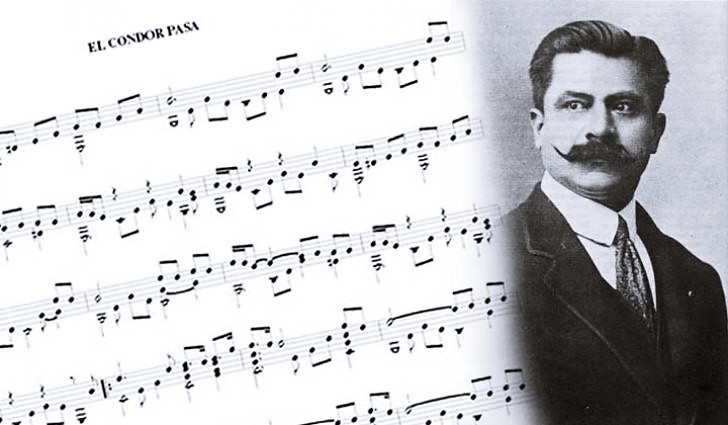
Daniel Alomía Robles
In the century that followed, the score’s homonymous ballad has been interpreted and recorded by countless artists around the world. Easily the most well-known rendition of this famous melody is Simon and Garfunkel’s “El Cóndor Pasa (If I Could),” (1970) which Dorr credits with catalyzing a Latin American music revival as well as spurring on a wave of Euro-American musicians and producers who collaborated with and brought into the international spotlight a number of groups who otherwise would have remained in relative obscurity. The tendency to see these projects as the work of (typically white) Westerners “discovering” and “saving” or paternalistically “curating” the dying musical cultures of the world, Dorr suggests, is part and parcel of a World Music concept that frames “primitive” traditions as fair game for extraction and appropriation into innovative sonic hybrids.
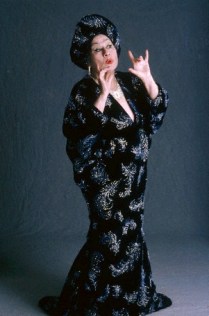
15 Nov 1991, Paris, France — Peruvian singer Yma Sumac
The “exotica” category follows the same logic, as the case of Yma Sumac illustrates. From the beginning of her career in the early 1940s with el Conjunto Folklórico Peruano to her 1971 psychedelic version of “El Cóndor Pasa,” Sumac’s vocal versatility and stylistic experimentations map out an experience of Andean indigeneity that Dorr hears in stark contrast to the narratives of the global music industry. While Capitol Records performed their own geography via their marketing of this sexualized “Incan princess,” the singer strategically composed her own sonic-spatial imaginary, not rejecting the difference suggested by “exotica,” but by synthesizing a “space-age” modern aesthetic with traditional songs. Dorr challenges us to listen to Sumac’s “El Cóndor Pasa” against Simon’s arrangement, thinking of her performative dissonances as disruptions of “the static geotemporal imaginaries of ‘authentic indigeneity’ that have most often informed the ballad’s deployment” (59).
If Chapter One makes a case for performance’s potential to shape notions of place and time, Chapter Two explores “spatial(ized) relations of musicking” (68) through a broader consideration of market strategies and the politics of sound in public space. Putumayo serves as another classic example of the global music industry’s pandering to multicultural idealism, promoting itself as “lifestyle company” that brings conscious capitalism into the curation of musical worlds. Dorr keeps her critique of Putumayo rather brief, but uses it as a convincing contrast for the focus of this chapter: the informal streams of economic activity and performance that she calls the “Andean music industry” (AMI). Among other examples from transnational and virtual “sites,” the Andean bands that performed in San Francisco’s Union Square throughout the 1990s demonstrate how performance geographies can challenge state and capitalist power while simultaneously running parallel to the marketing and distribution practices of the world music industry.
The AMI story is one of migration and the formation of a pan-Andean diaspora, of busking and bootlegging tactics that tested the boundaries of zoning and noise regulations as well as California’s immigration and labor policies, and of transposing music networks onto the internet when public performance became too precarious. It is also another case of dissonance, in which musicians willfully use their own cultural difference to their advantage, but not without consequences for poor musicians in South America; a telling example is the “Music of the Andes” CD, a mass-produced compilation used by various groups who, instead of having to record and press their own albums, could simply print their own covers for the Putumayoesque compilation and sell them to their none-the-wiser U.S. audiences (84).
But if the diasporic politics of the AMI came up short in challenging a monolithic representation of “Andean culture” or in highlighting the dynamic transits of Andean fusions such as chicha and Nueva Canción, the daily performances of street musicians in the race- and class-ordered Union Square support Dorr’s argument about the co-constitutive relationship between sound and space: “This unmediated display of embodied and sonic ‘otherness’ threatened the coherence of the square’s representational function by converting it into a spectacle of work and play for a population upon whose concealed labor the economic foundations of California’s wealth largely depend: undocumented migrant workers from the global South” (81).
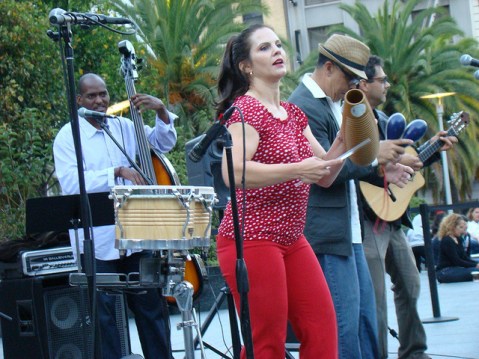
Busking in Union Square, 2013, Image by Flickr User Dr. Bob Hall
Elsewhere in 1990s San Francisco, musicians, artists, and activists formed a collective that, like the busking Andean groups, challenged dominant notions of public and private space while performing its own transnational and migratory experiences of Latinidad. In Chapter 4, Dorr relates the story of La Peña del Sur, a grassroots organization in the Mission District and, like the many anti-imperialist peñas popular throughout Latin America since the 1960s, a space for artists to perform or display their work for local audiences. While this peña provided a community for undocumented immigrants and local residents threatened by gentrification, it also served as an unsettling force against the sort of geographies that separate “queer space” from “heterosexual space” without regard for how these neighborhoods are also classed and racialized.
The founder and director of La Peña del Sur, Chilean exile Alejandro Stuart, was among several queer community members whose efforts constituted their shared space as a challenge to normative boundaries, a site for musicking that engendered dialogue among a wide range of people with divergent visions and motivations. Community organizers and students of cultural sustainability would do well to read Dorr’s account of this decade-long experiment that “enabled the exploration of sound-based solidarities rooted in the identification of common historical and political ground through improvisation and participatory performance” (168).

Victoria Santa Cruz, Image courtesy of Flickr User “Traveling Man”
Between these two compelling tales of the dynamic relationship of sound and space in San Francisco, Chapter 3 explores the significance of race, nation, gender, and sexuality within the performance geographies of several Afro-Peruvian artists. Dorr traces the movements of performers and activists who challenged the colonial boundaries that framed blackness as “antithetical to the emergent nation” (111); unlike the indigenous traditions that could be appropriated for an imagining of Peru as modern yet firmly rooted in history, Afro-Peruvian bodies and sounds were treated as contaminants within the postcolonial order.
Listening to Black feminist performance geographies, from Peru’s Black Arts Revival in the ’60s and ’70s to the recent hemispheric collaborations of “global diva” Susana Baca, one can hear the formation of not only such racially imagined communities as “the coastal” and the “Afro-Latinx diaspora,” but also of “the body.” A powerful case of this latter sort of performance is heard in the lyrics and experiences of Victoria Santa Cruz, who, in her choreographed, cajón- and chorus-accompanied poem, “Me Gritaron Negra,” contests the ways in which “[t]he physical contours of her body – her lips and skin and hair – become a geography inscribed with social meaning, an ideological imposition intended to enact and legitimate her ongoing displacement” (121).
Santa Cruz’s pedagogical and performative practices, in particular, reveal why Dorr has chosen sound – and not only broader analytics of performance and musicking – as a central theme to explore in terms of its relation to places and bodies. While this book might leave a few sound studies scholars wanting more elaborate description of particular sonic phenomena or ethnographic consideration of how sound is imagined among Dorr’s interlocutors, a few examples in particular are keys to thinking about how sound signifies, and is signified by, racially mapped bodies and places.
Most intriguing here is a discussion of Santa Cruz’s 1971 book, Discovery and Development of a Sense of Rhythm, which outlines the artist’s approach to “listen[ing] with the body” and tuning in to “rhythm’s Afro-diasporic logics” (116). A pedagogy and practice developed well in advance of Henri Lefebvre’s theory of rhythmanalysis, Santa Cruz’s concept of ritmo–internal rhythm— deserves consideration alongside the work of Amiri Baraka, Jon Michael Spencer, Fred Moten, and Daphne Brooks as crucial for thinking about how Black aesthetics and diasporic sensibilities are cultivated through sound and capable of mobilizing new mappings of bodies and their worlds.

Victoria Santa Cruz, still from el programa de La Chola Chabuca. (Video: América TV)
On Site, In Sound also calls for renewed thinking on sonic-spatial relations and the meanings that emerge from within them – how the sounds of particular Latin American voices and instruments come to be understood as masculine or feminine, indigenous or modern, exotic or local. Although “sound” as a specific performative or sensory medium might seem, at times, only one among many phenomena examined within the book’s threefold conceptual framing – listening, musicking, and performance – Dorr weaves it throughout her own performance geography where it takes on multiple forms and scales, challenging even the very boundaries defining what sound “is.” More importantly, this is a geography that scholars of “the sonic” or “music worlds” should read (and hear) as a reminder of sound’s unique ability to create and transcend boundaries – but rarely without a great deal of dissonance.
—
Featured Image: “Gabriel Angelo, Union Square,” by Flickr User Brandon Doran
—
Benjamin Bean is a PhD student in sociocultural anthropology at The University of California, Davis. His research interests include Afro-Caribbean music and sound, food and the senses, Puerto Rico, religion and secularism, and the Rastafari movement. During his undergraduate studies at Penn State Brandywine and graduate studies in cultural sustainability at Goucher College, Ben’s fieldwork focused on reggae music, the performativity of Blackness, and the Rastafari concepts of Word, Sound, and Power and I-an-I. His current fieldwork in Puerto Rico examines flavor, taste, and marketing in the island’s growing craft beer movement. Ben was formerly a vocalist and bass guitarist with the Philadelphia-based roots reggae band, Steppin’ Razor.
—
 REWIND!…If you liked this post, you may also dig:
SO! Reads: Dolores Inés Casillas’s ¡Sounds of Belonging!–Monica De La Torre
SO! Reads: Roshanak Khesti’s Modernity’s Ear–Shayna Silverstein
SO! Reads: Licia Fiol-Matta’s The Great Woman Singer: Gender and Voice in Puerto Rican Music–Iván Ramos
Share this:


Current Top Posts





April 2021

January 2020

November 2019

October 2019

August 2019

April 2014

November 2017

March 2015

December 2017

October 2015
 Sounding Out!
Recent Comments