
Ronca Realness: Voices that Sound the Sucia Body

This series listens to the political, gendered, queer(ed), racial engagements and class entanglements involved in proclaiming out loud: La-TIN-x. ChI-ca-NA. La-TI-ne. ChI-ca-n-@. Xi-can-x. Funded by an Andrew W. Mellon Foundation as part of the Crossing Latinidades Humanities Research Initiative, the Latinx Sound Cultures Studies Working Group critically considers the role of sound and listening in our formation as political subjects. Through both a comparative and cross-regional lens, we invite Latinx Sound Scholars to join us as we dialogue about our place within the larger fields of Chicanx/Latinx Studies and Sound Studies. We are delighted to publish our initial musings with Sounding Out!, a forum that has long prioritized sound from a queered, racial, working-class and “always-from-below” epistemological standpoint. —Ed. Dolores Inés Casillas
—
My Puerto Rican grandmother used to sing Pedro Infante’s “Las mañanitas” to all the women in the family on their birthdays, so naturally I grew up thinking this was a Puerto Rican song. Not quite – it’s Mexican. When my family came to New York City from Puerto Rico in the 1950s, they were starved of warm waters, mountains, and family members, but they were not starved of Spanish-language music and media thanks in large part to Mexico’s Golden Age of Cinema. In the Bronx, Puerto Ricans would go the theaters to watch movies like Nosotros los Pobres (1948),which popularized boleros like “Las Mañanitas.” This movie-going ritual in the wake of relocation and diaspora has provided the birthday soundtrack to my life.
My mother grew up listening to her father sing boleros, and she would later sing with the Florida Grand Opera Chorus when I was a child. My early knowledge of opera came from her. Growing up in Miami Beach, I would also listen to reggaetón and hip-hop in afterschool programs. The Parks & Recreation department would host dances for us, and that was where I first learned to dance perreo. My early musical surroundings represent what it means to be a colonial subject, to hear the Italianate vocal legacies of opera mixed with the Afro-Diasporic and Indigenous rhythms of reggaetón. This post contextualizes my experience within bolero’s colonial history and legacy particularly its operatic disciplining of brown and Black bodies and voices. Reggaetóneras provide models for sonic subversion by being ronca, raspy, or breathy, and thus overriding internalized Eurocentric dichotomies of feminine and masculine vocal timbres.
When I began my own operatic training in college, I was constantly told to “purify” my voice, to resist vocal “fry,” and to handle my acid reflux by avoiding spicy foods. I was steered away from singing the pop songs I had grown up with, and kept many musical activities secret, like when I soloed for the tango ensemble and my a cappella group. In graduate school, thanks to my Latina roommates, I began listening to reggaetón again. I reunited with the voices that raised me and was reassured that their teachings of resistance would always present themselves when I needed them.
After 20 years of listening to Ivy, I have located the descriptor that most closely encapsulates the way her voice sounds to me: ronca. This is Spanish for hoarse, and in my experience, it’s been used colloquially, mostly by women, to describe moments when their throats might feel sore, and their voices sound raspy, or masculine, even. Ronca has been articulated as an epistemology of vocal sounding in the artistry of lower-class Black reggaetón creators like Don Omar and more recently, Ozuna. Sounding ronca is a signifier of realness, of truly knowing the struggle of race and class oppression. It is a vocalization of full-body rage fueled by poverty and colonization.
Ivy’s voice is so special to me because she sounds like my aunt when she’s had a long day, my mom when she’s yelling, and my grandma after years of having long days and yelling at people. She sounds like the raw, unfiltered power that comes from exhaustion. She sounds like inner will and justified fury. She sounds like yelling at landlords and ex-husbands for hot water and child support. She sounds like age. And she always has, even when she was “young.” And this sound is even more beautiful and life-giving to me after 4+ years in a classical voice program that told me it was bad to sound hoarse or raspy, surveilled my eating, and perpetuated the colonization of Native and Black peoples through musical subjugation.

Operatic training utilizes mechanisms that are opposite of what is “natural” for me as a poor Latina from the barrio. It asks me to lift my voice, clarify it, and feminize it. This, to me, is antithetical to the girl who laughs really loudly, gets raspy often from yelling and eating too many Takis, and loves to sing from her chest. Ivy’s voice empowers my place as the antithesis. Even as I sang classically in college, my voice was still often described as “soulful,” “hoarse,” “raspy,” “throaty.” My voice, although in a moment of attempted cleanup in college, was read as having previously engaged in genres that disrupt colonial dichotomies of “art” and “noise.” The sonic Blackness– in particular the exoticized and tropicalized Blackness of Latinidad in the U.S.- of my timbre was legible, and perhaps even hyper-audible, in moments when I was trying to adapt to European art forms. Raquel Z. Rivera asserts in New York Ricans from the Hip Hop Zone (2003) that Latinidad doesn’t take away from Blackness but adds an element of exoticism to the Blackness. Thus, I have come to understand ronca voices as representative of a Latina/e liberatory sonic and embodied praxis that resists the derogatory discourse around racialized voices predicated on European ideals of cleanliness.
The ronca voice is negotiating suciedad, Deborah Vargas’ analytic for how queers of color may reclaim their abject bodies and social spaces. Readings of my voice in predominantly white spaces were contextualized by my queer ambiguously-brown body, which in direct opposition to whitening regimes, was sounding suciedad. This is what ronca voices do, and what I conceptualize as “ronca realness”: the tendency of Latinas/es to not hide behind the voice but rather keep it real with the audience via their vocal timbre. Ronca voices sound another option to Barthes’ hegemonic article “The Grain of the Voice,” which has been applied to Ivy Queen and Don Omar in Jennifer Domino Rudolph’s “‘Roncamos Porque Podemos,’” and Dara Goldman’s “Walk like a Woman, Talk like a Man: Ivy Queen’s Troubling of Gender.” I intend ronca realness to be understood as a queer of color vocal analytic born from community and lived experience.

Ronca voices reflect emotional states, flip colonial gendered vocal scripts, reveal if the singer had coffee that morning and Hot Cheetos the night before, and navigate tough musical contours with strain and stress; most importantly, they refuse to be white(ned). In college, my ronca realness was not always a choice. Keeping it real, in general, is sometimes undecided upon prior to the act of realness; it is an additional and deeply engrained responsibility that queer people of color have in white spaces to sound their dissent, or else face the continued exploitation of their communities. Further, these acts of realness may not even be legible as such but are often coded as bad behavior or an attitude problem.
Within communities of color and (im)migrant communities, it’s important to recognize that Ivy Queen’s ronca timbre was permissible because she was light-skinned, thin, and usually took on the masculine role of the rapper, rather than the feminine role of the dancer, in several of her videos. These privileges have left Afro-Latina ronca reggaetóneras like La Sista in the shadows.
La Sista has veered away from sounding ronca in recent years, but in her debut album, Majestad Negroide (2006), she praised Yoruba goddess Yemaya and Taino cacique Anacaona with a hoarse, raspy, bold sound. She is the Afro-Indigenous Latina many of us needed growing up, and her absence speaks to the ways in which Black ronca voices are policed and erased within Latinx culture and elsewhere. Let us praise her now.
—
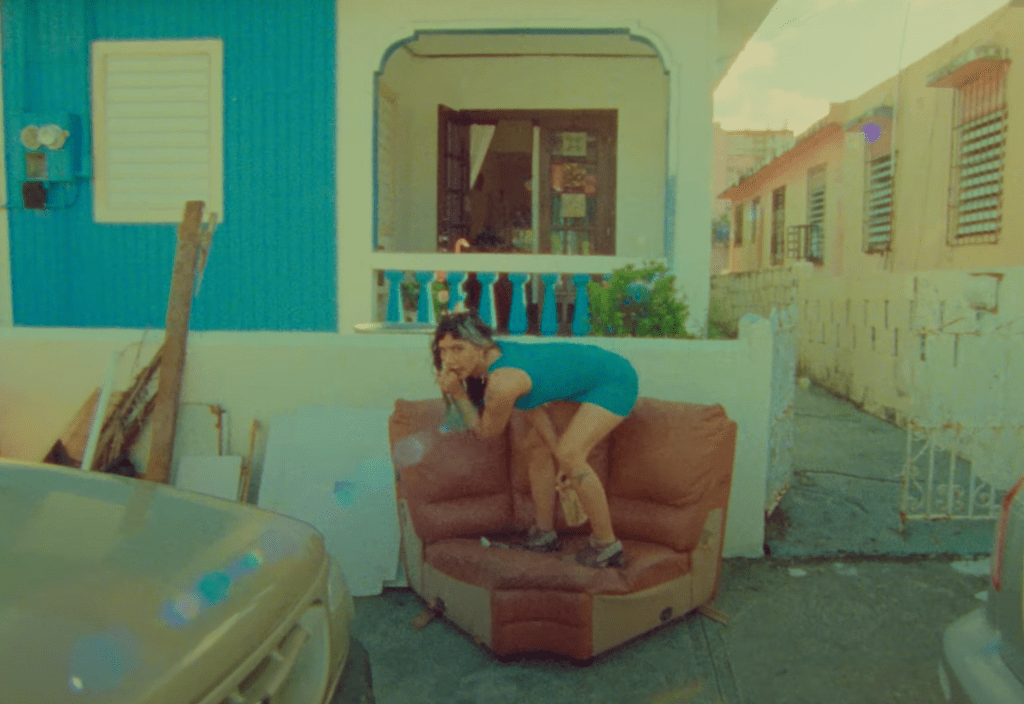
Featured Image: Still image by SO! from RaiNao’s “Tentretiene”
—
Cloe Gentile Reyes (she/her) is a queer Boricua scholar, poet, and performer from Miami Beach. She is a soon-to-be Faculty Fellow in NYU’s Department of Music and earned her PhD in Musicology from UC Santa Barbara. Her writing explores how Caribbean femmes navigate intergenerational trauma and healing through decolonial sound, fashion, and dance. Cloe’s poems have been featured in the womanist magazine, Brown Sugar Lit, and she has presented and performed at PopCon, Society for American Music, International Association for the Study of Popular Music-US Branch, among several others.
—

REWIND!…If you liked this post, you may also dig:
Contra La Pared: Reggaetón and Dissonance in Naarm, Melbourne—Lucreccia Quintanilla
“How Many Latinos are in this Motherfucking House?”: DJ Irene, Sonic Interpellations of Dissent and Queer Latinidad in ’90s Los Angeles—Eddy Francisco Alvarez Jr.
Unapologetic Paisa Chingona-ness: Listening to Fans’ Sonic Identities–Yessica Garcia Hernandez
SO! Podcast #74: Bonus Track for Spanish Rap & Sound Studies Forum
Cardi B: Bringing the Cold and Sexy to Hip Hop—Ashley Luthers
Share this:

SO! Amplifies: Immigrants Wake America Podcast and the Work of Engaged Digital Humanities


SO! Amplifies. . .a highly-curated, rolling mini-post series by which we editors hip you to cultural makers and organizations doing work we really really dig. You’re welcome!
—
Conceptualized at a time of rampant increase in anti-immigrant violence, Immigrants Wake America is a creative response to the growing bias and violence against immigrant women in the U.S., as seen in the Atlanta shootings, the rise in hate crimes since the onset of Covid-19, and the US-Mexico border crisis. We believe that storytelling allows us to find similarities and differences between ourselves and others, offering a humanizing counterpart to harmful media narratives. The podcast creates a living archive of stories not yet heard, serving as an audio intervention into how immigrant women’s (hi)stories are narrated and passed on.

Immigrants Wake America is a public humanities, community-engaged project of digital storytelling through podcasts, in partnership with the Tenement Museum in New York. It features storytellers who share their family stories about migration and the centrality of women in their life histories. These storytellers have submitted stories to the Tenement Museum’s digital archive Your Story, Our Story (YSOS),
Founded in 1988, the Tenement Museum, focuses on immigration and immigrants to “foster a society that embraces and values the role of immigration in the evolving American identity.” YSOS cofounded by Annie Polland and Kathryn Lloyd, is a digital archive that houses stories associated with immigration, migration, and cultural identity. Some of the storytellers are first generation immigrants, while others are descendants of immigrants, born and raised in the US; their great-grandparents or grandparents migrated to the US ages ago. Through YSOS, the Tenement Museum invites people across the country to share their stories in the online digital storytelling exhibit. Each story reveals one individual’s experience. Together, the stories help us see how the unique histories shape the nation, and the patterns that bind us together.
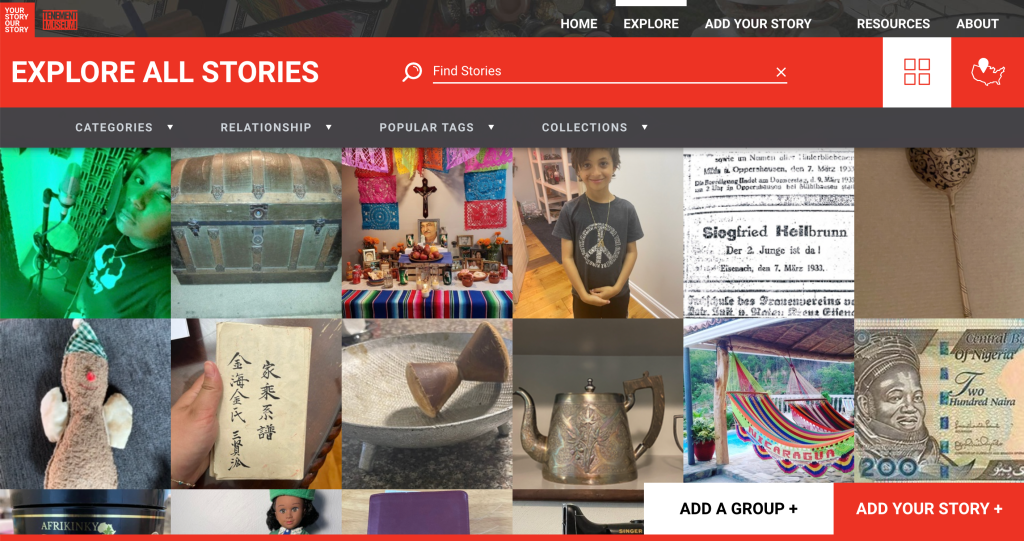
Through exploring and curating stories from Your Story Our Story, we facilitate conversations that supplement and expand it. This makes possible the conception of an archive that is both dynamic and collaborative. Such an archive resists the colonization and appropriation of lives and narratives of our storytellers. We navigate through the ethical conundrums that one might structurally and personally face in this collaborative endeavor. In our engagement with the archives at the Tenement Museum, we believe that our podcasting project really opens up the possibilities for an expansion of the archive.
We released our first episode, the Introductory Episode on January 15th, 2022, and have since been consistently releasing one episode per month.
While our podcast does not claim to retrieve or lay out these microhistories in their entirety, at an early stage of its development, we came to realize the potential that the form of the podcast itself offers for a different kind of storytelling. In our podcast, we treat stories as primary documents instead of marginalia. Michelle Caswell (2014) uses the term “symbolic annihilation” to describe the absence or misrepresentation of marginalized communities in archives. She advocates the powerful forces of community archives in countering “symbolic annihilation.” In thinking about archives in The Archaeology of Knowledge, Michel Foucault is concerned with “the density of discursive practices” wherein he observes “systems that establish statements as events and things (145)” This system of statements (as events or things) is what contributes to the law of what can be said. Processes of digital communal archiving such as those done by South Asian American Digital Archive (SAADA) or the Tenement Museum attempt to extend or expand the systematic possibility of events and things. Caswell and her colleagues have demonstrated the importance and success of the SAADA project. They have also pointed to the impossibility of representation in a traditional archive which is built on violence committed on colonized and enslaved bodies, also eloquently pointed out by Saidiya Hartman’s scholarship.
Through our experience we’ve learnt that podcasts can serve as a transgressive-dynamic expansion of digital archiving, given their unique ability to cut across racial and gendered lines of preconceived sonic notions and their potential to expand the current techniques and media of digital archiving. We map this formal potential of the podcast in the way it intersects with digital archiving in the following ways:
First, narratorial voice.
We wanted our project to act as an intervention in the way in which immigrant women’s (hi)stories are consumed and passed on. We wanted to provide counter narratives. It was essential that the storytellers share their stories in their own voices, literally! The audio medium allows us to produce a space for listening to voices that are otherwise marginalized and/or demonized.
–Le Li and Shruti Jain
Among the several unique and inspiring stories of resilience that the Tenement Museum houses, one such is a story by an immigrant case manager at the American Civic Association in Binghamton, Goretti Mugambwa. The museum and our podcast make it possible for her story to be narrated by herself in her voice. With her experience of working with the refugee and immigrant community she also does not just remain an individual voice, but acts to further a collective assertion.
Next, sonic variations.
Our storytellers’ voices are not just “characteristics” of the story but are an essential part of the story itself. We believe that each immigrant and their descendent brings to the story their unique tonal texture. This diversity destabilizes what immigrants and their descendants are expected to sound like. The sounds we add in the editing process are minimal. We try not to impose emotional cues and responses upon our listeners.
–Shruti Jain and Le Li
The multiplicity of voices in our podcast–and therefore in the archive–are not just “characteristics” of the aural storytelling or listening process, but are as much an essential part of the story itself. In line with what The Sonic Color Line reminds us, our work also finds that, “sound frequently appears to be visuality’s doppelgänger in U.S. racial history” (Stoever 4). This leads to the coding of race as not just visual but aural too. We want to clarify that the white constructed ideas of how people of color must sound flatten out the complexities in how people within and across communities do sound. At the same time, these notions of white sonic normativity also create a strong sense of what one must or must not sound like in order to succeed in the racial capitalist world order. The storytellers of our podcast and we ourselves are of diverse backgrounds. This, for us, is a way to demonstrate the “complex range of sounds actually produced by people of color” (Stoever 43). As Nancy Morales argues in “Óyeme Voz: U.S. Latin@ & Immigrant Communities Re-Sound Citizenship and Belonging,” the sound of ‘everyday voices’ mobilized against—and remarking on—the nation-state’s attempts to mark immigrant communities as vulnerable exerts an impactful and profoundly material agency.” With its conversational and collaborative format, our podcast serves as a dynamic medium to represent (his)stories that complicate generic conventions in critical ways.
Then, collaboration.
We have also been personally deeply impacted by the process of working on this podcast. We have made lasting bonds with our colleagues and storytellers alike. The storytellers of our podcast act not just as guests, but as collaborators and stakeholders. Instead of interpreting the stories in our own way and retelling the stories, we collaborate with the storytellers, and facilitate the unfolding of hidden stories by the storytellers. Dr. Lisa Yun, Professor of English at Binghamton University, and Kathryn Lloyd, Senior Director of Programs, Tenement Museum, have been advisors and the executive producers of the podcast. Together with Lloyd and Yun, we built a project on the ethos of collaboration.
The editing process of IWA too, is different. Rather than making individual editorial decisions, we engage the storytellers directly in post-production. After finishing a first edit of an episode collaboratively between ourselves, we then send it to the storytellers for their feedback and approval before releasing it. Sometimes, the storytellers do suggest changes. Based on their feedback, we re-edit the episode and eventually release it after the storytellers approval. We have also innovated methods of community editing, where we edit in groups of as large as 15 people.
Finally, accessibility.
The podcast medium makes Immigrants Wake America an ideal project for the public humanities. As opposed to lengthier podcasts, each episode of our podcast is edited down to 15-20 minutes. These can be used by educators as an in-class resource to generate discussion and activities. Community listeners could tune in during lunch breaks, get-togethers, cooking, driving or doing chores. Our episodes can also serve as conversation starters and help facilitate affective bonds among immigrants and non-immigrants alike.
The final episode of our first season, “Finding Our Grandmother in the Records,” aired just last week, and a second season is in the works.
As a way to expand this project, our second season will feature storytellers from our local community in addition to Your Story, Our Story. We plan to have units within our project dedicated to translation, recording and editing, and creating teaching resources. We aim for meaningful and engaged conversations and try to blur the supposed boundaries between the university and the community. Join us!
—
The first season of Immigrants Wake America was sponsored through the Institute for Advanced Studies in the Humanities at Binghamton University and a Public Humanities Grant from Humanities New York. Dr. Lisa Yun, Professor of English at Binghamton University, and Kathryn Lloyd, Senior Director of Programs, Tenement Museum, have been our advisors and the executive producers of the podcast. IWA is available on major streaming platforms such as Spotify, Google Podcasts, Apple Podcasts, Amazon Music, Soundcloud, and Audible.
—
Le Li and Shruti Jain are pursuing their PhDs at Binghamton University in the Translation Research and Instruction Program and the English Department respectively. They were Humanities New York Public Humanities fellows (2021-22) and graduate fellows of the Institute for Advanced Studies in the Humanities (IASH) at Binghamton University (2021-22). Through their podcast project and their work with digital community archives, Le and Shruti are currently working on exploring intersection between podcasts and digital archiving. They try to capitalize on the unique ability that the form of the podcast offers to cut across racial and gendered lines of preconceived sonic notions, which makes possible the conception of an archive that can be both dynamic and collaborative. Le’s research interests include translation studies, cultural studies, diaspora studies, and public humanities. Shruti’s PhD focuses on the Enlightenment, British Empire and the relationalities between race and caste formations.
—

REWIND!…If you liked this post, you may also dig all this good stuff about sound studies pedagogy! Good luck with Fall semester, folks!:
“Heavy Airplay, All Day with No Chorus”: Classroom Sonic Consciousness in the Playlist Project—Todd Craig
SO! Podcast #79: Behind the Podcast: deconstructing scenes from AFRI0550, African American Health Activism – Nic John Ramos and Laura Garbes
The Sounds of Anti-Anti-Essentialism: Listening to Black Consciousness in the Classroom- Carter Mathes
Making His Story Their Story: Teaching Hamilton at a Minority-serving Institution–Erika Gisela Abad
Teaching Soundwalks in a Course on Gentrification, Black Music, and Corporate America–Rami Toubia Stucky
Deejaying her Listening: Learning through Life Stories of Human Rights Violations– Emmanuelle Sonntag and Bronwen Low
Audio Culture Studies: Scaffolding a Sequence of Assignments– Jentery Sayers
Deep Listening as Philogynoir: Playlists, Black Girl Idiom, and Love–Shakira Holt
“Toward A Civically Engaged Sound Studies, or ReSounding Binghamton”–Jennifer Lynn Stoever
Listening to #Occupy in the Classroom–D. Travers Scott
SO! Podcast #71: Everyday Sounds of Resilience and Being: Black Joy at School–Walter Gershon
Sounding Out! Podcast #13: Sounding Shakespeare in S(e)oul– Brooke Carlson
A Listening Mind: Sound Learning in a Literature Classroom–Nicole Brittingham Furlonge
My Voice, or On Not Staying Quiet–Kaitlyn Liu
(Re)Locating Soundscapes of Schooling: Learning to Listen to Children’s Lifeworlds–Cassie J. Brownell
If You Can Hear My Voice: A Beginner’s Guide to Teaching–Caroline Pinkston
Mukbang Cooks, Chews, and Heals – David Lee
SO! Podcast #80: Refugee Realities Miniseries–Steph Ceraso
Share this:


Current Top Posts





April 2021

January 2020

November 2019

October 2019

August 2019

April 2014

November 2017

March 2015

December 2017

October 2015
 Sounding Out!
Recent Comments