
The Sounds of Equality: Reciting Resilience, Singing Revolutions

.

SO! Amplifies. . .a highly-curated, rolling mini-post series by which we editors hip you to cultural makers and organizations doing work we really really dig. You’re welcome!
When the pandemic hit the world in late 2019, the concept of lockdown ceased the social life of the people and their communities. In these unprecedented circumstances, a video from Italy took the internet. People in Italian towns such as Siena, Benevento, Turin, and Rome were singing from their windows and balconies, which raised morale. The song “Bella Ciao,” an old partisan Italian song, became an anthem of hope against adversity. This anti-fascist song was popularized during the mid-20th century across the globe as a part of progressive movements. Following this, people in many countries around the world created their renditions of “Bella Ciao” in Turkish, Arabic, Kurdish, Persian, French, Spanish, Armenian, German, Portuguese, Russian, and within India in languages such as Punjabi, Marathi, Bangla, and even in sign language renditions. It was such an apt moment that captured the idea of empathy, solidarity, and the human need for community. This moment was still resonating with me when I was approached by Goethe Institut, New Delhi, to work on music and protest, and create The Music Library. I knew what I needed to do.
Embed from Getty ImagesThe Music Library was conceptualized as a weekly playlist of protest songs. I believe protests are not just demands but are aspirations, unfulfilled promises that truly represent the resilience of people. I could not imagine anything more beautiful than protest music to represent the world, as it amplifies human desires for connection and better days ahead. I designed it as a weekly music bulletin that people could dwell in for half an hour, and it would be like a short musical insight to that country or theme. Although the project had to be cut short due to institutional limitations, The Music Library creted 36 weekly playlists focused on liberation movements, anti-colonial struggles, people’s uprisings, and popular expressions of dissent.

The Music Library hosts two types of playlists: issue-based and country- or region-specific. This approach curates and classifies music for a broader audience attuned to these categories. When I prepare a playlist, the first thing I seek is to incorporate marginalized and diverse voices. Diversity can be based on caste, gender, language, region, and more. I typically favor field recordings, amateur productions, and emerging artists. Occasionally, the featured artists have as few as 50 views on their videos. After listening to numerous songs and consulting individuals with greater expertise, I select 5-8 songs and then write a blurb to introduce the playlist. Sometimes, I also seek help for language assistance. In that sense, it’s a very collaborative effort. The Music Library’s mission resonates with Merje Laiapea’s mapping of Ukrainian resistance to the Russian invasion through music. The Music Library similarly engages protest music, but with a wider array of areas and themes.
After the first few weeks, I decided to transition from Indian protest music to global and I wanted to foster a gradual introduction instead of a snap transition. I realized that inviting guest curators would enable the transition to linger on for a bit before settling in, and the guest curators would have a much better idea of the protest culture in their respective country and/or area of research. For example, Sara Kazmi, a scholar-activist-singer from Pakistan, curated a playlist on protest music of Pakistan; Yueng, who is researching Hong Kong music for his Ph.D, curated a playlist on The Umbrella Movement in Hong Kong. So their expertise and knowledge of respective countries give us a better sense of what protest music is for people there than I could provide on my own. Like Sara and Yueng, many of the guest curators have either been part of protest movements or have written, observed, or researched closely. Likewise, there are guest playlists by musicologist Lucas Avidan that emphasize the prominence of hip-hop music, or as some call it “Bonga flava” in Tanzanian protest music, and a playlist on MC Todfod, an emerging rapper from Mumbai Hip-Hop collective Swadesi who passed away at the age of 24. Protests themselves are essentially about bringing people together and working together. In this sense, the co-curatorial process resonated with the idea of protest music itself as a collective action.
The idea of protest is essentially an act, attitude, orientation, and assertion against the dominant conservative system. So, in that sense, its definition is as varied as the kinds of conservatism existing in societies. It could be based on class, caste, gender, race, nation, region, language, food, and culture. In short, protest music means speaking up against power. Protest music plays multiple roles for the people practicing it or whom it represents. In a highly unequal power relationship, it is like a crack or a rupture against hegemony. In others, it asserts power. For many, protest music symbolizes an idea, utopia, like one world or Begumpura, i.e., land without sorrow, in 15th-century saint-poet Ravidas from India. With old social issues such as casteism, patriarchy, feudalism still lingering around and consolidating, and capitalism and nationalism getting strongholds across the globe, the world is more fragmented and hostile. In this situation, the protest music from around the world raises some particular issues but also many universal ones, such as equality, recognition, dignity, food, housing, healthcare, education, and above all, the right to live as an equal citizen. The Music Library brings all of this protest music under a single umbrella, as all this music has one thing in common: Resilience! At times, The Music Library is a music room that soothes, and other times a war cry for equality!
Bangladesh’s playlist, for example, curated by Dhaka-based artist, Emdadul Hoque Topu, is based on Liberation War songs. The Liberation War was a unique liberation movement based on linguistic identity. So, language, a mode of expression like music, was at the heart of the movement. Interestingly, when the recent popular uprising occurred, I was in Dhaka and saw the popular resentment against the Liberation War and its icons. It shows that protest music is as evolving and contemporary as any other expressive form, one age’s protest song could later turn into a voice of the oppressor or used to oppress any dissent. For instance, Rajakars, a term that till recently had very negative connotation due to its association with the detractors of anti-liberation, has been employed and repurposed in a chant or slogan ami ke, tumi ke, Rajakar, Rajakar (who am I, who are you, Rajakar, Rajakar) for the current uprising that led to the overthrow of the Sheikh Hasina-led government.
In another instance, the historic Farmer’s Protest of 2020-21 in India–termed the biggest movement in recorded history– has led to a proliferation of music to bolster it. Though the protest started in the north Indian state of Punjab, it spread across India and drew global support. Punjab is a musically unique place; it is one of India’s most popular and prolific independent music industries. Due to early migration history, Punjabi music has spread globally and has been adaptive of derived from various musical cultures such as rap, pop, etc, while maintaining its distinct linguistic identity. This made the Punjabi music popular and relevant beyond its linguistic boundaries. The movement has been chronicled by a newsletter called the Trolley Times, where I worked as a co-editor. Numerous Punjabi singers have contributed immensely by producing music and being part of the movement. After a long time, a strong impulse in the popular cultural sphere evolved in solidarity with the mass movement.
The Music Library was under construction when the world was going through a pandemic, and unprecedented isolation, a hallmark of oppression. In the pandemic, when people were dying, this quote became popular: Corona is the virus, Capitalism is the pandemic. People could see the havoc of capitalism playing out in full public display from the first world to the third world. Someone who is cornered, pushed against the wall, with no recourse to grievance redressal, cries out to make themselves count, and find solidarity and rise. I designed The Music Library to show how music can break a slumber and bring people to march together, similarly to what “Bella Ciao” did during COVID-19.
It began as a hum that was joined by neighbors, and then it spread, loudly, across the world as an expression of solidarity and resilience. “Bella Ciao” is such a marvellous testimony of what music can do and has been doing! I hope The Music Library serves as a humble repository of this resilience.
—
Featured Image: Image of “Bella Ciao” being sung in Santiago, Chile during the ‘estallido social’ (2019) by AbarcaVasti, CC BY-SA 4.0 https://creativecommons.org/licenses/by-sa/4.0, via Wikimedia Commons
—
Mukesh Kulriya is a Ph.D. scholar in Ethnomusicology at The Herb Alpert School of Music, University of California, Los Angeles, USA. His research focuses on the intersection of music and religion in South Asia in the context of gender and caste. His Ph.D. research examines bhakti, or devotion practices within the ambit of popular religion in Rajasthan, India. Since 2010, he has collaborated on India-based projects centered around the craft, culture, folk music, and oral traditions as an organizer, archivist, translator, and researcher. He also works on global protest music and currently working on a podcast on Music and Hate.
—

REWIND!…If you liked this post, you may also dig:
Twitchy Ears: A Document of Protest Sound at a Distance–Ben Tausig
The Sounds of Anti-Anti-Essentialism: Listening to Black Consciousness in the Classroom – Carter Mathes
#MMLPQTP Politics: Soccer Chants, Viral Memes, and Argentina’s 2018 “Hit of the Summer”–Michael S. O’Brien
A Tradition of Free and Odious Utterance: Free Speech & Sacred Noise in Steve Waters’s Temple–Gabriel Salomon Mindel and Alexander J. Ullman
Singing The Resistance: January 2017’s Anti-Trump Music Videos–Holger Schulze
Share this:

Tape Hiss, Compression, and the Stubborn Materiality of Sonic Diaspora

In an article for Pitchfork, music critic Adam Ward reminisces about digital music files that sound as if they’re “being played through a payphone,” and calls the extreme compression of the low-quality MP3 “this generation’s vinyl crackle or skipping CD.” The crackles, hisses, and compression that characterize such sound files are what I term “encoded materiality.” Focusing on the encoded materiality of the digital helps us to reconfigure our approach to sonic media, understanding how the compression of early MP3s and tape hiss remind us not only of lost fidelity, but also of the richness of exchange. These warm and stubborn sonic impurities, having been encoded in our digital listening formats and thus achieving repeatability and variability, act as persistent reminders that we can think diaspora beyond melancholy and authenticity, sidestepping the questions of purity and loss that so often characterize dialogues in the field of diaspora studies.
In Mechanisms, his work on electronic textuality, Matthew Kirschenbaum proposes a “material matrix governing writing and inscription in all forms” composed of four elements: “erasure, variability, repeatability, and survivability” (xiii). The defects of sonic technology that become encoded in digital files are one such type of inscription. Tape hiss and other recording accidents–such as Casey Kasem ruining your attempt to tape record the first Western song you fell in love with after leaving Hong Kong by fading the outro and butting in with his banter–achieve repetition and survival during the digital encoding process, becoming a welcome reminder of time and place. Such materiality helps us to better understand the politics of diaspora. It clues us in to how the elements of textual encoding (erasure, variability, repeatability, and survivability) become embedded within diaspora’s complex logic.
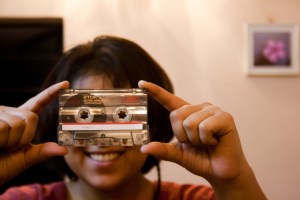
Image by DraconianRain @Flickr CC BY-NC.
To think through these complex moments of exchange, let me offer a story about my experience with tape hiss. I grew up listening to music touched by this particular sonic grain: a ground level of noise upon which my sonic experiences were built. After I received my first iPod in 2005, I connected a tape player to the input of my computer, recorded a stack of tapes, and then manually split them into MP3s—pseudo-piracy committed in earnest. A few weeks ago, I dug up these same files and put them on my phone, once again returning the buried albums to their former glory on a constant rotation playlist. I keep returning to these particular files, rather than finding the now easily available digital versions, because I admire the survivability of their materiality. The materiality of these tracks allowed me to trace the complexity of my own history—the tape hiss is just as much a part of this history as the songs themselves.
After first moving to Canada from Hong Kong, my family and I established ourselves by unswervingly performing the same routine each weekend. We would have late lunch at our favorite dim sum restaurant, drive around for a bit, and then relax at home; there wasn’t much to do in the ex-urbs of Toronto. On those drives, we listened to selections from a stack of cassette tapes in the glovebox of our old Pontiac Bonneville. Sally Yeh’s 1987 album Blessing was on constant rotation and received its fair share of wear. This was one of the tapes I recorded to my computer, destined for digitization.
Because I hit the record button a few seconds early, my MP3 of Sally Yeh’s Blessing begins with a few seconds of silence. It’s enough to trick me into thinking that the song isn’t playing. In a quiet enough spot, I can hear that it’s actually tape hiss. No matter where I am, on the road or in the shower, my mind fills in the blank with the thick ker-chunk of the cassette entering that Pontiac stereo right before that familiar tape hiss would fill the car, always giving us a few sometimes-needed, sometimes-awkward moments of silence before the music started. The sonic texture of that tape stems from its material nature as plastic and metal. The hiss itself is due to the size of the magnetized particles on the plastic. Because of these sounds, the song tells its own story. It recalls our shared sonic and material experience as I migrate it from device to device.
Before Blessing made its way into our car, it was one of the few cassette tapes that my parents carefully packed into a dozen cardboard boxes and shipped by sea to Canada in the late 1980s. This was in the midst of the countrywide protests in China that led to the events at Tiananmen Square. That insistent ker-chunk of plastic on metal that my brain inserts every time I play the MP3s keeps my experience of the music grounded in this earlier history, too. Strange that a fluffy pop song would remind me of the serious political strife taking place on the doorstep of a Hong Kong nervously awaiting its “handover.” This sonic anchor’s ability to recall to me these snippets of history, both personal, national, and transpacific has been crucial in the development of my own diasporic identity. Listening to this particular recording of Blessing helps me to keep track of my self and my history.
Ker-chunk.
The act of withdrawal that many of us perform in order to interface with our sonic technologies, as Alexander Weheliye shows in his reading of Ralph Ellison’s Invisible Man in Phonographies, can play a powerful role in understanding one’s own racial subjectivity. Weheliye focuses on the scene in which the titular narrator-protagonist retreats to a subterranean cave-like space to listen to Louis Armstong’s recorded, disembodied voice in complete solitude. He asserts that the narrator builds his own subjectivity through a recognition of the self by projecting that self onto Louis Armstrong’s “vocal apparatus,” that is, his voice coming through a phonograph (143). “The phonograph’s ability to disconnect the singing voice from its face, or rather to replace it with a technological visage, further heightens its materiality, which impels the protagonist to imbue Armstrong’s voice with a surplus of signification” (Weheliye 145).
More than a black and white photo or a stern historical lecture from the elders, the “heightened materiality” of the digital format, a type of “technological visage” cathects my own diasporic history most forcefully to the sonic anchor of tape hiss because it acts as a “voice without a face” in the same way as the phonographic Armstrong. But despite the privacy of the phonographic listening act in this scenario, Weheliye suggests that
the phonographic listening modality also bears the traces of sociality… since the listening subject is drawn out of him/herself by encountering the technologically mediated sounds of other subjects—we might even go so far as to suggest that the phonograph itself functions as a subject, especially in its interfacings with various humans. (165)
So it is with similar sonic technologies that can encourage the “eschewing [of] the social” such as iPhones, CDs, and, yes, cassette tapes. Like Ellison’s narrator interfacing with the mechanical apparatus that conveys Armstrong’s voice, the insistent “defects” kept on the digital file keep the mechanism of its delivery at the fore, allowing me first to understand that diasporic feeling of dis-ease—and to imagine beyond it.
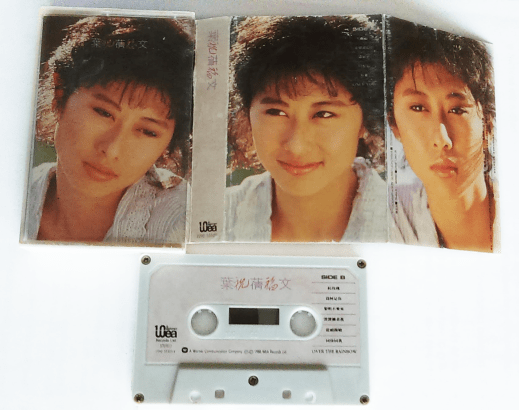
Sally Yeh’s “Blessing.” Image used with permission by the author.
What I gain from the digital yet still stubbornly material tape of Blessing is not any overt lyrical or thematic gesture to a diasporic subjectivity on the artist’s part, but rather an induction into what Giorgio Agamben calls, “the idea of an inessential commonality, a solidarity that in no way concerns an essence” (18), or perhaps a community based on “belonging itself” (84). Likewise, Weheliye’s “diasporic citizenship coarticulate[s] the national and transnational instead of playing a zero-sum game with political identification” (369). If diaspora is defined by the perpetual desire to seek an imagined originary point of true identity that inevitably leads to melancholy, as psychoanalysis maintains, tape hiss and other encoded materialities turn the gaze away from the mists of origin, validating instead the development of diasporic identity in the aftermath of emigration. Of course, loss and melancholy are legitimate psychic aspects of the diasporic experience, as persuasively demonstrated by scholars such as David Eng, Shinhee Han, Anne Anlin Cheng, but they neither define the whole experience nor are they mutually exclusive to it. It is in this way that we can think of diaspora as a community of belonging by becoming.
A consideration of the stubborn ways that materiality is encoded in the digital helps us to think of diaspora as more than psychic fait accompli—it is also a ‘coming community’ characterized by the process of belonging. Kirschenbaum’s matrix provides the right foundation for a study which considers how material inscriptions are related to our diasporic lives. The inscription that defined my diasporic becoming came from the cassette tape that travelled across the ocean in a boat for five weeks, escaped erasure, survived repeated playings, became digital, and lives on now as a hissing reminder of our history of emigration. What else may we find about our own becoming and belonging if we attune our ears to the encoded materialities of sonic diaspora?
–
Featured image “Decayed Cassette” by darkday @Flickr CC BY.
–
Chris Chien is a Ph.D. candidate in the Department of English at the University of Southern California working variously in the areas of sound, diaspora and transpacific studies, all with a distinctly queer bent. He completed his M.A. in English Literature at Loyola Marymount University and his Honors B.A. in English Literature and Latin at the University of Toronto. Chris has presented papers on angelic gender fluidity in John Milton’s Paradise Lost and post-colonial affect in the work of Herman Melville and Amitav Ghosh at the Rocky Mountain MLA and South Atlantic MLA conferences respectively. He is currently developing a paper that examines the performativity of diaspora, masculinity, and the capitalist ethos in Eddie Huang’s memoir Fresh Off the Boat and its adaptation as an ABC sitcom.
–
 REWIND! . . .If you liked this post, you may also dig:
Pushing Play: What Makes the Portable Tape Recorder Interesting?—Gus Stadler
SANDRA BLAND: #SayHerName Loud or Not at All — Regina N. Bradley
Listening (Loudly) to Spanish-language Radio — Dolores Inés Casillas
Brasil Ao Vivo!: The Sonic Pleasures of Liveness in Brazilian Popular Culture — Kariann Goldschmitt
Share this:


Current Top Posts





April 2021

January 2020

November 2019

October 2019

August 2019

April 2014

November 2017

March 2015

December 2017

October 2015
 Sounding Out!
Recent Comments