
to follow an invisible creek: in search of a decolonial soundwalk praxis

i begin with an acknowledgement of the myriad of organizers, scholars, artists, and teachers that have shaped and continue to shape the way that i think and write. Édouard Glissant, Christina Sharpe, Lucille Clifton, Saidiya Hartman, Fred Moten, Sylvia Wynter, Katherine McKittrick, Dionne Brand, June Jordan, and Audre Lorde. it is through their profound reflections on questions of Blackness, place, belonging, earth, and love, that i have found meaning in and context for what follows.
—
in the context of the rapid rise of big tech in san francisco, california, the perspective of land as perpetually exploitable is ever-present. tech-sponsored development projects are always framed by the city as being motivated by care and consideration for residents, and sometimes as being motivated by environmentalism. in reality, the displacement and destruction that results from projects like these falls primarily on poor people of color, and their homes, gardens, businesses, community spaces, and schools. similarly, large-scale development projects more often than not have devastating impacts on the land – whether it’s the land that’s being built over or the sacrifice zone elsewhere. perhaps the electric cars of san francisco are thought to represent clean energy and a healthy modern city, but the manufacturing of these cars is predicated upon extensive mining and exploitative and extractive labor outside far outside the city’s borders. and these cars drive over flattened creeks and sand dunes turned to asphalt—through gentrified neighborhoods on stolen land of the Ramaytush Ohlone, people who are still alive and fighting for sovereignty on their traditional territory, and who remain stewards of the land.
these disparities are present in the sounds of the bay area. sound, quite literally, does not exist in a vacuum. the presence of sound thus implies the presence of something outside of that sound; in every sound we hear, there is also information about the context that surrounds it. and the sounds that we do hear say something about the value of the sounds that we don’t. however, i want to argue for a soundwalking praxis that does not settle for the sounds that most easily reach the ear, as in the freeway noise or the planes passing above or the white people on the street, but that reaches beyond to listen for the negative sonic space that is always present and creating itself in the spaces between what we perceive as audible. in my understanding, this is a practice of giving life to that which capitalism/white supremacy/colonialism renders dead, a practice of centering the life that is otherwise stepped on, forgotten, discarded, silenced. listening for the ecologies of the dispossessed. for proof of life, insisting. this is a decolonial soundwalk praxis.
Allie Martin describes “decolonial soundwalk praxis” as a way of listening that disrupts and disturbs dominant western understandings of sound and space, in “Hearing Change in the Chocolate City: Soundwalking as Black Feminist Method” (2019). to me, it also involves cultivating an embodied practice of centering that life which dominant pedagogies deem less than, exploitable, and extractable. in the specific geographies of the bay area, it has meant that my primary orientation while soundwalking has been to listen for the creek that runs through the land—even when the water runs dry, even when all we can see is an intersection.

the creeks i followed were mostly routed underground, culverted to run under parking lots, freeways, shopping malls, grocery stores, and other urban sites of development. the prioritizing of urban development/renewal/gentrification in the bay area over tending to the ecologies of its creeks points to the place that the land is seen to hold in so-called modern society: as a resource available to exploit as desired, as is convenient for the logistics of capitalist expansion and development. to listen in such a way, for the creek and for other forms of life forced underground and to the margins, requires methods perhaps alternative to the traditional soundwalk. we must renegotiate the categories of sound that are implied in western colonial pedagogies. we must reevaluate what constitutes a “creek sound” or a “nature sound” in the first place.
to listen for the creek when it is covered by concrete necessitates that we reach beyond thinking of a creek as something which exists in and of itself, in isolation.

∼∼∼might the sound of a creek be more than just trickling water falling through rocks? can it not be heard still in the place where it meets the ocean?∼∼∼

∼∼∼or in the rustling of the trees who drink from the same groundwater?∼∼∼
.

∼∼∼couldn’t a creek be heard in a voice that speaks of it, as in a prayer, or a promise, or a song?∼∼∼
.
if we understand space as relational, as Nigel Thrift offers in “Space: The Fundamental Stuff of Human Geography” (96), then perhaps we can reach an imagining of a creek as finding its life everywhere where water is sacred, running freely through the bodies of those that know it is there.
acknowledging the body as the point of contact between the self and the environment is an important part of a decolonial soundwalk praxis. “place is involved with embodiment” Thrift says (103), and in fact, when we truly acknowledge the body, the very boundary between the body and the environment begins to dissipate, because the body itself is constantly a part of place-making processes. if sound is a dimension through which we can understand place, then, similarly, listening for the life insisting in a place is not separate from listening for the people who are in relationship with it.
in my soundwalks, i leaned into the fact that i was experiencing every place principally through my body, and as i became more comfortable recording, i gave myself more permission to allow my experience to be subjective. what i realized is that my subjectivity, my specific presence to my body’s relationship with the places i was in, was an important orientation to be able to embody a decolonial soundwalk praxis – to be able to hear the sounds that otherwise may have been neglected.
∼∼∼while walking along lobos creek trail, for example, i noticed, growing out of the sand, plants that were familiar to me, that i had relationships with. the house finches were chirping, and my footsteps were clear∼∼∼
.
∼∼∼but the plants i recognized were not – could not be – audible to me until i spoke their names and touched their seed pods.∼∼∼
.
∼∼∼i pulled a few pods off a branch and holding them near the microphone i cracked them open, letting the seeds fall into my hands. i listened to the pods split down the middle and drop the seeds, and in their snapping i heard how much tension they were holding.∼∼∼
.
i felt how much strain it must be to make and carry all those seeds, how much release it must be to crack open and spill out of yourself, and i was grateful to bear witness. i held the seeds in my hand and some time later, i gave them to the creek. in allowing myself the trust to follow my body’s intuitive relationship with the given place, i found sounds that i otherwise would not have heard. ultimately, i found a depth of connection to and intimacy with a place that before listening to in this way, i was a stranger to.
the work of giving attention to the sounds that go unheard is necessarily an embodied exercise. it demands relationship and it demands entanglement. it demands crawling inside a mossy culvert to hear the creek talk.
curious to hear how the creek sounded differently in the tunnel, i went off the trail at piedmont park to climb inside the section where the culvert begins. with the dripping, there was a nuance to its rhythm distinct from its sounds outside of the tunnel. i was able to hear, but only by coming inside and joining the creek. we sat there together, in the dark, for a while.
it also meant sawing down a 20-foot-tall agave in order to save the seeds after the 30-something-year-old plant finally bloomed—with bright yellow flowers on branches shaped like coral—and then began to dry out and lean precariously. to keep the other plants safe, and to release some pressure from the agave, we cut its stalk and from it saved its branches, seed pods, and seeds. the pods are now hanging around the garden at the Land of Disturbance and Defiance as art.

i am principally interested in sound because i am interested in love, and when i imagine a decolonial soundwalk praxis, intimacy is surely at the center. this perspective offers a way of learning place from the position of a being who is co-creating it – not as a scientist but as a steward. a decolonial soundwalk praxis complicates traditional soundwalking’s aversion to the body. we cannot exist separate from the sonic space around us anymore than we can exist separately from the ecologies woven into our lives. to touch is to alter, and so the work here is to lean into the inevitability of connection, the impossibility of objectivity. a decolonial soundwalk praxis rejects the extraction of sound as data, pushing us instead to open our bodies/hearts/minds to receive the sounds of a place as the place is receiving us. how might we use sound to remove ourselves from the perspective of the observer? and what kind of responsibility to place does this open up? if we are a part of the places we are in and listening to, then surely we owe them reciprocity, love, conversation, patience; we must listen as we would a relative, a lover, or a friend.

i chose to record my final soundwalk at the garden on walnut and virginia street in berkeley, california, because it is a place that i know well and love dearly and i hoped to center that. the north side of the garden runs alongside strawberry creek.
rather than imposing a plan/route through the garden upon arriving, i allowed my relationship with the land to guide my movement through it. in my final mix, i layered pieces from this soundwalk together with selected excerpts from a meeting i attended with two fellow members of A.G.A.V.E., or Aspiring Gardeners Affirming Vibrant Ecologies (also Aspiring Gardeners Against Violent Extraction).in which we were trying to synthesize a manifesto using notes from previous conversations, itself a process of collective and layered creation. i chose to include portions of our conversation centered around ideas of relationship and care grounded in land, and i chose sounds from the walk that i feel hold in them intimacy and history:
∼∼∼the crows, who we feed every day and who plant seeds for us∼∼∼
∼∼∼the lock, which only those who know the land can open∼∼∼
∼∼∼and the marigolds, which we grow every year and which we harvest for offerings∼∼∼
.
these sounds are proof of relationship. small sounds that are easy enough to forget to hear, but that are important to remember – and so i try, as i would for an invisible creek.
if a decolonial soundwalk praxis is anything, it is that love is listening, and so, my promise to invisible creeks (and all quiet[ed] sounds) everywhere is to lean a little closer,
and feel your whisper on my neck,
and to listen well,
and to take notes,
and to remember,
and to conspire.
—
Featured Image: “California Pepper Tree” by Flickr user baird, CC BY-SA 2.0
—
ameia camielle smith (they/she) is an aspiring gardener, dancer, and writer based in the san francisco bay area (Ohlone land). they are of mixed Afro-Indian ancestry and are greatly shaped by the seeds/shells/lives that exist at the intersection of these diasporas. ameia’s work is anchored in cultural ecologies and Black feminist geographies, and they are most inspired by stories of survival and collaboration between people and plants.
ameia received their B.A in geography from the university of california berkeley in may 2024. they are currently traveling through the southern united states where they are exploring maroon swamp geographies, tracing the steps of Zora Neale Hurston, and listening to the swampy cicada sounds of their childhood in north-central florida.
—

REWIND! . . .If you liked this post, you may also dig:
Flâneuse>La caminanta–Amanda Gutierrez
Unsettling the World Soundscape Project: Soundscapes of Canada and the Politics of Self-Recognition–Mitchell Akiyama
Soundwalking on the Edges: Sound, Safety and Privilege in São Paulo, Brazil—Paola Cossermelli Messina
El Caracol: A Stroll through Space and Time in Mexico City–Anthony Rasmussen
Sonic Connections: Listening for Indigenous Landscapes in Kent Mackenzie’s The Exiles–Laura Sachiko Fugikawa
EPISODE 53: H. Cecilia Suhr’s “From Ancient Soul to Ether”
EPISODE 47: Finding the Lost Sounds of Kaibah–Marcella Ernest
.
Share this:

SO! Reads: Kirstie Dorr’s On Site, In Sound: Performance Geographies in América Latina
 “World Music,” both as a concept and as a convenient marketing label for the global music industry, has received a fair deal of deserved criticism over the last two decades, from scholars and musicians alike. In his famous 1999 op-ed, David Byrne wrote that the term is “a none too subtle way of reasserting the hegemony of Western pop culture. It ghettoizes most of the world’s music.” Ethnomusicologists have aldo challenged the othering power of this term, inviting us to listen to “worlds of music” and “soundscapes” as the culture of particular places and times, suggesting that these sonic encounters with difference might teach “us” (in “the West”) to consider how our own musical worlds are situated in social and historical processes.
While this has been an important move toward recognizing the multiplicity of musicking practices (rather than reinforcing a monolithic “Other” genre), the study of “musical cultures” runs the risk of territorializing musical “traditions.” Linking them to geographically delineated points of origin, nations or homelands that are made to seem natural, fixed, or timeless often overlooks the heterogeneity of places, essentializing the people who make and listen to music within, across, and in relation to their ever-changing borders. The challenge for music critics and scholars has been–and still is–to delegitimize the alienating broad brush of the “world music” label without resorting to a classification system that reifies music production and circulation into exotic genres or fetishized “local” traditions.
 In her 2018 book, On Site, In Sound: Performance Geographies in América Latina(Duke University Press), Kirstie A. Dorr demonstrates a method for conceptualizing relations between music and space while avoiding the pitfalls of colonial and capitalist definitions of “culture” and “identity.” She takes the term “performance geography” from Sonjah Stanley Niaah, whose discussion of Jamaican dancehall employs this analytic as “a mapping of the material and spatial conditions of performance: entertainment and ritual in specific sites/venues, types and systems of use, politics of their location in relations to other sites and other practices, the character of events/rituals in particular locations, and the manner in which different performances/performers relate to each other within and across different cultures” (Stanley Niaah 2008: 344). Dorr looks at “musical transits” rather than musical cultures, focusing on the politics and relations within sound and performance across South America and its diasporas; one particular relation serves as the central argument of the book: “that sonic production and spatial formation are mutually animating processes” (3).
Three conceptual frames help Dorr follow the musical flows that push against national and regional boundaries sounded by the global music industry: listening, a form of attention toward the interplay of sensory content, form, and context; musicking, or conceptualizations of music-making in terms of relationships and creative practices, rather than the musical “works” they produce and commodify; and performance as “a technique of action/embodiment that. . .potentially reshapes social texts, relationships, and environments” (14-16). Through close listenings to performances in Peru, San Francisco, and less emplaced sites such as YouTube and the “Andean Music Industry,” Dorr makes a strong case for performance geographies as creative decolonial strategies, both for participants in musical transits and for scholars who imagine and invent the boundaries and trajectories of musicking practices.
***
Nearly a century after Peru won its independence from Spain, limeño playwright Julio Baudouin debuted El Cóndor Pasa, a two-act play promoting national unity through a tale of indigenous miners in a struggle against their foreign bosses. The play’s score, composed by musician and folklorist Daniel Alomía Robles, weaves Peruvian highland music into Western-style arrangements and instrumentation, and was widely received by its 1913 audience as the sound of what Peru was to become: a modern nation firmly rooted in the cultures of its indigenous peoples.
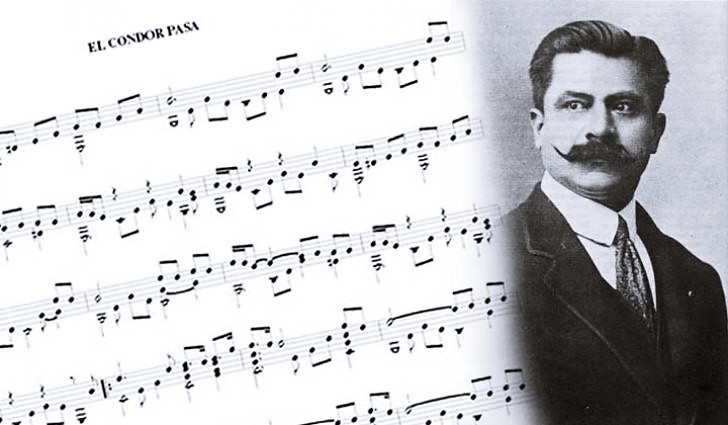
Daniel Alomía Robles
In the century that followed, the score’s homonymous ballad has been interpreted and recorded by countless artists around the world. Easily the most well-known rendition of this famous melody is Simon and Garfunkel’s “El Cóndor Pasa (If I Could),” (1970) which Dorr credits with catalyzing a Latin American music revival as well as spurring on a wave of Euro-American musicians and producers who collaborated with and brought into the international spotlight a number of groups who otherwise would have remained in relative obscurity. The tendency to see these projects as the work of (typically white) Westerners “discovering” and “saving” or paternalistically “curating” the dying musical cultures of the world, Dorr suggests, is part and parcel of a World Music concept that frames “primitive” traditions as fair game for extraction and appropriation into innovative sonic hybrids.

15 Nov 1991, Paris, France — Peruvian singer Yma Sumac
The “exotica” category follows the same logic, as the case of Yma Sumac illustrates. From the beginning of her career in the early 1940s with el Conjunto Folklórico Peruano to her 1971 psychedelic version of “El Cóndor Pasa,” Sumac’s vocal versatility and stylistic experimentations map out an experience of Andean indigeneity that Dorr hears in stark contrast to the narratives of the global music industry. While Capitol Records performed their own geography via their marketing of this sexualized “Incan princess,” the singer strategically composed her own sonic-spatial imaginary, not rejecting the difference suggested by “exotica,” but by synthesizing a “space-age” modern aesthetic with traditional songs. Dorr challenges us to listen to Sumac’s “El Cóndor Pasa” against Simon’s arrangement, thinking of her performative dissonances as disruptions of “the static geotemporal imaginaries of ‘authentic indigeneity’ that have most often informed the ballad’s deployment” (59).
If Chapter One makes a case for performance’s potential to shape notions of place and time, Chapter Two explores “spatial(ized) relations of musicking” (68) through a broader consideration of market strategies and the politics of sound in public space. Putumayo serves as another classic example of the global music industry’s pandering to multicultural idealism, promoting itself as “lifestyle company” that brings conscious capitalism into the curation of musical worlds. Dorr keeps her critique of Putumayo rather brief, but uses it as a convincing contrast for the focus of this chapter: the informal streams of economic activity and performance that she calls the “Andean music industry” (AMI). Among other examples from transnational and virtual “sites,” the Andean bands that performed in San Francisco’s Union Square throughout the 1990s demonstrate how performance geographies can challenge state and capitalist power while simultaneously running parallel to the marketing and distribution practices of the world music industry.
The AMI story is one of migration and the formation of a pan-Andean diaspora, of busking and bootlegging tactics that tested the boundaries of zoning and noise regulations as well as California’s immigration and labor policies, and of transposing music networks onto the internet when public performance became too precarious. It is also another case of dissonance, in which musicians willfully use their own cultural difference to their advantage, but not without consequences for poor musicians in South America; a telling example is the “Music of the Andes” CD, a mass-produced compilation used by various groups who, instead of having to record and press their own albums, could simply print their own covers for the Putumayoesque compilation and sell them to their none-the-wiser U.S. audiences (84).
But if the diasporic politics of the AMI came up short in challenging a monolithic representation of “Andean culture” or in highlighting the dynamic transits of Andean fusions such as chicha and Nueva Canción, the daily performances of street musicians in the race- and class-ordered Union Square support Dorr’s argument about the co-constitutive relationship between sound and space: “This unmediated display of embodied and sonic ‘otherness’ threatened the coherence of the square’s representational function by converting it into a spectacle of work and play for a population upon whose concealed labor the economic foundations of California’s wealth largely depend: undocumented migrant workers from the global South” (81).
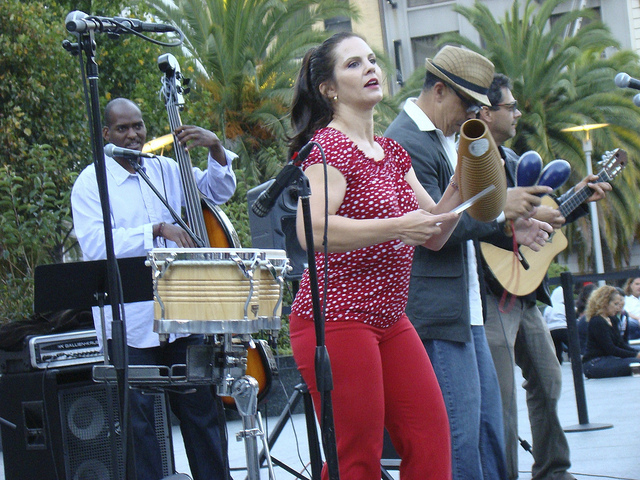
Busking in Union Square, 2013, Image by Flickr User Dr. Bob Hall
Elsewhere in 1990s San Francisco, musicians, artists, and activists formed a collective that, like the busking Andean groups, challenged dominant notions of public and private space while performing its own transnational and migratory experiences of Latinidad. In Chapter 4, Dorr relates the story of La Peña del Sur, a grassroots organization in the Mission District and, like the many anti-imperialist peñas popular throughout Latin America since the 1960s, a space for artists to perform or display their work for local audiences. While this peña provided a community for undocumented immigrants and local residents threatened by gentrification, it also served as an unsettling force against the sort of geographies that separate “queer space” from “heterosexual space” without regard for how these neighborhoods are also classed and racialized.
The founder and director of La Peña del Sur, Chilean exile Alejandro Stuart, was among several queer community members whose efforts constituted their shared space as a challenge to normative boundaries, a site for musicking that engendered dialogue among a wide range of people with divergent visions and motivations. Community organizers and students of cultural sustainability would do well to read Dorr’s account of this decade-long experiment that “enabled the exploration of sound-based solidarities rooted in the identification of common historical and political ground through improvisation and participatory performance” (168).

Victoria Santa Cruz, Image courtesy of Flickr User “Traveling Man”
Between these two compelling tales of the dynamic relationship of sound and space in San Francisco, Chapter 3 explores the significance of race, nation, gender, and sexuality within the performance geographies of several Afro-Peruvian artists. Dorr traces the movements of performers and activists who challenged the colonial boundaries that framed blackness as “antithetical to the emergent nation” (111); unlike the indigenous traditions that could be appropriated for an imagining of Peru as modern yet firmly rooted in history, Afro-Peruvian bodies and sounds were treated as contaminants within the postcolonial order.
Listening to Black feminist performance geographies, from Peru’s Black Arts Revival in the ’60s and ’70s to the recent hemispheric collaborations of “global diva” Susana Baca, one can hear the formation of not only such racially imagined communities as “the coastal” and the “Afro-Latinx diaspora,” but also of “the body.” A powerful case of this latter sort of performance is heard in the lyrics and experiences of Victoria Santa Cruz, who, in her choreographed, cajón- and chorus-accompanied poem, “Me Gritaron Negra,” contests the ways in which “[t]he physical contours of her body – her lips and skin and hair – become a geography inscribed with social meaning, an ideological imposition intended to enact and legitimate her ongoing displacement” (121).
Santa Cruz’s pedagogical and performative practices, in particular, reveal why Dorr has chosen sound – and not only broader analytics of performance and musicking – as a central theme to explore in terms of its relation to places and bodies. While this book might leave a few sound studies scholars wanting more elaborate description of particular sonic phenomena or ethnographic consideration of how sound is imagined among Dorr’s interlocutors, a few examples in particular are keys to thinking about how sound signifies, and is signified by, racially mapped bodies and places.
Most intriguing here is a discussion of Santa Cruz’s 1971 book, Discovery and Development of a Sense of Rhythm, which outlines the artist’s approach to “listen[ing] with the body” and tuning in to “rhythm’s Afro-diasporic logics” (116). A pedagogy and practice developed well in advance of Henri Lefebvre’s theory of rhythmanalysis, Santa Cruz’s concept of ritmo–internal rhythm— deserves consideration alongside the work of Amiri Baraka, Jon Michael Spencer, Fred Moten, and Daphne Brooks as crucial for thinking about how Black aesthetics and diasporic sensibilities are cultivated through sound and capable of mobilizing new mappings of bodies and their worlds.

Victoria Santa Cruz, still from el programa de La Chola Chabuca. (Video: América TV)
On Site, In Sound also calls for renewed thinking on sonic-spatial relations and the meanings that emerge from within them – how the sounds of particular Latin American voices and instruments come to be understood as masculine or feminine, indigenous or modern, exotic or local. Although “sound” as a specific performative or sensory medium might seem, at times, only one among many phenomena examined within the book’s threefold conceptual framing – listening, musicking, and performance – Dorr weaves it throughout her own performance geography where it takes on multiple forms and scales, challenging even the very boundaries defining what sound “is.” More importantly, this is a geography that scholars of “the sonic” or “music worlds” should read (and hear) as a reminder of sound’s unique ability to create and transcend boundaries – but rarely without a great deal of dissonance.
—
Featured Image: “Gabriel Angelo, Union Square,” by Flickr User Brandon Doran
—
Benjamin Bean is a PhD student in sociocultural anthropology at The University of California, Davis. His research interests include Afro-Caribbean music and sound, food and the senses, Puerto Rico, religion and secularism, and the Rastafari movement. During his undergraduate studies at Penn State Brandywine and graduate studies in cultural sustainability at Goucher College, Ben’s fieldwork focused on reggae music, the performativity of Blackness, and the Rastafari concepts of Word, Sound, and Power and I-an-I. His current fieldwork in Puerto Rico examines flavor, taste, and marketing in the island’s growing craft beer movement. Ben was formerly a vocalist and bass guitarist with the Philadelphia-based roots reggae band, Steppin’ Razor.
—
 REWIND!…If you liked this post, you may also dig:
SO! Reads: Dolores Inés Casillas’s ¡Sounds of Belonging!–Monica De La Torre
SO! Reads: Roshanak Khesti’s Modernity’s Ear–Shayna Silverstein
SO! Reads: Licia Fiol-Matta’s The Great Woman Singer: Gender and Voice in Puerto Rican Music–Iván Ramos
Share this:


Current Top Posts





April 2021

January 2020

November 2019

October 2019

August 2019

April 2014

November 2017

March 2015

December 2017

October 2015
 Sounding Out!
Recent Comments