
SO! Reads: Nicole Brittingham Furlonge’s Race Sounds: The Art of Listening in African American Literature

 Is literature truly a primarily visual entity? Do we only read books or are we actually actively “listening in print”(1)? These are the main questions that Nicole Brittingham Furlonge explores in Race Sounds: The Art of Listening in African American Literature (2018). As Black literature is often considered in terms of its attention to music, listening has therefore been limited to the musicality of stories, and many voices are left unheard. What Furlonge does in Race Sounds is go back to these unheard voices and focus our attention on them to see what we have been missing.
Furlonge wants to demonstrate how to “uncover the different ways of knowing that emerge from aural engagement” (3) such as exposed in Invisible Man, Their Eyes Were Watching God, and Sterling Brown’s “Ma Rainey.” She urges us to learn to “decode print differently” (4) by attuning the reader to the practice of listening, as well as to (black) sound(s) studies in more general terms, by referring to the essential scholars of the field: Tsitsi Jaji, Fred Moten, Kevin Quashie, Jennifer Stoever, and Alexander Weheliye – to name a few. Furlonge further “joins a collective effort to shift from a heavy emphasis on sounding to an attention to listening practices” (9). By redirecting the reader to listening practices, Furlonge leads us to reconsider our own “coexistence among humans.” (9)
 Furlonge, previously chair of the English Department at the Princeston Day School, and new Director of Teacher’s College’s Klingenstein for Independent School Leadership is not only an experienced scholar, but a teacher experiencing first hand what it means to listen: in a classroom and in society. Race Sounds is a five chapter book, moving from a consideration of “Literary Audiences” (chapter one), to the “Silence of Sound” (chapter two), to various forms of Listening (chapters three-five). Her fifth chapter, as well as her epilogue, have an especially interesting approach to Sound Studies through her lens as an educator. Not only does Furlonge have extensive classroom experience and administrative expertise in curriculum development, diversity issues, faculty development and issues regarding equity and access, but she is in a good position, as an independent scholar, to reflect on listening practices in and out of academia. It is quite exceptional to consider pedagogy in a critical text, as it observes education in the classroom and citizenship, in addition to her critical analysis.
By guiding her reader to listening in new modes throughout the book, Furlonge demonstrates how to “read in a multimodal way” (109) in order to learn to listen. This multimodal method includes an attention drawn beyond the book to “sonic literacy,” “aural pedagogies,” as well as the full sensory process of listening (from hearing, to vibrations, to sensory immersion of many kinds, and so on). She insists that, “while hearing is a physiological form of reception, listening is interpretive, situated, and reflective” (83), and this is ultimately what she presents in Race Sounds.
Furlonge aims at an audience of readers and listeners ready to deepen their understanding of the importance of sounds through the multisensory experiences that she proposes, especially as she describes her experience of “Aural Listening in the English Classroom.” She “aim[s] to amplify listening as a creative, aesthetic, and interpretative practice in ways that provoke robust motivations to develop our capacities to listen” (15) and manages to do just that by guiding her readers to consider sounds, voices, vibrations, silences, and historical listening, such as (re)reading Zora Neale Hurston’s Their Eyes Were Watching God in a new light, pointing to protagonist Phoebe’s listening throughout the novel.
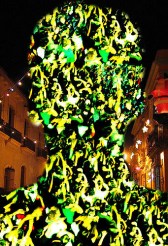
Image by Flickr User Adrian Sampson, from a series of three art pieces engaged with Ralph Ellison’s Invisible Man (CC BY 2.0)
By close reading, or listening, to many canonic texts such as Their Eyes Were Watching God, The Chaneysville Incident, and Invisible Man, Furlonge performs an in-depth understanding of sound and what it means to “unmute words in print” (109). She renews the ways to interpret the texts by teaching her readers how to hear sonic literature. After situating the texts in the literature, she depicts what sounds and silences in the narratives tell the reader. For instance, in the first chapter, “Our Literary Audience,” Furlonge distances herself from the often-times asked question of “whether or not Janie realizes her voice over the course of [Their Eyes Were Watching God]” and thinks about “Phoebe’s hungry listening” (25) and what it adds to the conversation. Rather than analysing the story’s narrator yet again, Furlonge turns the reader’s attention towards her friend, the listener. The reader is presented with the importance of listening with an analysis of the “storyhearer” (60) and the work that they accomplish by listening in proper ways, which allows the speaker to develop a voice they know is heard. In this sense, “storyhearers” are used to critique and bring the listening back into stories. As Furlonge considers the body a “living archive” (63), the intake of sounds and its use and reiterations transport the stories and transform the listener into an archive that will allow the story to live on and be transported.
Race Sounds, therefore, brings to the discussion ideas of what it means to listen and one’s responsibility of listening properly and carrying the story within one’s self. “Historical listening” (82) further defines the importance of the audiences in engaging with sounds. As one’s listening, in becoming knowledge, develops this importance, as well as a civic responsibility, to bring the story where it needs to be. Furlonge wonders about the same question Peter Szendy asks, “Can one make a listening listened to? Can I transmit my listening, as unique as it is?” (102). Through reading of The Chaneysville Incident, she demonstrates the carrying of such stories through sound, “a sound that contains memories” (117), and its historical as well as civic importance.
Furlonge also brings new insight to Ralph Ellison’s Invisible Man, a novel often studied in African American Sound Studies, such as in Weheliye’s Phonographies, because of its use of the phonographand its attention to the use of music. However, Furlonge diverges from the usual exploration of Ellison’s narrator with his phonograph and insists on vibrations and the experience of “tactile listening” (55), or the materiality that comes with the listening experience. In shifting the conversation, Furlonge presents the physicality of sound and voices, and does so throughout Race Sounds. Redirecting the reader’s attention to how listening practices affects the novel’s narration, Furlonge aims for the reader to rethink their own listening practices in turn.

Teagle F. Bourge in Oren Jacoby’s adaptation of Ralph Ellison’s INVISIBLE MAN. At the Huntington Theatre Company Jan. 4 – Feb. 3, 2013. Photo: Michael Brosilow (Court Theatre production), (CC BY 2.0)
By directly addressing our way of being in the world, Furlonge creates a text that speaks to the reader, and cannot leave one indifferent. In her last chapter, a walkthrough of her class on listening, Furlonge plunges with the reader into a sense of meaning; everything that one has just read comes together into her classroom. The result of Furlonge’s observations guide the reader into finding a new listener within themselves. Before concluding her book, she describes:
While I hoped students would grow as listeners, I did not anticipate that their perceptions of themselves as readers and writers would also shift. […] Helping students learn to listen, to be attentive to others, and to be discerning of all the talk that comes their way can lead to enduring understandings about themselves and the ways in which they want to engage with and change their world. (118)
As optimistic and ambitious as this statement is, I believe Furlonge manages to teach exactly this to the reader of Race Sounds. By concretely applying in her classroom what she presents in this book, not only does she prove how her work furthers the conversation of Sound Studies, she demonstrates how it belongs in larger conversations about our society’s listening practices and the role of every person in it.

“Students travel around the world with books” image by Flickr User Garrison Casey, (CC BY 2.0)
Furlonge’s book intends to speak to anyone interested in their own listening practices. By being conscious of one’s own body as a “living archive,” it may allow a story to live on by listening properly to it. Finally, “we are unaware of the conversations we miss when we speak” (120) concludes the book on a reflection unto the self to be a better listener, in order to allow our surroundings to teach us to listen differently, and maybe hear things we have not heard before.
—
Featured Image: Quinn Dombrowski,(CC BY-SA 2.0)
—
Alexandrine Lacelle is mainly interested in Modernist literature, women’s writing, and Sound Studies (especially silences). She is pursuing her Master’s degree in English Literature at Queen’s University, where she will be starting her PhD in the fall of 2019, with a focus on the use of wordlessness and sounds in early 20th century literature by women. Originally from Montreal, she completed her BA in English Literature at Concordia University, where she was able to practice her background in French, English, and German.
—
 REWIND!…If you liked this post, you may also dig:
SO! Reads: Dolores Inés Casillas’s ¡Sounds of Belonging!–Monica De La Torre
SO! Reads: Roshanak Khesti’s Modernity’s Ear–Shayna Silverstein
SO! Reads: Kirstie Dorr’s On Site, In Sound: Performance Geographies in América Latina–Benjamin Bean
Share this:

Cardi B: Bringing the Cold and Sexy to Hip Hop
 In “Asesina,” Darell opens the track shouting “Everybody go to the discotek,” a call for listeners to respond to the catchy beat and come dance. In this series on rap in Spanish and Sound Studies, we’re calling you out to the dance floor…and we have plenty to say about it. Your playlist will not sound the same after we’re through.
Throughout January, we will explore what Spanish rap has to say on the dance floor, in our cars, and through our headsets. We’ll read about trap in Cuba and about Latinx identity in Australia. And because no forum on Spanish rap is complete without a mixtape, we’ll close out our forum on Thursday with a free playlist for our readers. Today we continue No Pare, Sigue Sigue: Spanish Rap & Sound Studies with Ashley Luthers’ essay on femme sexuality in Cardi B’s music.
Liana M. Silva, forum editor
—
“Ran down on that bitch twice” was all I heard in this tight, dark basement filled with black and brown bodies, sweat dripping everywhere from everyone. Girls danced all over, yelling and shouting lyrics as they clapped and pointed along to the fast, upbeat rhythm of the song, feeling their own sensations and pleasure from the vibe, and rapping with the catchiness of the repeated phrase, “Ran down on that bitch twice!” As everyone was jumping, the space around me shook because there was so much body movement and flow; it was lit. This wasn’t the first time I heard Cardi B, but dancing along to her song “Foreva” was definitely the first I remember hearing her. Since that dark basement party, I realized that the attitude and energy Cardi B invokes through her raps and lyrics is addicting.
Listening repeatedly to “Foreva,” and the rest of her debut mixtape Gangsta Bitch Music Vol.1, has attuned me to Cardi B as a stone cold, gangster bitch: someone who is fearless, tough on the outside and inside. She doesn’t hesitate; she doesn’t bluff. She gets straight to the point and lets you know that she will fuck you up if and when necessary. A ‘G’ she is, as some would say when describing a person who shows no fear and is always hustling—except that someone is imagined as a black male from the so-called ‘hood who affiliates with drugs, gangs, etc. The music itself reflects this gangster feel, through the hard trap sounds and beats in every track. Trap music as a style and subset of Hip-Hop, and arguably a genre on its own, originated in Atlanta, and has over time become mainstream all across the U.S. specifically within the Northeast region. Within Cardi’s performed, stone cold bitch lyrical persona, she embodies an aggressive femme sexuality, a racialized femme hunger for sex with black men, and an emotional depth that makes her endearing to listeners. Her embodiment of this multiplicity—stone cold attitude, femme sexual thirst, and emotional complexity—can be heard in her music, through the explosion of beats, rhythms, and lyrics that keep listeners hooked to the sound of her self-image. In other words, Cardi B’s sonic and lyrical movements work in tandem with her audio-visual construction of black, Caribbean, Bronx femme desire.
Nowadays this audio-visual construction is visible across her music and social media, but I want to focus on the image of her debut mixtape cover, Gangsta Bitch Music, Vol.1. This image hailed me and continues to hold me in thrall after lengthy meditations on it. In it, Cardi B sits in the backseat of a car, high-rise apartments peering through the back window, with her legs spread wide open. Between her legs, a big, black, faceless, tatted man gives her head as she casually drinks her Corona. The man’s back sprawls in the place where we might imagine Cardi B’s junk/pussy; he’s her bitch. The audacity of displaying her desire mid-sex-act intrigues me and does more than merely assert black femme sexual desire. The media blew up when Nicki Minaj did her lollipop photoshoot in which her legs are wide open, and her crotch is heavily exposed. But Cardi B’s mixtape cover has a different impact, because of the positioning of its vulgarity and audacity.

I’ve seen pictures of Nicki Minaj and Lil’ Kim where they’re half naked, open to giving men pleasure, and completely distorting the expectation of respectable black women to cover their bodies and assets. But what makes Cardi’s mixtape visual different even from Lil’ Kim’s and Minaj’s visual constructions is that it shouts power from the position often occupied by cis-male desire. Cardi B is seizing her own sexual power and gangster agency while she asserts her business hustle from the seated position of power that is often assumed by cis-male gangster rappers and performers. In the angle and composition of the mixtape image, we, as viewers, are positioned to look up at her as we witness her experiencing pleasure. She’s above us, and her chosen sexual object, who is a big black man, a figure whose masculinity is historically challenged by normative and respectability-obsessed society, and who is historically susceptible to being emasculated, is situated beneath her: there’s a troubling of power’s embodiment, specifically through sex, in this image. She’s visually insisting on getting play.

I connect Gangsta Bitch Mixtape Vol. 1’s cover image to the sounds, vibes, and lyrics of Cardi B’s tracks within the mixtape. In “Foreva,” for example, she raps, “Silly muthafucka who raised you/ a nigga with a pussy how disgraceful.” It’s at this point that we realize that the “bitch” that she “ran down on,” “twice,” is also a dude. In the lyrics, she alternates between beefing with trifling chicks and dudes; for Cardi, bitches breach a gender dyad. She raps from a masculine position as a femme, which ultimately illustrates her mixtape cover’s reversal of who is in the receptive and dominant position of sexual power. In “Foreva,” she’s talking down on black men the same way that most of these men speak on black women in the Hip-Hop industry. Cardi twists the normative misogyny and disrespect that is often demonstrated towards black women in Hip-Hop and instead uses that towards apostrophic black men. The lyrics of “Foreva” and the Gangsta Bitch mixtape cover both sustain this idea of Cardi B working within masculine tropes as a woman in the industry. On the mixtape cover, she is the one who is receiving pleasure, instead of giving it to a man. Lyrically and physically, she’s in a place where she’s on top, looking down on her subject/object of sexual desire, and inviting her audience to watch.
Sonically, “Foreva” and other tracks fits within the genre of trap music. Many of the songs in the mixtape have aggressive beats. The genre is characterized by a deep, hard mood created by the fast beat: Justin Burton describes it as “one of the most iconic sonic elements of trap is the rattling hihat, cruising through subdivisions of the beat at inhuman rates.” This is what we hear and feel from Cardi’s music itself. Specifically, the BPM for “Foreva” is 161 which fits into the range of typical Trap music. The way she sounds is what she embodies. The flow of “Foreva” tells us as listeners that Cardi B isn’t here to play and she damn sure won’t let anybody stop her from making her money. The rest of the music on the mixtape takes a similar route, in that these crisp rhythms speak to her power, her urban upbringing, coming from the Bronx, and her days as a stripper. She owns her sexuality and claims it through the music. The cover reflects this: she is poised and looking directly at us, her stone-cold persona manifested in how she also appears utterly unbothered by you, us, looking at her, looking at us.
Cardi B’s a freak. Clearly. (As if we didn’t know this.) But the way she visually and sonically expresses her sexual yearning is more complicated than the word freak can capture. The thing with Cardi B is, she’s not afraid. In fact, she doesn’t care about respectability. Even when she raps about making money or callin’ shots on someone, she never hesitates to slide in something sex-related because she knows she’s good at getting and giving play, both sexually and musically: “Fuck him so good he gonna want to spend all that/ Pussy got him on the jugg he gonna re-up and come right back.” If you read the lyrics from “With That,” you could think the lyrical subject is a male rapper, like trap’s Future or Gucci Mane. In fact, this song is a remake from Young Thug’s “With That,” which comes from his album Barter 6. Young Thug is one of the big faces in the Atlanta Trap music scene and his track “With That” reflects the life of a rapper like him. Poppin pills, stacking money tall, Thug knows he’s killing the game and shitting on these other rappers with his sounds–Cardi B echoes that bravado in her remake.
Drugs, sex, money, hustle: Cardi B, in a way, replicates the masculine attachment to these tropes. But we are not listening to an abstract, masculinist lyrical subject on her mixtape; we are listening to a black femme subject. So, this goes beyond ‘replication’, as we may wonder whether it has ever historically not been the case in the Americas that black women also had to hustle, grind, find stimulation to escape normative constraints, and take care of their sexual desires. Which is to say, black men are not the OG hustlers; arguably, black women are, and Cardi B channels that historical force in her audio-visual construction of a stone-cold bitch who knows how to get play, and still have feelings in a hatin’ ass world.
We’re introduced to this hard, stone cold Cardi B inside and outside of her music’s lyrics as she repeatedly performs that she is not at all ashamed of the fact that she used to be stripper, aka, someone who hustles hard. Her choice of the trap genre, as a black Latina, acknowledges the existence of that hustle theme within it—even honors it. Her refusal of shame and respectability affects that take a specific toll on black women in the Americas, circles me back to the welcoming aura she displays on the mixtape cover. She wants viewers to see her in her happy place; she wants us listeners to hear how good she is in bed; she wants the world to know she’s a freak. This is her way of fucking with the mythical construction of masculinity in Hip-Hop where cis-men are the most badass, aka, the “most political” subjects; she acts on her own urges and desires, which does a lot more than just show femme as “sexy.” She’s sexy and she’s cold and so is her music too: the kick drums, synth lines, and hihats make her sonically ominous and cold.

In one of Cardi B’s latest tracks, “Money,” I still hear echoes of “Foreva,” but I’m hearing so much more. I find myself paying as much attention to the audio as to the visual constructions that Cardi B’s generous yet cutting aesthetic offers: in the cover image for “Money,” we see her naked body, positioned in a way that shows off her peacock thigh tattoo, suggesting but keeping her junk from you. She’s wearing a plethora of gold watches, almost as if they’re long-sleeve gloves, and a gold hat, the shape of which channels both Beyoncé’s in “Formation” and Jeffery’s (aka, Young Thug) on the cover of Jeffery. Unlike the cover of the first mixtape, Cardi does not give us her hair in this image, and she does not give us her gaze; while she directs her face at the camera, the hat dripping with diamonds conceals her hair and her eyes from us—or, she is giving her gaze to herself, to the inward rewards of her hustle. The ice is cold, but the image is warm as a swarm of gold bling and golden light surrounds her.
Lyrically, on “Money,” she’s doing what she does best, rapping about her hustle, her money, and still managing to throw in a little something about her love for sex. Sonically, this is pure trap. We hear an orchestration of keyboards, brass, and drums. As for us, listening viewers, we not only consume her music, but also continue to take in everything Cardi B has to offer because it fascinates and pleases us. She returns our pleasure (in her pleasure) to us, and nothing less than that.
—
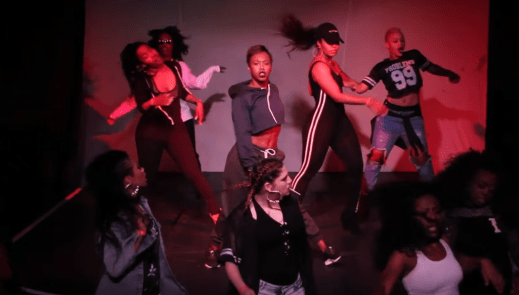
Featured Image: Still from “Cardi B ‘Foreva’ (Live) Choreography By- Hollywood”
—
Ashley Luthers is currently a Senior at Wesleyan University studying English and Economics. She has spent the past year researching and studying Cardi B inside and outside of the classroom. Her final senior essay revolves around Cardi B as a black femme artist in Hip-Hop through an analysis of different theories surrounding the black female body.
—
 REWIND! . . .If you liked this post, you may also dig:
“The (Magic) Upper Room: Sonic Pleasure Politics in Southern Hip Hop“–Regina Bradley
“What Feels Good to Me: Extra-Verbal Vocal Sounds and Sonic Pleasure in Black Femme Pop Music” -Robin James
“I Love to Praise His Name”: Shouting as Feminine Disruption, Public Ecstasy, and Audio-Visual Pleasure–Shakira Holt
Share this:


Current Top Posts





April 2021

January 2020

November 2019

October 2019

August 2019

April 2014

November 2017

March 2015

December 2017

October 2015
 Sounding Out!
Recent Comments