
Enacting Queer Listening, or When Anzaldúa Laughs

 Marginalized bodies produce marginalized sounds to communicate things that escape language. The queer body is the site of sounds that engage pleasure, repression, rage, isolation, always somehow outside of dominant language. Sound Studies tells us that we should trust our ears as much as our eyes, justifying our trust in sound, and of the resonating body. Affect Theory goes further, saying that all senses play into a body that processes input through levels of response, experience, and anticipation. Affect is the vibrational space that is both bodily memory and anticipation. So where do sound and affect meet in queer bodies? How do marginalized peoples use sound and the body to express liberation, objectification, joy, and struggle?
Our writers in Sound and Affect tackle these questions across a spectrum of the marginalized experience. I opened the series by offering the concept of the tremble, a sonic form of affect that is necessarily queer in its affective reach. Last week, Kemi Adeyemi, sloooooooowed thingggggggggs doooooooooownnnnn so to hear the capitalist connections between the work expected of black bodies and the struggle for escape from this reality through the sonic affects, temporal shifts, and corporeal elsewhere of purple drank. Next week, Justyna Stasiowska brings the noise in a discussion of the trans body and the performance work of Tara Transitory. Today, Maria P. Chaves Daza explores the connection between voice, listening, and queer Chicana community formation: through space, across time, and with laughter. —Guest Editor Airek Beauchamp
—
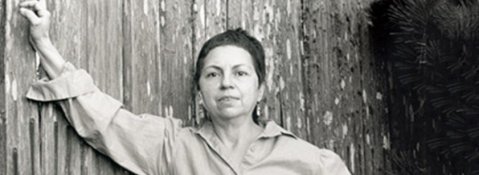
In October 1991 at the University of Arizona fall reading series, Gloria Anzaldúa read several poems and short stories–work now held at the UT-Austin Collection. Recently, I sat in my living room listening to the recording, feeling the buzz of her presence, the audible excitement in the Modern Languages Auditorium that Gloria Anzaldúa is about to speak. After some welcoming statements and a poem by Rita Magdaleno, inspired by Magdaleno’s reading of Borderlands, Anzaldúa takes the stage.
As part of her praxis, Anzaldúa makes space for queer people, both through her words and vocal tone. She begins with a joke about her relationship with mics and takes the time to thank the organizers, especially for her cozy writer’s cottage. Anzaldúa dedicates the reading to Yolanda Leyva, her old roommate, telling Leyva she hasn’t forgotten her. Then, she announces her involvement in Sinister Wisdom and encourages women of color in the audience to contribute to this all-lesbian journal. She proceeds to laugh as she says, “lesbians of color only, sorry. [laughs]” Similarly, as she announces a collection she is editing with Francisco Alarcon about Chicana dykes and Chicano gay men, she says, “so if anybody is a Chicana dyke or a Chicano gay man, sorry about the rest of you” [laughs]. In the future she will also edit a book called Chicana Theory “Chicanas only (laughs), sorry.” Last, she acknowledges Chuck Tatum for changing the title of his annual from “New Chicano Writings” to “New Chicana/o Writings” and for allowing for Spanish and Spanglish Tex-Mex when he first wanted pieces in English. Anzaldúa takes the opportunity to recognize and promote the work of Chicana/o lesbian and gay writers by demarcating several publications exclusive to their work. This exclusivity is softened with giggles and laughs, affects, which help work through the tension(s) of recognition and exclusion caused by this explicit circumscription.
Her nervous, silly laugh–echoed in the laughs of her audience–reaches out to bring me into that space, that time. Her smooth, slow and raspy voice–her vocalic body–touches me as I listen.

Gloria Andzaldúa Image from the Tumblr of BiRadical
In their introduction to The Affect Reader, Gregory J. Seigworth and Melissa Gregg assert affect’s “immanent capacity for extending […] both into and out of the interstices of the inorganic and non-living, intracellular divulgences of sinew, tissue and gut economies and the vaporous evanescenses of the incorporeal (events, atmospheres, feeling-tones)” (2).This sound recording of Anzaldúa’s poetry reading is an example of the immanent capacity this “incorporeal” event has to resonate and “sometimes stick to bodies and worlds” for listening audiences (1). Affect in its simplest form is “the name we give to those forces […] that serve to drive us to movement, towards thought and extension” and is “synonymous with force or forces of encounter (2).” My encounter with Anzaldúa’s (incorporeal) recording and the affect created through listening to her work lead me to ponder an answer to Seigworth and Gregg’s question:
How does a body marked in its duration by these various encounters with mixed forces, come to shift its affections (its being affected) into action (capacity to affect)? (2)
Toward an answer to this question, this post explores my relationship between Anzaldúa’s voice and my pedagogy, both her speaking voice as well as the interior voice she offers her audience, the way in which she opens spaces for queer women of color, and the resonances I find in both. As a queer woman of color who once felt isolated, Anzaldúa’s work has in many ways liberated me as a scholar, providing me with access to a voice for my own experiences. But Anzaldúa’s voice–its tactile material aspects and the way its sound builds affective connections between myself and other queers of color–strikes a chord in me that resonates without the need for language, across space and time. Her voice in the recording and in her writing sparks a recognition and validation of my being.

“Viva Gloria Anzaldúa,” acrylic on canvas, by Jake Prendez
Yvon Bonenfant’s theorization of “queer listening” highlights a practice of visibility and exclusivity that enables Anzaldúa’s vocalic body to reach out to the queer community, and for us to “listen out” in return. In “Queer Listening to Queer Vocal Timbres,” Bonenfant identifies the vocalic body as central to listening experience. He defines the vocalic body as an instrument producing vibrations that touch others, and a socially produced body positioned by environmental factors in a set of relations of power that produce identity. From these constitutive power relations the queer body listens for other queer bodies since “queer is a doing, not a being;” and listening is an active process of identifying the elements reaching out to queer people (78). Thus, Bonenfant, elaborates queer listening as
a listening out for, reach[ing] towards, the disoriented or differently oriented other […] listening out through the static produced by not-queer emanations of vocalic bodies. […] since hearing is feeling touch, this act of finding requires attunement to the touch of the vocalic bodies that caress queer. Sometimes, one has to listen very carefully to find them (78).
Queer listening then, takes seriously the power that bodies have to make sounds that reach out of the body to touch queer people and queer people’s ability to feel them.
***

CLICK on image of Gloria Andzaldúa to hear the recording I discuss from the University of Arizona, 10/23/91
On the University of Arizona’s recording, I can hear in Anzaldúa’s laugh a relish in her ability to take up space, to have before her an audience of more lesbian, gay and queer writers to contribute to her several anthology projects. Her voice is filled with a nervous excitement; after all, there is always a danger in being queer. Her laugh resonates as a physical instantiation of the risk of her own existence and of the other queers in the room. It is also a soothing mechanism; her laugh momentarily takes the edge off of some of her words as it reaches out, touches, and brings together queer people of color.
It is in this same way, that Anzaldúa’s work creates the space to speak and listen to queer people of color in many contexts. I was first introduced to Anzaldúa in the classroom, specifically a feminist theory class. It was the first time I had heard a Chicana speak about being queer (or anyone who was mestiza for that matter); the classroom can be fraught with danger for students like me. Cindy Cruz, in “Notes on Immigration, Youth and Ethnographic Silence,” argues that the classroom needs to be a space aware of the political climate that silences LGBTQ immigrant students (68). In the classroom, writers such as Anzaldúa, Cherrie Moraga, Audre Lorde, and bell hooks all contribute to the growing canon of “politically undesired” identities (68). Without these writers, the queer-identified person may never be given a reason or a chance to speak about their experience as brown/black transgressive sexual subject. For this reason, when I teach I always read Anzaldúa aloud or ask members of the class to do so. Her powerful language, when vocalized, creates what Bonenfant would call a somatic bond that inhabits the students themselves, the classroom, and demands that we discuss homophobia, sexism, misogyny, and racism from the perspective of the atravesadx: the immigrant queer person of color. Reading Anzaldúa aloud creates what Karen Tongson calls “remote intimacy: a way of imagining our own spaces in connection to others.” This is almost a pirate bond, a way of connecting the undesired and marginalized.
I have experienced this affective bond on multiple occasions, but one instance stands out.
In a Critical Race Theory class during my fifth year grad school, a fellow student, an immigrant woman of color, came out to the class by way of a seminar paper. As she read the paper she was shaking, her voice cracked, and tears rolled down her face. She was terrified of the consequences of “coming out,” however she found the courage to write and share her experiences. I remember how this reading touched me, the student’s voice interlaced with quotes explaining Anzaldúa’s concept of “homophobia”—the fear of going home– moved through the classroom and classmates: people leaned in, shifted in their seats, began doodling, some shook their heads in agreement in relation to coming out. I don’t think the student would have felt this was possible or appropriate if we hadn’t read Anzaldúa; the only lesbian writer on the syllabus.
The sound of Anzaldúa’s text creates a vocalic body for queer listening available to people who yearn for its touch. Bonenfant posits this idea of yearning as inherently queer. Queer, as a form of doing, requires performative activity, always looking to find our own likenesses in others. Recognizing sound as touching the vocalic body, “queer listeners can perhaps catch some of the subtle variations in timbre that indicate a resonant ‘identity’ that wants to touch someone like us” (78). Anzaldúa’s various texts speak of concrete experience but the timbre of her voice–and the voice(s) reading her work–speaks to much more, a certain trembling that I feel in my own experience and that I wish to not only receive but to share with other queers of color also reaching out while also always receptive to the timbre of likeness.
Affective phenomena do not rely on textual or linguistic acts to communicate but instead are networked intensities of impulse that connect the individual body-mind to the bodies-minds of others. As Gregg and Seigworth explain,
Affect arises in the midst of in-between-ness: in the capacities to act and be acted upon. […] That is, affect is found in the intensities that pass body to body. In fact, it is quite likely that affect more often transpires within and across the subtlest of shuttling intensities: all the minuscule or molecular events of the unnoticed (2).
Anzaldúa incites in me a sense of intensity as the unnamable but unmistakable realities of my own experience resonate when I listen, while also lighting in me a force, an exertion of a “politically undesirable” self that I must assert in the world and in the classroom as a space of in- between-ness. Anzaldúa’s writing and the timbre of her voice are, to me, intensities and forces that go unnoticed, except by those who are yearning for them. Listening to Anzaldúa in the classroom proliferates the possibility of queer listening encounters; listening to Anzaldúa at home, in my living room, regenerates my belief in the impossible, in our ability to be in intimate spaces without homophobia: the fear of going home.
—
Featured Image: Used with the generous permissions of artist Alma Lopez. See more of her work at: http://almalopez.net/
—
JS and AB are grateful for the the editorial work of Tara Betts on early drafts.
—
Maria P. Chaves Daza is a doctoral candidate in the English Department at SUNY Binghamton University studying testimonios of undocumented women. They are a McNair Scholar and a Clifford D. Clark Fellow. They hold a B.A in Women’s Studies form NEIU in Chicago and a Master’s in Philosophy from the Philosophy, Interpretation and Culture (PIC) Program (SUNY Binghamton).
 REWIND!…If you liked this post, check out:
“Music to Grieve and Music to Celebrate: A Dirge for Muñoz”-Johannes Brandis
On Sound and Pleasure: Meditations on the Human Voice-Yvon Bonenfant
“Hearing Queerly: NBC’s ‘The Voice’”-Karen Tongson
Could I Be Chicana Without Carlos Santana?-Wanda Alarcón
Óyeme Voz: U.S. Latin@ & Immigrant Communities Re-Sound Citizenship and Belonging-Nancy Morales
Share this:

Straight Outta Compton . . .Via New York

Sounding Race in Rap Songs explores the production of musical identity in hip hop’s first two decades as a commercial genre. Although I don’t ignore lyrics or visual imagery, my main purpose is to analyze rap music as music, to understand how specific artistic decisions contribute to racial meaning in particular songs. My methods revolve around the study of how producers manipulate breakbeats, also commonly known as “breaks.” Initially understood as short, percussion-heavy passages that appear in many songs recorded in the 1960s and 1970s, breaks have been central to hip hop from the music’s earliest days in the South Bronx when DJs began isolating and looping them on their turntables to the delight of dancers. Since then, producers have tried out new approaches to working with breakbeats: hiring studio musicians to re-record them; programming drum machines to imitate them; and using sampling-sequencing technology to capture and rearrange them.
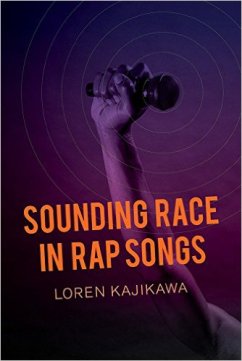 Throughout the book, I describe how producers use breaks and give rise to musical-racial codes that can be manipulated to project a variety of identities and attitudes. The following excerpt from the third chapter of Sounding Race, explains how the style of beat making popularized by the New York-based Bomb Squad (Public Enemy’s production team) provided a blueprint for pioneering west coast gangsta rap group N.W.A’s depiction of Compton, California. By layering multiple loops into a dense, cacophonous mix, N.W.A transposed Public Enemy’s “too black, too strong” sound onto the world of Los Angeles’s postindustrial streets.
N.W.A and its former members have been in the news recently thanks to the biopic Straight Outta Compton. Yet one aspect of the group’s development downplayed in the film is the way that its members formulated their identities in relation to east coast rap. In the mid-1980s, New York was the undisputed center of the industry, and its influence on L.A.-based acts is easy to see and hear. Ice Cube’s first group C.I.A. ( Cru’ In Action) used a nasal, hocket style approach to rapping cribbed directly from the Beastie Boys 1986 album License to Ill. And the cover of N.W.A’s first album N.W.A and the Posse, features numerous group members posing with the giant clock necklaces made famous by Public Enemy’s Flavor Flav. In similar fashion, the beat Dr. Dre produced for “Straight Outta Compton” (the title track to their breakout 1988 album) followed the Bomb Squad’s potent formula for signifying militant blackness. —Loren Kajikawa
—
The following is an excerpt from Chapter Three “‘Let Me Ride’: Gangsta Rap’s Drive Into The Popular Mainstream,” of Loren’s Kajikawa’s Sounding Race in Rap Songs, with thanks to The University of California Press. Any notes have been included in the text to conform to Sounding Out!‘s style sheet.
We [Public Enemy] were in Vegas and they [N.W.A.] were on tour with us, and I had just got the vinyl in. That’s what this is all about. Because Run-DMC and LL Cool J gave me energy. And if our energy happened to be transferred to N.W.A., then that’s what this whole thing is for.” Chuck D as quoted in Brian Coleman, Check The Technique: Liner Notes For Hip-Hop Junkies (New York: Villard Books, 2007), 354.
According to Chuck D, Public Enemy’s musical style directly influenced Dre, and he recalls giving the first two copies of It Takes a Nation of Millions To Hold Us Back to Dr. Dre and Eazy-E prior to the album’s official release. The recorded evidence supports Chuck D’s recollection. For many of the tracks on Straight Outta Compton, Dr. Dre seems to have borrowed from the “loops on top of loops” style of Public Enemy’s Bomb Squad.
In fact, when Ice Cube left N.W.A. in 1989, he hoped that Dre would continue to make beats for his solo project. When this proved impossible due to Dre’s contractual obligations to N.W.A., Ice Cube began collaborating with the Public Enemy’s Bomb Squad, which served as the production unit for his album Amerikkka’s Most Wanted (1990). N.W.A.’s breakthrough was finding a way to put a distinctive spin on these influences, and the artistic strategy that they arrived at for their first Ruthless Records release was designed to put themselves on the map—both literally and figuratively.
Rather than shout out the multiplicity of neighborhoods where their members were actually from (as they had done in “Panic Zone”), N.W.A. chose to center their identity around Dr. Dre and Eazy-E’s hometown of Compton, California. The sound of Compton as Dr. Dre imagined it, however, drew on musical practices and artistic decisions similar to those found in Public Enemy’s “Rebel Without a Pause.” To construct the rhythmic foundation of “Straight Outta Compton,” Dre looped the breakbeat from The Winstons’ “Amen Brother” (1969), one of the most sampled beats in hip hop, that also served as the foundation for dozens of songs in the UK’s “jungle” (aka “drum and bass”) genre.

Like other heavily sampled breaks from this era, the one-measure loop features a syncopated interlocking of snare and bass hits that is reminiscent of James Brown’s “Funky Drummer (featuring Clyde Stubblefield’s famous beat). As if he were following the Bomb Squad’s exact formula, Dr. Dre layered a drum machine (Roland TR-808) over this break.

The 808 was programmed to add its characteristic bass boom to the first two drum kicks of the “Amen” loop, and to tick off a 16-count hi-hat pulse with a closing hi-hat clasp on the downbeat of every other measure. The “Amen” break and the two hi-hat parts, provide the rhythmic foundation around which Dr. Dre places numerous other repeating sounds. Two other ingredients stand out in this beat: a guitar ostinato and a low drone on what sounds like a baritone sax or trombone (or perhaps a downwardly pitched sample of another instrument). The guitar ostinato, which plays straight eighth-notes on E-flat except for a one step descent to D-flat on the “and” of every fourth beat, churns out tight 1-measure units of sound.

The horn drone (also on E-flat) has a raw, muddled quality, and casts an ominous cloud over the track.
By combining these layers with the dense percussion track, Dre created a tightly packed funk groove with many sonic similarities to Public Enemy’s Bomb Squad. Like “Rebel Without a Pause,” the track to “Straight Outta Compton” features tight 1-measure loops stacked on top of one another to create a thick and intense groove.

Comparison of layers of looped sound in Public Enemy’s “Rebel Without a Pause” and N.W.A.’s “Straight Outta Compton”
Except for the drone, most of the elements in the track have a punchy feel, full of rhythmic stabs and staccato attacks, including the automatic gunfire that Dre samples to follow Ice Cube’s reference to an AK-47 assault rifle. Due to the “noisiness” of the beat, the way sonic space seems filled to maximum capacity, the members of N.W.A.—similar to Public Enemy’s Chuck D and Flavor Flav—practically yell their verses, as if they must raise their voices in order to be heard over the cacophony. Even before the actual words to “Straight Outta Compton” are digested, the sound of the track and the group’s vocals evoke the palpable tension of imminent conflict, which reinforces the theme of violent confrontation in the song’s lyrics. For the chorus of “Straight Outta Compton,” Dr. Dre strings together a series of samples with rapid-fire precision. The sound of screeching car tires from Davy DMX’s “One for the Treble” is followed by turntable scratching; the scratching leads directly to a choppy sample of the words “City of Compton” from Ronnie Hudson’s “Westcoast Poplock,” which is then followed by more scratching. The whole chain of musical events is deployed over the breakbeat from Funkadelic’s “You’ll Like It Too,” which Dr. Dre splices into the beat just for the chorus. The rapid cutting from one sample to the next exemplifies the “rupture” Tricia Rose identifies as fundamental to hip hop’s post-industrial aesthetic in Black Noise: Rap Music and Black Culture in Contemporary America (39).
Thus, the music and lyrics for “Straight Outta Compton” depict the city as a place of extremes, where things happen fast and change is sudden and complete. It is a place where one is either equipped to deal or left behind. In this way, Dr. Dre exploited the spatial characteristics encoded in Public Enemy’s music to depict Compton as place. The sonic characteristics that animated Public Enemy’s militant blackness were rerouted and effectively transposed onto N.W.A.’s depiction of Los Angeles gangstas.
—
Loren Kajikawa has served on the faculty at the University of Oregon’s School of Music and Dance since 2009. His main area of research and teaching is American music of the twentieth and twenty-first centuries, and he offers a variety of courses in music history, ethnomusicology, and musicology. Kajikawa’s writings have appeared in American Music, Black Music Research Journal, ECHO: a music-centered journal, Journal of the Society for American Music,and Popular Music and Society, among others. His recent book Sounding Race in Rap Songs (University of California, 2015) explores the relationship between rap music’s backing tracks and racial representation.
—
 REWIND! . . .If you liked this post, you may also dig:
“‘I’m on my New York s**t’: Jean Grae’s Sonic Claims on the City”––Liana Silva
Love and Hip Hop: (Re)Gendering The Debate Over Hip Hop Studies–Travis Gosa
Caterpillars and Concrete Roses in a Mad City: Kendrick Lamar’s “Mortal Man” Interview with Tupac Shakur–Regina Bradley
Share this:


Current Top Posts





April 2021

January 2020

November 2019

October 2019

August 2019

April 2014

November 2017

March 2015

December 2017

October 2015
 Sounding Out!
Recent Comments