
Sounding Out! Podcast #48: Languages of Exile

CLICK HERE TO DOWNLOAD: Languages of Exile
SUBSCRIBE TO THE SERIES VIA ITUNES
ADD OUR PODCASTS TO YOUR STITCHER FAVORITES PLAYLIST
Factual Dispersion, Poetic Compression
With words stepping backwards from the wave of news coverage, attempting to retrace a moment or point in time, to go back where things began, to the innocuous genesis of a single deliberate decision, the resentment or, in some camps, the war crime, within the continuous ebb and flow. The stepping back breaks up the habit of our clear factual articulation – a clear factual articulation that, in its fact, becomes ignorable as it satisfies the need for fact and its pincer click of tiny precision. This articulation now carries other words, carries them forward from the reversal of the day’s date stamped so firmly and authoritatively on the facts, as if justification itself.


Stepping backwards and moving forwards with the words of Syrian poets, women whose poems are oddly and noticeably not dated in the books recovered in translation from the British Library, despite the original words being imminently intelligible within the contemporary language of the particular place from where they were written – whether that be Syria, France, Lebanon or elsewhere. The necessary compression of meaning within each sentence of this poetry is in turn counterpointed against the fact of legal journalistic accuracy and its subsequent dispersal, its general thinning out, particularly in the face of reported death.
Poets:
Artists
—
All images supplied by the artists
—
David Mollin’s work is concerned with ideas of contingency within the professionalized contemporary art world, and in particular with the effect of power consolidation and commodification and those elements of the work that disappear as a result of such a process. This has led to an increasing interest in the use of writing as a process of materialization of an artwork that fails to materialize. Mollin has co-founded with Matthew Arnatt the project 100 Reviews (Alberta Press and Greengrassi Gallery) and, with John Reardon, he co-edited ch-ch-ch-changes: Artists talk about teaching (Ridinghouse, 2009). Mollin works collaboratively on text-based sound work with Salomé Voegelin.
Salomé Voegelin is an artist and writer engaged in listening and hearing as a socio-political practice. She is the author of Sonic Possible Worlds: Hearing the Continuum of Sound, Bloomsbury, NY, 2014 and Listening to Noise and Silence: Towards a Philosophy of Sound Art, Continuum, NY, 2010. While her solo work focuses on the small and slight, unseen performances and moments that almost fail to happen, her collaborative work, with David Mollin, has a more conceptual basis, establishing through words and sounds conversations and reconfigurations of relationships and realities. http://www.salomevoegelin.net
Follow their collaboration at: https://twitter.com/mollinvoegelin
—
 REWIND! . . .If you liked this post, you may also dig:
detritus 1 & 2 and V.F(i)n_1&2 : The Sounds and Images of Postnational Violence in Mexico – Luz Maria Sánchez
Sounding Out! Podcast #41: Sound Art as Public Art–Salomé Voegelin
Share this:

SO! Amplifies: Cities and Memory
 SO! Amplifies. . .a highly-curated, rolling mini-post series by which we editors hip you to cultural makers and organizations doing work we really really dig. You’re welcome!
—
Inspired by how sound and memory interact, Cities and Memory is a sound program with the aim of “remixing the world, one sound at a time,” existing on the (already quite blurred) line between documentary field recording and sound art.
Its primary manifestation is an online global sound map, on which every location boasts two sounds, the “city” and the “memory.” The “city” sound is the faithful, documentary field recording capturing that place at that time, as it existed and was heard. The “memory” sound is a reimagined, remixed, reinterpreted version of that sound: everything from oral reconstructions, full-on techno tracks built around a field recording, ambient reimaginings, and all the points in between, as summarized in this roundup of creative approaches from the site. The reimagined sounds represent how sound is remembered and experienced differently by each individual, and explore what happens in that magical period between sounds being physically experienced and their being mentally processed, interpreted, and above all felt.
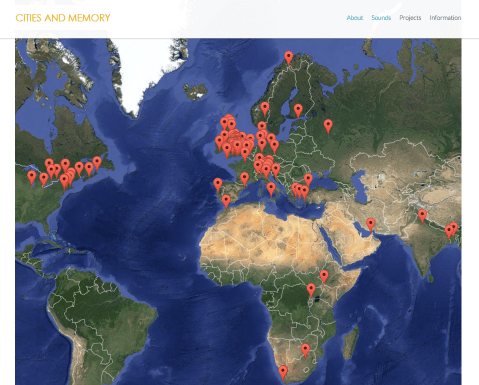
Starting from that basic premise, Cities and Memory has collected more than 600 sounds from around the world in just over a year, with more than 100 artists, musicians, field recordists and sound enthusiasts contributing anything from a field recording snatched on a mobile phone through to a complete musical reconstruction.
Over recent months, Cities and Memory has expanded with a series of projects each exploring a different avenue or window onto sound that has been opened up. For instance, last November saw #HamburgSounds, an ambitious project to sound map the vast city of Hamburg, Germany and to reimagine its sounds. A four-day recording session garnered enough recordings for forty sound artists each to give their take on a different aspect of Hamburg’s sounds and what they meant to them. The results were symbolically released over a 24-hour period, representing a day in the city’s life, and in the memories and imagination of its citizens. For more sounds from Hamburg, click here.

This year also saw a project using Brian Eno and Peter Schmidt’s Oblique Strategies cards as creative direction for reimagining field recordings. The reimagined sounds that came from more than 100 different creative strategies employed in the project were even more diverse than its locations, which covered everything from jungle in Thailand and Shanghai temples to the urban centres of Chicago, New York and London. Spectrum analysis, musical cryptograms, working simultaneously with artists in different countries, even TripAdvisor reviews(!) – every creative sonic technique in the book seems to have been used in one way or another.
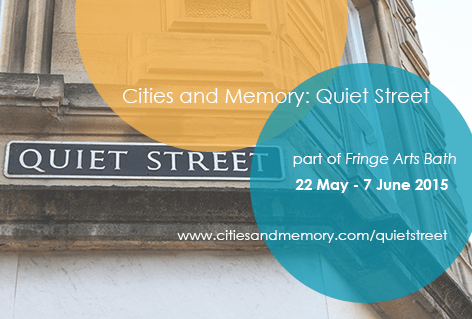
The latest project, called Quiet Street, takes the form of a simultaneous digital and physical exhibition, reimagining the sounds of the city of Bath as part of its Fringe Arts Bath Festival. The physical installation presents two sides of sonic memory – first, the documentary field recording of a location in Bath, and second the reimagined, or ‘memory’ version of the sound. The audience can navigate between two sonic ‘versions’ of Bath simultaneously on different sides of the space. One side broadcasts the “city” sound from a location, the other the matching “memory” sound, a remix or reinterpretation of the field recording, time-synced so that the sets of sounds shift in and out of one another in unison. The listener chooses – by his or her own physical proximity – to experience freely the two sound worlds.
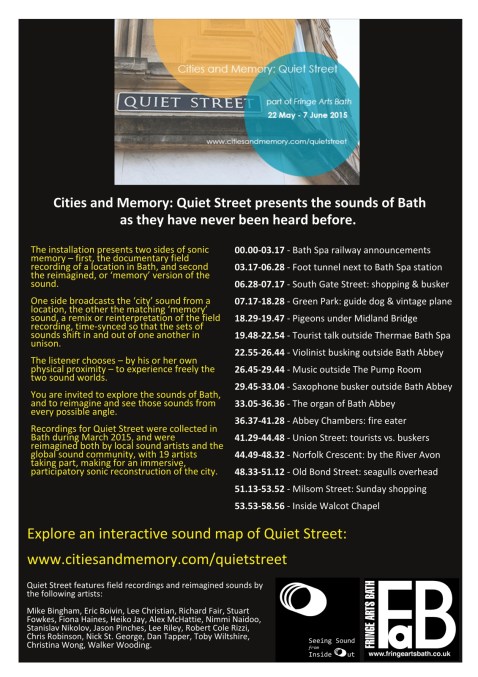
Visit the physical installation of Quiet Street at Fringe Arts Bath Festival, 22 May 2015 – 7 June 2015 at 8/9 New Bond Street Place, Bath
As the “city” and “memory” sounds are precisely time-synced in the installation, an additional creative challenge for the artists was to create reimagined version the same length as the source field recording. More importantly, they also needed consider not just how the reimagined sound stood on its own, but how it would live simultaneously in the same space as the field recording, creating a direct tension between “real” documentary sounds and the memory of those sounds in the same space.
The digital exhibition of Quiet Street allows the sounds to be explored through a map interface. It also allows listeners to simulate the installation experience with a series of installation mixes, presenting the field recording and reimagined sound on opposite sides of the stereo field. You can access playlists here and here as well as download the album documenting the event here.
As a curator, the most exciting thing to me is that the central idea behind Cities and Memory is so open; there are almost infinite possibilities for its application. A new angle on sound, place or memory can bring up a new project at any point, and every contributor brings their own experience and interpretation.
In the course of exploring hundreds of field recordings, examining them in detail and finding a creative angle from which to reinterpret them, I’ve developed a new appreciation not just of field recording as a practice, but of how to listen to whichever environment I find myself in. It’s given me a new perspective on sound and on music, and how utterly blurred the lines are between the two. I listen very differently to the world now. As Cities and Memory continues to grow, I hope many others will too.

—
Stuart Fowkes is the creator and curator of Cities and Memory, producing a large number of the source field recordings and reimagined ‘memory’ versions himself, as well as curating the project as a whole. Quiet Street runs from 22 May to 7 June at 8/9 New Bond Street Place, Bath, as part of Fringe Arts Bath, and digitally at www.citiesandmemory.com/quietstreet. Find out more about Cities and Memory and how to contribute: http://citiesandmemory.com/what-is-cities-and-memory-about/
—
 REWIND!…If you liked this post, you may also dig:
Toward A Civically Engaged Sound Studies, or ReSounding Binghamton–Jennifer Stoever
SO! Amplifies: Ian Rawes and the London Sound Survey–Ian Rawes
SO! Amplifies: Carleton Gholz and the Detroit Sound Conservancy–Carleton Gholz
Share this:


Current Top Posts





April 2021

January 2020

November 2019

October 2019

August 2019

April 2014

November 2017

March 2015

December 2017

October 2015
 Sounding Out!
Recent Comments