
Sonic Homes: The Sonic/Racial Intimacy of Black and Brown Banda Music in Southern California


This series listens to the political, gendered, queer(ed), racial engagements and class entanglements involved in proclaiming out loud: La-TIN-x. ChI-ca-NA. La-TI-ne. ChI-ca-n-@. Xi-can-x. Funded by an Andrew W. Mellon Foundation as part of the Crossing Latinidades Humanities Research Initiative, the Latinx Sound Cultures Studies Working Group critically considers the role of sound and listening in our formation as political subjects. Through both a comparative and cross-regional lens, we invite Latinx Sound Scholars to join us as we dialogue about our place within the larger fields of Chicanx/Latinx Studies and Sound Studies. We are delighted to publish our initial musings with Sounding Out!, a forum that has long prioritized sound from a queered, racial, working-class and “always-from-below” epistemological standpoint. —Ed. Dolores Inés Casillas
—
No tengo nada de sangre de Mexico. Soy afro americano.
(I have no Mexican blood. I am African American.)
El Compa Negro (Ryhan Lowery)
The grain is the body in the singing voice, in the writing hand, in the performing limb.
Roland Barthes (The Grain of the Voice,1971)
***This post is co-authored by Sara Veronica Hinojos and Alex Mireles
Sarah La Morena (Sarah the Black woman), or Sarah Palafox, was adopted and raised by a Mexican family in Mexico. At the age of five, she moved to Riverside, California, a predominantly Mexican city an hour east of Compton. Palafox started singing as a way to express the racism she faced as a child in Southern California, feeling caught between her Black appearance and her Mexican sound. She found her voice in church, a nurturing environment where she could be herself, surrounded by her family’s love. She gained attention with a viral video of her rendition of Jenni Rivera’s “Que Me Vas a Dar.” Palafox delivers each note with profound emotion and precision, leaving even the accompanying mariachi violinist in awe.
Similarly, El Compa Negro (The Black Friend/Homie) or Rhyan Lowery heard the sounds of banda coming from his neighbor’s backyard in Compton; a historically Black-populated city with a current Mexican majority. Lowery couldn’t shake the song out of his head and learned the song’s Spanish-language lyrics. Like Palafox, videos of him singing in Spanish during high school made him a viral sensation. “They called me ‘el compa negro’ (…) All I heard was ‘blah blah blah negro or negro’ and I wasn’t having it until they explained to me what it meant. And I was like ‘ok, cool’.”
The sonic stylings of El Compa Negro and Sarah La Morena within the banda genre enable transcultural connections beyond the pan-Chicano-Mexican-Central American popularity of tecnobanda and la quebradita. The 1990s banda craze, writes George Lipsitz “challenged traditional categories of citizenship and culture on both sides of the US-Mexico border.” Banda music might sound like it was established south of the border, but multicultural listeners and dancers continue to influence its vibrations. Pop stars like Snoop Dogg, Shakira, Bad Bunny, and Karol G have released (tokenized) songs with Mexican-tinged, banda-recognizable beats. Yet, both El Compa and Sarah demonstrate a form of musical Black/Brown, working-class intimacy. Their respective musics are much less about a pop star (duet) kind of solidarity and much more about a deep knowing, a sensibility among working-class cultures and othered people that resonates through the aesthetics of sound. As Karen Tongson writes in Relocations: Queer Suburban Imaginaries, about her experience of “queer, brown, immigrant musical discovery” in Riverside, the hometown she shares with Sarah La Morena: “It is the music that inspires us to ask questions” (26).
Certainly, US Mexican immigrant culture does not have the same (mainstream) cultural caché as African American culture, unless somehow softened or filtered. Jalapeños get “de-spicifed“; pre-made Día de Los Muertos altares are now at Wal-Mart, and huipiles are available as fast-fashioned “peasant blouse;” filtering out their Mexican-indigenous origins. Thus, classics like “La Yaquesita” and originals like “Yo Soy Compton” heard through the grain of Black voices affirm the possibilities of U.S. Mexican belonging or what D. Travers Scott characterizes as a form of “intimate intersubjectivities;” rooted in long-established Black/Brown co-existences across the borderlands and city barrios. Turning the volume up on these artists serves an important counterpoint to Latino anti-Black racism.
Their voices, blending with brass and tambora, embody a Black-Brown sonic and symbolic solidarity, or spatial entitlement. As theorized by Gaye Theresa Johnson in Spaces of Conflict, Sounds of Solidarity, innovative applications of technology, creativity, and space foster new collectives which, even when “unheard” by historians, assert social citizenship and pave the way for new working-class political futures. In the contested neighborhoods of greater Los Angeles, Black and Brown communities are often pitted against one another through processes of containment and confinement leading to competitions for jobs, housing, status, and political power. Yet, they share the experiences of labor exploitation, housing segregation, and cultural vilification. Filmed in the intimate settings of backyards, the viral videos underscore Black/Brown hood/barrio soundscapes as multi-generational, familial, and culturally hybrid. Home is where shared class, racial, and gender politics are negotiated and resolved.
Asserting Black identity and the choice to perform in Spanish creates a unique visual and auditory experience within the Mexican-dominant world of banda. In fact, in 2024, Lowery made history as the first Spanish-language artist signed by Death Row Records, a label known primarily for hip hop. The lively rhythms of banda – oompah-oompah-oompah – offers both banda and hip hop listeners a new orientation to discern the racial-cultural politics of broader Los Angeles.
Like the mid-century Haitian-Mexican bolero singer Antonia del Carmen Peregrino Álvarez, alias “Toña La Negra,” the added tags “Negro” and “la Morena” signals Black singers’ recognition of the meaning(s) of their racial difference within the transnational Mexican music scene. The auditory discomfort that their vocal grain might cause is named and thus recognized as the persistent colorism of listeners at large. Lowery describes his initial unease with the given “Compa Negro” nickname. “My Mexican friends always tell me ‘Hey, compa negro, you’re Mexican, man. God just left you in the oven a little too long.’” The harassment came from both Black peers and Mexicans alike, for liking banda, dating Latinas, or dressing “like a Mexican.” “They would say, ‘You hate being Black. Self-hate. Self-hate. I’m like man it ain’t that I self-hate, it’s just that I embrace something. I took the time to have an open mind and study something, you know?” His way of being made sense in the context of a Compton teenage experience. “Becoming Mexican” by way of musical/cultural engagement surpassed skin tone-deep and nationalist differences.
Or, as Mexican ranchera singer Chavela Vargas–born in Costa Rica–famously asserted, “Mexicans are born wherever the hell they want!” Try listening to Juan Gabriel’s “Amor Eterno” to find out. Black creatives like Evander, Vaquera Canela, and Terry Turner are just a few more examples of Black mexicanidad. Yessica Garcia Hernandez reminds us that Black and Brown sonic solidarities have been the driving pulse of US popular music. She argues, “Home and sound is acknowledging that both corridos, hip-hop, and G-funk relationally, has formed paisas.”
El Compa Negro’s “Verde es Vida,” a tribute to California’s weed culture, lowriders, and corridos, booms loudly. The song begins with an accordion playing reggae rhythms, soon interrupted by percussion, guitars, and El Compa’s fast-paced verses. About a minute in, the accordion slows the tempo with a few reggae notes before the vocals return, reintroducing the corrido rhythm: “Hoy andamos en LA bien tranquilitos. En el lowrider escuchando corridos.” The reggae-corrido fusion ends with the familiar “pom pom pom pom!” of the drums, typical of banda and corrido finales, as the accordion plays its last note. Through Lowery’s reggae corrido, we hear his “sonic home” rooted in Black and Brown Los Angeles.
—
Featured Image: still from Sarah La Morena’s “La Llorona” (2020)
—
Sara Veronica Hinojos is an Assistant Professor of Media Studies and on the advisory board for Latin American and Latino Studies at Queens College, CUNY. Her research focuses on representations of Chicanx and Latinx within popular film and television with an emphasis on gender, race, language politics, and humor studies. She is currently working on a book manuscript that investigates the racial function of linguistic “accents” within media, called: GWAT?!: Chicanx Mediated Race, Gender, and “Accents” in the US.
Alex Mireles is a PhD student in the Department of Feminist Studies at UC Santa Barbara. She writes on Latinx identity and queerness, labor, and global capitalism through aesthetic movements in fashion, beauty, media, and visual cultures. Her dissertation explores the queer potential and world-making capabilities of Chicanx popular culture through Mexican regional music, social media, queer nightlife, and film.
—

REWIND!…If you liked this post, you may also dig:
Boom! Boom! Boom!: Banda, Dissident Vibrations, and Sonic Gentrification in Mazatlán—Kristie Valdez-Guillen
Listening to MAGA Politics within US/Mexico’s Lucha Libre –Esther Díaz Martín and Rebeca Rivas
Ronca Realness: Voices that Sound the Sucia Body—Cloe Gentile Reyes
Echoes in Transit: Loudly Waiting at the Paso del Norte Border Region—José Manuel Flores & Dolores Inés Casillas
Sounding Out! Podcast #28: Off the 60: A Mix-Tape Dedication to Los Angeles–Jennifer Stoever
Share this:

Sound and Curation; or, Cruisin’ through the galleries, posing as an audiophiliac
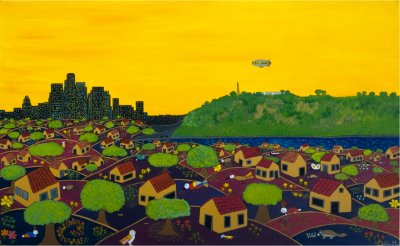
“L.A. Reimagined” by Dalila Paola Mendez (c), Mendez’ work will be featured in re:present LA, opening 5/3/12
But to love this turf is love hard and unrequited.
…
To love L.A. is to love more than a city
It’s to love a language.
–“L.A. Love Cry” (1996) by Wanda Coleman
Los Angeles, an enigmatic metropolis to many who arrive here with a dream in hand and hope for a better tomorrow, still challenges historians, artists, and troubadours on how to best represent it. Poet Wanda Coleman, born in Watts, captures the pain and wonder of loving this city in “L.A. Love Cry.” Because the city is “hard and unrequited” one must also be willing to love its nuances and see it as“more than a city.” To love this city, “it’s to love a language,” a cultural immersion that goes beyond the seeming ease of words into the complexities of sound and rhythm.
Through a Museum Studies course I teach at Claremont Graduate University entitled Welcome to L.A., I introduce students to varied texts in which scholars and artists challenge the imaginaries created by outsiders, boosters, and apocalyptic cinema. Instead, the course readings present how we in L.A. actively engage with one another by fostering communities of creative praxis. For the students’ final project, they curate and develop educational programming for an exhibition at a local museum or art center. On May 3, 2012, this semester’s project, re : present L.A., opens at the newly-renovated Vincent Price Art Museum (VPAM) located on the East Los Angeles College Campus. Showing works from over thirty artists from May 3-July 27, re : present L.A serves as an extension of the conversations we had in class, not only celebrating the interconnectedness of our communities but encouraging new associations and encounters within the visual and resonant space of VPAM’s Community Focus Gallery. For a look at the Virtual Exhibit Catalogue, click here.
In each exhibition for Welcome to L.A., I try to include something that challenges myself to think outside the white-box, per se, of the gallery. Given that we had read several texts that highlighted in the importance of music to build and uplift communities of color in Los Angeles, it was both important and necessary for me to include sonic elements in re: present LA that exhibits L.A.s vibrant musical legacy as intermingled with and fundamental to its visual culture. Among the challenges to document the cross-cultural connections between ethnic communities in Los Angeles is how to unpack what Anthony Macias calls “the cultural networks” that facilitated these exchanges through the music scenes at music halls, clubs, youth centers and record stores in Mexican American Mojo (10-11). Studies done by George Lipsitz, Macias, and Victor Viesca, provide readers a means to understand how the music in Los Angeles is much more than entertainment; it is political; it is a lifestyle; it defines spaces of multicultural interactions. In How Racism Takes Place, Lipsitz points out how integral the reclamation of space defined the political outlook and music in Horace Tapscott’s Arkestra based in South L.A. Viesca’s research documents the rise of an East L.A. rock sound, post-Los Lobos, that was defined by the activism of the Zapatista Movement and California’s Prop 187 through the work done at the Peace & Justice Center, Self-Help Graphics, and Regeneración.
Therefore, in order to engage both the history and the sound of Los Angeles’s musics with the city’s visual representations, I invited Rubén Funkhuatl Guevara from Ruben & The Jets, is a multi-threat musician, performer, writer, and producer, and Jennifer Stoever-Ackerman (of Binghamton University, Sounding Out!, and of course, Riverside, CA) to curate playlists for a “sound booth,” which will consist of a stationary iPod™ Nano that gallery visitors can use at their leisure. The classic circular wheel allows the viewer to advance tracks or play the playlists on shuffle. Headphones will be set up so that the viewer can either focus on their listening experience or, listen while viewing the artwork around them. Since the gallery is relatively small, the pieces on the opposite wall are recognizable though are distant. In addition, Maya Santos of Form Follows Function will screen their short documentary on Radiotron, a youth center that presented Hip-Hop shows during the 1980s.
Guevara’s playlist Los Angeles Chicano Rock & Roll is included in the exhibition thanks to the Museum of Latin American Art. Stoever-Ackerman’s playlist Off the 60, unites the two spaces of East L.A. and Riverside through a mix of intra- and trans-cultural musical experiences. Guevara’s rock & roll selections highlight many of the bands that emerged in East L.A. Both the musical listings and the liner notes for the sound presentations will be accessible on the re:present L.A website when the exhibit goes live on May 3rd, 2012.
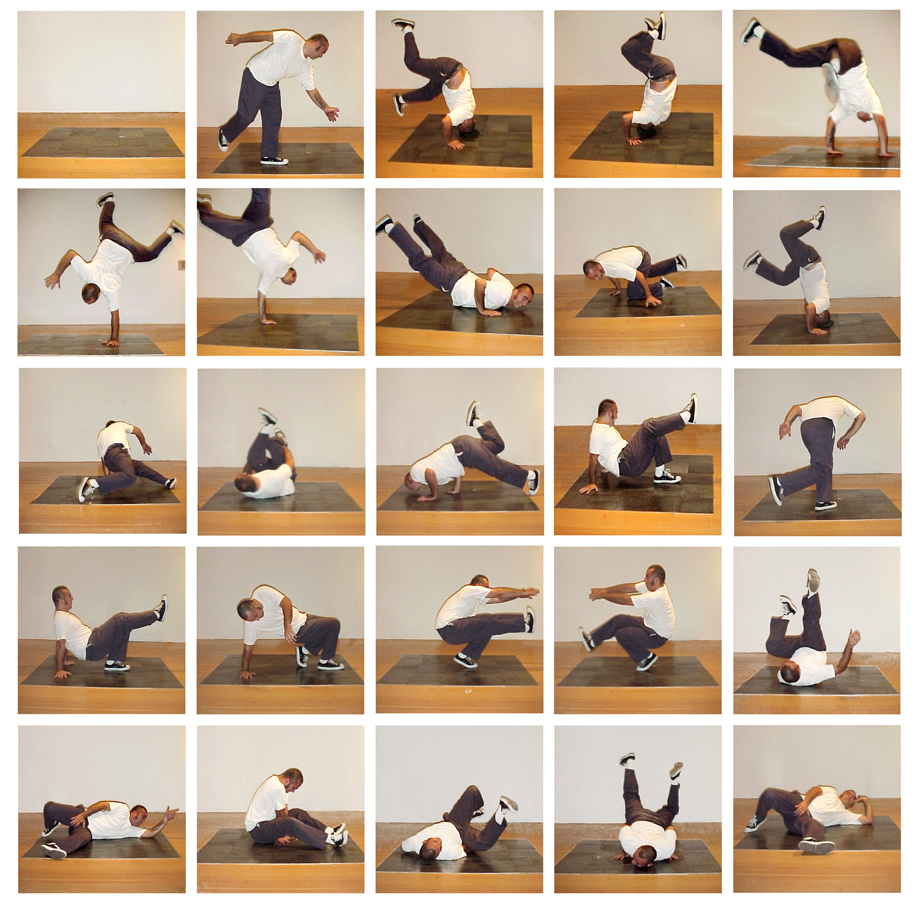
Juan Capistran’s The Breaks (2000), Courtesy of the Artist
.
My sonic intervention in the white, often silent, spaces of the gallery was especially inspired by two recent precedents: the inclusion of the iPod™ in MEX/LA (2011) at the Museum of Latin American Art and Phantom Sightings (2008) at the Los Angeles County Art Museum. Both experiences invited me as a viewer to see the artwork through another sensory experience. The first time I saw music included in an exhibition not specifically about music (such as the Experience Music Project’s 2007 American Sabor: Latinos in U.S. Popular Music, or Marvette Peréz’s curation of ¡Azúzar! The Life and Music of Celia Cruz at the Smithsonian National Museum of American History) was LACMA’s Phantom Sightings, which garnered much critical acclaim and criticism due to the premise of presenting contemporary Chicano Art inspired ‘after’ the Chicano Movement. However, I want to focus on one aspect of the exhibition, a corner display with books that informed the curators’ conceptual approach and on the bookshelf was an iPod™. The iPod™ included playlists from some of the artists reflecting their inspiration for their artwork. I enjoyed listening and reminiscing while sitting in the gallery. However, I wanted the music to take more of a central role in the exhibition, especially because much of the artwork so obviously revealed traces of Los Angeles’ musical influences, partly due to the recent generation of artists who actively engaged in subcultural expressions and referenced it in their art. For example, as Ondine Chavoya describes in the Phantom Sightings catalogue, Juan Capistran’s The Breaks (2000) is a giclée print documenting the artist break-dancing on Carl Andre’s minimalist floor pieces. The guerilla performance then is presented through a series of twenty-five still images showing the various movements seen in how to break-dance books (125). Shizu Saldamando’s ink on fabric portraits of Siouxsie (2005) and Morrissey (2005) showcase how post-punk and new wave music from England is part of her life as an Angeleno (and that of her friends), yet the medium is reminiscent of pinto drawings. Saldamando also does portraits of her friends at clubs, backyard bbqs “documenting a world where identity is fluid” as Michele Urton describes in the catalog (197).
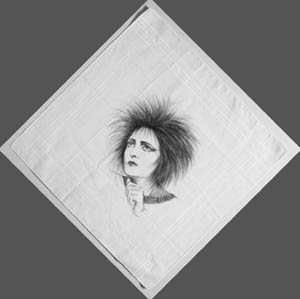
Shizu Saldamando’s Siouxsie (2005), Courtesy of the Artist
It would be another three years before MEX/LA would further marry music with art, now casting it in relation to the politics of Chicano and Mexican presence in Los Angeles. MEX/LA, among the many Pacific Standard Time exhibitions presented throughout Los Angeles, was among the best curated due to the range of artifacts representative of the city and the cultural production emerging in post-war L.A. Another striking element was the influence of Méxicano popular culture among Chicanos and vice-versa. As curator Rubén Ortiz-Torres, and associate curator Jesse Lerner write on the MoLAA website: “The purpose of the construction of a ‘Mexican’ identity in the South of California is not to consolidate the national unity of a post-revolutionary Mexico, but to recognize and be able to participate in an international reality, with all its contradictions and conflicts that this entails.” One of the ways this cultural exchange was embodied was in the playlists curated by Rubén Funkhuatl Guevara and Josh Kun that were prominently displayed alongside the artwork and heard in the interactive iPod™ “sound booths,” that invited viewers to sit on beanbags and listen. The music served to contextualize the art in relation to popular culture of the time. For example, Guevara presents a Chicano rock & roll genealogy that followed the chronology of the visual exhibit, 1930-1980, that begins with boogaloo and swing of the 1940s era culminating with the punk rock sounds of The Bags.
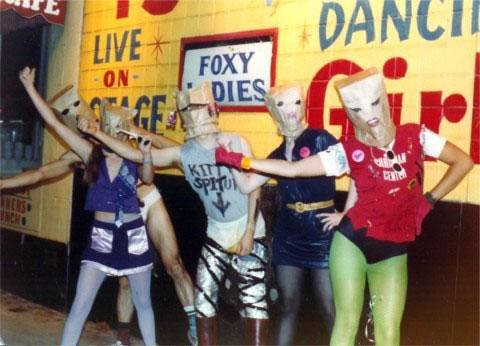
“Bag Parade,” 1977, Courtesy of Alice Bag
In both these exhibitions, the music served to complement the artistic elucidations of identity, race, and American popular culture seen in much of the artwork. The simplicity of the presentation was due to the inclusion of a familiar object like the iPod™. What is surprising is that more exhibitions have not incorporated more sonic elements to engage viewers’ other sensory experiences beyond the podcasts, or cell-phone audio listening tours set up at most major museums. While musical playlists can serve as another didactic component of an exhibition like the more established audio tours, I am arguing for a different use of sound in museum space, one that provides a wider sense of agency, connection, and encounter with the visual elements on display rather than a one-way transmission of information. In the cases of MEX/LA and Phantom Sightings, the inclusion of iPods™ provided a tool to understand the cultural production of a “post-Chicano movement” generation of artists while at the same time enabling an experience that recognized—and resonated with—my bicultural experience.
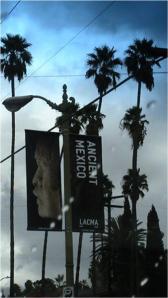
“Ancient Mexico in Ancient Mexico” by Yvonne Estrada (c), is featured in re:present LA, opening 5/3/12
Being that L.A. is a car culture moving to the rhythms of the radio waves, I’m always seeking to find synchronicity between music that feels me with joy and my work as a cultural worker. Part of my impetus to locate Los Angeles sonically in re : present L.A. was driven by the question: is it possible to capture my sonic landscape growing up in the city of Los Angeles that ranges from Hip-Hop – British Rock – Mexican Pop? The playlists curated by Guevara and Stoever-Ackerman are familiar to me personally. Stoever-Ackerman’s Off the 60, reminds me of the sounds of my youth, when KDAY and KROQ rocked the radio waves and my students banded together in my high school quad according to their favorite music – metal-heads, b-boys, alternative rock, and the cha-chas, who traveled across town every Friday night to Franklin High, where DJs spun L.A. disco. At home, the music was different. My mom and tías used to reminisce about their homeland every Sunday night through the variety show Siempre en Domingo, binding us to the t.v., religiously following the rising stars. Through the bi-lingual selections in Guevara’s Los Angeles Rock & Roll, there’s a familiarity of home and the music heard at backyard parties and quinceañeras.
By including my iPod™ nano, I bring together my lived experience as a cultural worker through the sounds of L.A. and activate the white walls of the museum. The playlists created by Guevara and Stoever-Ackerman serve to reflect the history of the community surrounding VPAM, as well capture the diversity of the city sonically re:presenting L.A. to our audiences. While the playlists can stand alone as audio curations in their own rights, I hope that they will engage audiences to rethink the relationship between music and art, and feel their lived experience inclusive within the museum.
—-
reina alejandra prado saldivar is an art historian, curator, and an adjunct lecturer in the Social Science Division of Glendale Community College in Glendale, California and in the Cultural Studies Program at Claremont Graduate School. As a cultural activist, she focused her earlier research on Chicano cultural production and the visual arts. Prado is also a poet and performance artist known for her interactive durational work Take a Piece of my Heart as the character Santa Perversa (www.santaperversa.com) and is currently working on her first solo performance entitled Whipped!
Share this:


Current Top Posts





April 2021

January 2020

November 2019

October 2019

August 2019

April 2014

November 2017

March 2015

December 2017

October 2015
 Sounding Out!
Recent Comments